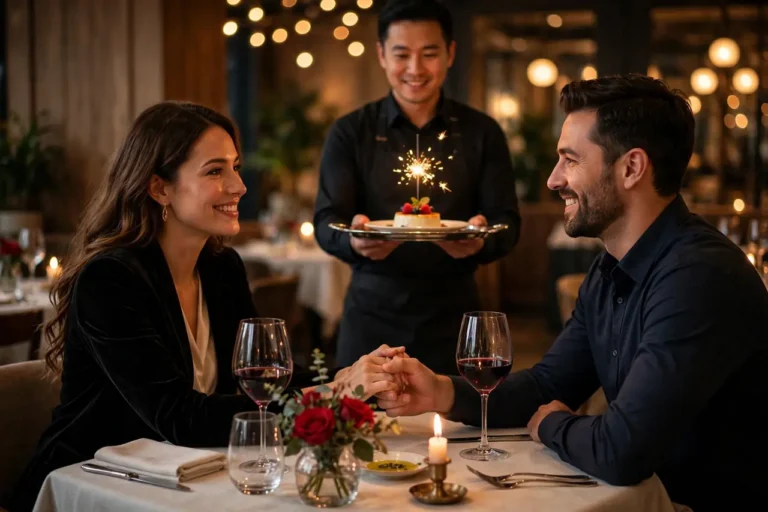
Ask anyone to name the world’s most romantic country and France usually comes first. Yet what the French actually do on February 14 often surprises visitors expecting grand public spectacles. In France, Valentine’s Day is called La Saint-Valentin or, more tenderly, La Fête des Amoureux — the Festival of Lovers — and it is celebrated the French way: intimately, elegantly, and without much fuss. Forget crowded streets and public flash mobs; this is a holiday of whispered words over candlelit dinners, carefully chosen cards, and a glass of champagne at exactly the right moment.
This guide goes beyond the postcard clichés to show how the French really celebrate Valentine’s Day — from the country’s genuinely wild historical customs (one of which was banned by the government) to the small village that has turned the saint’s name into an entire tourism industry, to the quiet rituals ordinary French couples practice today.
What “La Fête des Amoureux” Really Means
The French have two names for February 14. The formal one is La Saint-Valentin, the feast of Saint Valentine. The affectionate one is La Fête des Amoureux — literally “the Lovers’ Feast.” That second name captures the holiday’s spirit in France far better than any translation. Unlike in some countries where Valentine’s Day has ballooned into a celebration of friendship, family, and self-love, in France it remains stubbornly, exclusively romantic. You do not give a Valentine to your coworker or your grandmother. The day belongs to couples — or to someone you wish were your couple.
That exclusivity shapes everything about how the day feels. French Valentine’s Day is quieter and more private than its American cousin. Restaurants do not typically advertise wild Valentine’s parties; instead, they offer a menu Saint-Valentin, a special fixed menu for two, often with champagne. Florists report one of their biggest days of the year, and jewelry shops do brisk business — but the celebration itself happens behind closed doors, in booths and bedrooms, not in the streets.
There is also a distinctly French restraint about the whole affair. Many French people will tell you, with a characteristic shrug, that they “do a little something” for the day — on fait quelque chose de simple. The emphasis is on thoughtfulness and taste rather than scale. A single perfect rose can carry more weight than two dozen, and a handwritten card outranks an expensive gadget. Understanding this restraint is the key to understanding everything that follows.
A Short, Honest History of Valentine’s Day in France
France’s relationship with the lovers’ holiday is older and stranger than most people realize. Two threads of history — one literary, one frankly chaotic — run through the French story, and both deserve an honest telling.
The Duke, the Tower, and the First Valentine
One of the most durable origin stories of the Valentine’s card itself begins with a Frenchman. Charles, Duke of Orléans, was captured at the Battle of Agincourt in 1415 and imprisoned in the Tower of London for the next quarter-century. During his captivity, tradition holds, he wrote tender verses to his wife back in France — rhymed love letters that historians regard as among the earliest surviving examples of what we would now call valentines. Whether or not his poems were the literal “first” Valentine’s cards, the association stuck, and France has claimed a founding role in the holiday’s paper tradition ever since. The French carte d’amitié — the love card, often decorated with hearts and cupids — remains a central element of the celebration.
There is a second, older literary thread. The medieval English poet Geoffrey Chaucer is often credited with linking Saint Valentine to romantic love, but French courtly culture was the greenhouse where that idea grew. In 1400, the Charter of the Court of Love in France described a lavish feast celebrating love — evidence that the French aristocracy was already formalizing romance into ritual centuries before Hallmark existed. The notion, common in both England and France, that birds pair off “in the middle of February” gave the midwinter date a natural, poetic logic: if nature renews its vows in mid-February, why shouldn’t people?
La Loterie d’Amour: The Custom That Got Banned
Then there is the wilder chapter — the one French history books mention with a wince. For generations, parts of France observed a Valentine’s custom known as the loterie d’amour, the “lottery of love.” On the day, young men and women would gather in houses facing each other across a street and call out from window to window, pairing off as fancy struck. So far, so picturesque. But the custom had a cruel asymmetry: a man who grew dissatisfied with his match could simply abandon her and choose again, while the jilted women had no such recourse.
What happened next is well documented and genuinely startling. The spurned women would gather together, build a bonfire, and burn pictures or effigies of the men who had rejected them — hurling insults at the male population in general while the flames rose. What began as folk matchmaking regularly tipped into public mockery and genuine conflict. The French government eventually intervened and officially banned the practice, putting an end to the love lottery by decree. It remains one of the few Valentine’s traditions in history to be outlawed by the state — a reminder that the French have been negotiating the line between romance and chaos for a very long time.
Historians hedge on the exact dates and the precise legal instrument of the ban, and the custom’s details vary from telling to telling. But the core is consistent across sources: a window-to-window pairing ritual, an unfair double standard, a bonfire of revenge, and finally a government decree. It is a fittingly dramatic origin story for a country that treats love as a serious art.
Timeline: How France’s Valentine’s Day Evolved
1400s–1700s: The Courtly Foundations
French aristocratic culture formalizes the celebration of love in poetry, feasts, and courtly ritual. The Duke of Orléans writes his famous verses from the Tower of London after 1415. Handwritten love letters — the ancestors of the Valentine’s card — circulate among the French elite. Meanwhile, in villages, folk customs like the loterie d’amour flourish largely outside official notice.
1800s: The Ban and the Bourgeois Valentine
The government bans the loterie d’amour after its bonfire reprisals grow too disorderly. Respectable France replaces folk chaos with bourgeois order: the printed Valentine’s card arrives, florists professionalize, and February 14 becomes a proper date on the urban social calendar. The day is romantic, commercial, and — crucially — private.
1900s: Modern Rituals Settle In
The twentieth century gives French Valentine’s Day its modern shape: the menu Saint-Valentin at restaurants, the florist’s busiest winter day, perfume and jewelry as the classic gifts. Postwar prosperity and the rise of the restaurant as a social institution cement the candlelit dinner as the holiday’s centerpiece. The village of Saint-Valentin begins, in 1983, its deliberate reinvention as the village des amoureux — the village of lovers.
2000s–Today: The Intimate Holiday Endures
Despite globalization, social media, and the occasional imported flash mob, the French Valentine’s Day stays remarkably true to its character: couple-focused, understated, and resistant to spectacle. Paris leans into its “City of Love” branding for tourists while Parisians themselves keep the day low-key. The Saint-Valentin village festival grows into a multi-day celebration drawing visitors from across France.
France’s Valentine’s at a Glance
| Detail | What to Know |
|---|---|
| Date | February 14 — La Saint-Valentin |
| Affectionate name | La Fête des Amoureux — the Festival of Lovers |
| Famous banned custom | La loterie d’amour — the “lottery of love” pairing ritual, banned by government decree |
| Valentine’s card link | Charles, Duke of Orléans, wrote verses to his wife from the Tower of London after 1415 |
| Village of lovers | Saint-Valentin, Indre — under 300 inhabitants; lovers’ festival held since 1983 |
| Typical celebration | Menu Saint-Valentin dinner for two and a handwritten card |
| Classic gifts | Red roses, perfume, jewelry; fine chocolates from a chocolatier |
Watch: How the French Celebrate La Saint-Valentin
For a native perspective on the day’s unwritten rules — the single rose, the affectionate nicknames, the casual-but-sincere approach — this explainer from a French culture channel captures the spirit better than any guidebook.
How Modern French Couples Actually Spend February 14
So what does a typical French Valentine’s Day look like in practice? Strip away the tourism brochures and the pattern is consistent across the country.
The dinner is the day. For most French couples, Valentine’s Day is essentially a dinner — but a very particular kind of dinner. Restaurants across France offer special menus Saint-Valentin, multi-course tasting menus designed for two, almost always with a champagne option. Booking ahead is essential; the best tables in any French city are reserved weeks in advance. Many couples, especially younger ones or those watching their budget, cook at home instead — and in France, cooking at home for Valentine’s is not a lesser option. A carefully prepared meal, a good bottle of wine, and candles can be more romantic than any restaurant, and the French know it. If you’re looking for inspiration on that front, our guide to Valentine’s Day dinner ideas works beautifully with a French-inspired menu.
Cards matter more than you’d think. The carte de Saint-Valentin is a bigger deal in France than in some cultures, precisely because the French treat written words as the truest currency of romance. A card is not a formality; it is the main event’s opening act. The best ones are handwritten, often with a poem or a private joke. Mass-produced cards exist, of course, but the French ideal is personal — a few sincere lines beat a page of printed verse.
Flowers, perfume, jewelry — in that order of tradition. The classic French Valentine’s gift runs along well-worn tracks: red roses (still the undisputed champion), a good perfume, or a piece of jewelry. Chocolates are popular but, interestingly, carry slightly less symbolic weight than in some countries — in France, chocolate is an everyday pleasure, so it needs exceptional quality or presentation to feel like a Valentine’s gesture. Lingerie is also a traditional gift, given privately and without embarrassment. For a broader look at how these traditions compare, see our overview of Valentine’s Day traditions around the world.
Public displays stay private. You will not see French cities decked out in Valentine’s kitsch the way some American towns are. Shop windows may show a tasteful heart or two, and bakeries produce special Saint-Valentin pastries, but the streets themselves look much like any February day. The romance is happening indoors. This discretion is not coldness — it is the French belief that love is most real when it is least performed.
Saint-Valentin: The Village That Turned a Name Into a Festival
In the Indre department of central France sits a village of fewer than 300 inhabitants with the most fortuitous name in the country: Saint-Valentin. Nobody can say with certainty which Saint Valentine the village was named for — historically, at least seven saints bore the name, most of them martyrs — but in 1983 the village council stopped worrying about the hagiography and started building a tourism strategy around the obvious. Saint-Valentin would become le village des amoureux: the village of lovers.
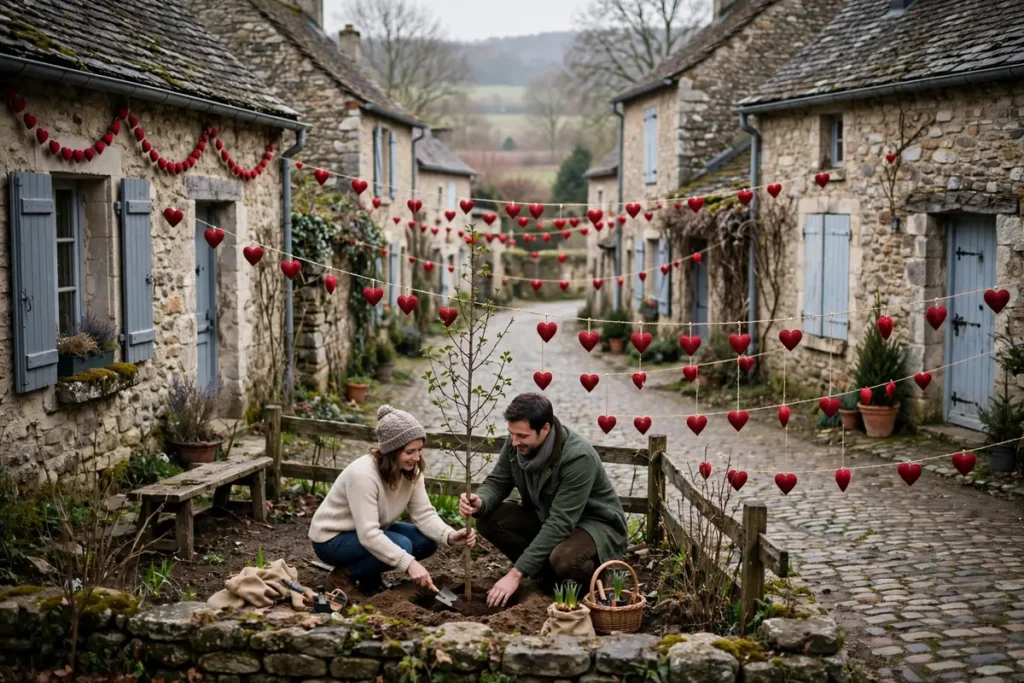
Four decades later, the strategy has worked beyond anyone’s expectations. Every year, on the weekend closest to February 14, the tiny village hosts a multi-day Fête des Amoureux that draws couples from across France and beyond. The permanent infrastructure of romance is remarkable for a place this size: dedicated romantic installations in the village center, a Jardin des Amoureux (Lovers’ Garden), and the famous tree-planting ritual, where couples plant a tree together as a living symbol of their commitment — each tree bearing the donors’ names, growing as their love grows.
The festival program itself reads like a love-themed county fair: exhibitions, fashion shows, wedding planners, chocolatiers, jewelry displays, concerts, and — the emotional centerpiece — ceremonies where couples can renew their wedding vows or receive a confirmation de mariage in what they consider the most appropriate place in France. Local legend and the village’s own publicity lean into the romance hard, and visitors happily play along. Mid-February, when much of France is gray and cold, turns out to be an ideal time for a romantic getaway — and Saint-Valentin has built a genuine industry on that insight.
Practical note for visitors: the village is small, rural, and best reached by car or by train to nearby Châteauroux. Accommodation in the village itself is extremely limited, so book months ahead for the festival weekend or stay in the surrounding Berry region. The celebration is unabashedly sentimental and French — expect sincerity, not irony.
Regional Tour: How February 14 Looks Across France
France is not a monolith, and Valentine’s Day wears slightly different clothes in different regions.
Paris: Romance as a Public Art
Paris is the exception to French discretion — or rather, it performs romance for the world while its residents celebrate privately. Visitors flock to the bridges, the Eiffel Tower, and Montmartre; Parisian couples book the menu Saint-Valentin like everyone else but skip the tourist rituals. Our companion guide to Valentine’s Day in Paris: romantic traditions and customs covers the capital in full detail, including the rise and fall of the Pont des Arts love locks.
Provence and the South: Love in the Off-Season
In the south, February is the quiet season — which is precisely the point. Couples from northern France and abroad escape to Provence, the Côte d’Azur, and the Luberon for long Valentine’s weekends: truffle-season dinners, empty beaches at sunset, and village hotels offering forfaits Saint-Valentin (Valentine’s packages) with spa treatments and champagne. The southern celebration is less about the single day and more about the long weekend.
Lyon: The Gastronomic Valentine’s
In France’s culinary capital, Valentine’s Day is unapologetically about food. Lyon’s celebrated bouchons and haute restaurants compete for the most inventive menu Saint-Valentin, and local chocolatiers — Lyon has a serious chocolate tradition — do some of their best business of the year. A Lyon Valentine’s is a feast first and everything else second.
Alsace: Half-Timbered Hearts
Alsace’s storybook villages — Colmar, Riquewihr, Eguisheim — lean into the fairy-tale aesthetic with unusual enthusiasm. Half-timbered houses draped in lights, winstubs (wine taverns) serving local vintages, and a Germanic influence that makes the celebration slightly more festive and public than the French norm. The region’s Christmas-market infrastructure pivots neatly to Valentine’s décor.
Brittany and Normandy: Wild Coasts, Quiet Fires
In the west, Valentine’s Day takes on a windswept, elemental character: long walks on empty Atlantic beaches, dinners in stone crêperies with the fire lit, and a general preference for nature over nightlife. It is the least commercial regional variant — and, many couples say, the most romantic.
Myth vs. Fact: French Valentine’s Day
Myth: The French invented Valentine’s Day.
Fact: The holiday’s origins are murky and international — Roman, Christian, and English literary threads all predate or parallel the French ones. What France can fairly claim is a central role in the holiday’s romantic mythology: the Duke of Orléans’ verses, the courtly love tradition, and the carte d’amitié. “Invented” is too strong; “co-authored” is about right.
Myth: French couples are extravagantly romantic on February 14.
Fact: The French ideal is thoughtful restraint, not extravagance. The culture prizes la petite attention — the small, perfect gesture — over grand spectacle. A French Valentine’s that looks “low-key” to an outsider may feel deeply romantic to the couple living it.
Myth: The love lottery was a charming folk game.
Fact: The loterie d’amour was, by most accounts, genuinely unpleasant for many participants — particularly the women, who could be publicly abandoned and had only the bonfire of revenge as recourse. Its banning was a response to real disorder, not prudishness. Charming it was not.
Myth: Saint-Valentin village is an ancient pilgrimage site for lovers.
Fact: The village’s romantic identity is a deliberate, modern creation dating to 1983 — a brilliant piece of place-branding, not a medieval tradition. That doesn’t make the festival less enjoyable; it just makes it a twentieth-century invention rather than an ancient one.
Myth: Parisians spend Valentine’s Day at the Eiffel Tower with locks and roses.
Fact: The love locks are gone (removed in 2015), and most Parisians treat February 14 like the rest of France: a nice dinner, a card, a gift — at home or in a neighborhood restaurant. The grand romantic gestures are mostly performed by tourists.
How to Celebrate Valentine’s Day the French Way
You don’t need to be in France to borrow its approach. The French method is less about budget than about philosophy — and it translates beautifully anywhere.
1. Make the dinner the event
Whether you book a restaurant or cook at home, treat the meal as the centerpiece, not the prelude. In France, the menu Saint-Valentin is a multi-course affair taken slowly. At home, that means: a real starter, a proper main, cheese, dessert — and no phones at the table. Time is the luxury ingredient. For menu inspiration that works on any budget, our guide to planning a thoughtful Valentine’s Day on a budget pairs well with French-style simplicity.
2. Write something by hand
The French take the card more seriously than the gift. Write a real letter or card — not a text, not a printed verse, but a few honest lines in your own hand. Mention something specific: a moment from the past year, a small habit of theirs you love, a hope for the year ahead. This is the carte d’amitié tradition at its best, and it costs nothing.
3. Choose one perfect thing over many good things
La petite attention: one rose instead of a dozen, one excellent chocolate instead of a box, one well-chosen perfume sample instead of a bottle you’re unsure about. The French gift philosophy rewards precision over volume. If you’re planning the evening itself, our Valentine’s Day date ideas can help you build the night around that single perfect gesture.
4. Keep it between the two of you
Resist the urge to perform the day for an audience. The French instinct — that love is most real when least performed — is worth adopting. Post the photo tomorrow, or not at all. Let the evening belong to the two people in it.
5. End with champagne (or its spirit)
Champagne is the traditional French Valentine’s toast, but the principle matters more than the bottle: mark the moment. A specific toast, a shared dessert, a walk after dinner — something that says this night was different from other nights.
Frequently Asked Questions
What do the French call Valentine’s Day?
The French call it La Saint-Valentin, and more affectionately La Fête des Amoureux — the Festival of Lovers. Both names are in common use, with the latter capturing the day’s romantic exclusivity: in France, this holiday is for couples, not for friends or family.
Is Valentine’s Day a big deal in France?
It is significant but understated. Florists, restaurants, jewelers, and perfumeries do major business, and most couples mark the day in some way. But the celebration is private and restrained compared to countries with more public Valentine’s culture. You won’t find the streets transformed; the romance happens at dinner tables, not in parades.
What is the loterie d’amour?
The loterie d’amour (lottery of love) was a historical French Valentine’s custom in which young men and women in facing houses called out to each other from windows and paired off. Men could abandon unsatisfactory matches; jilted women responded by burning the men’s pictures in a bonfire. The disorder it caused led the French government to ban the practice by decree.
Where is the village of Saint-Valentin, and what happens there?
Saint-Valentin is a village of fewer than 300 people in the Indre department of central France. Since 1983 it has marketed itself as le village des amoureux (the village of lovers), hosting a multi-day Fête des Amoureux on the weekend nearest February 14, with vow renewals, a lovers’ garden, tree-planting ceremonies for couples, exhibitions, and concerts.
Do the French exchange Valentine’s cards?
Yes — and they take them seriously. The handwritten carte de Saint-Valentin is often the emotional centerpiece of the French celebration, valued above expensive gifts. Personal, sincere words in your own handwriting are the gold standard; printed verses are a distant second.
What are traditional French Valentine’s gifts?
The classic trio is flowers (red roses above all), perfume, and jewelry. Fine chocolates from a good chocolatier and lingerie are also traditional. The guiding principle is quality over quantity — one perfect item beats an armful of ordinary ones.
The Quiet Art of the French Valentine’s
France’s Valentine’s Day contains multitudes: a duke writing verses from a London prison, a banned love lottery that ended in bonfires, a tiny village that rebranded itself around a saint’s name, and millions of quiet dinners happening right now in apartments from Lille to Marseille. What unites them is a distinctly French conviction — that love deserves beauty, sincerity, and privacy, in that order.
La Fête des Amoureux is not the loudest Valentine’s Day in the world. It may be the most honest one. And whether you celebrate it in Paris, in Provence, or at your own kitchen table with candles and a handwritten card, the French lesson is the same: make it personal, make it beautiful, and keep it between the two of you. Joyeuse Saint-Valentin.