
Do not sweep the floor. Do not wash your hair. Eat twelve grapes at midnight, wear red underwear, carry an empty suitcase around the block, and for heaven’s sake do not lend anyone money. New Year’s Day comes wrapped in more superstitions than almost any other date on the calendar — a global patchwork of things you must do, and things you absolutely must not do, on January 1. This guide tours the world’s first-day superstitions country by country, separates the charming from the questionable, and asks the interesting question underneath: why do smart, modern people still knock on wood at midnight?
The logic behind nearly all of it is one ancient idea: the beginning sets the pattern. Anthropologists call it sympathetic magic — the belief that the first day of the year is a microcosm of the whole year, so whatever happens on January 1 will echo through the next 364 days. Eat well on the first day and you will eat well all year; cry on the first day and sorrow follows. It is not rational, exactly — but it is deeply human. Before you plan your first day (our perfect first-day plan keeps things practical), here is the folklore.
The Table: What to Eat for Luck
Food superstitions dominate January 1, because a full table on the first day promises full tables all year:
- Spain and Latin America — twelve grapes: at each of the twelve strokes of midnight, eat one grape per stroke — the uvas de la suerte. Manage all twelve and the year brings luck; choke or miss one and that month is suspect. The tradition dates to 1909, when Alicante grape growers had a surplus harvest and marketed it brilliantly.
- Philippines — round fruits: tables groan with twelve round fruits (grapes, oranges, melons), because round symbolizes coins and wealth. Polka dots on clothing double the effect.
- American South — black-eyed peas and greens: peas for coins, collard or mustard greens for folding money, cornbread for gold. The tradition’s roots trace to the Civil War era, when peas were among the few foods left to Southern families.
- Germany and Austria — marzipan pigs: the Glücksschwein (lucky pig) in marzipan or pastry, because pigs symbolize prosperity and progress (they root forward). Lentil soup, with its coin-shaped legumes, is another New Year staple.
- Italy — lentils and cotechino: lentils for coins, the rich pork sausage for abundance — the fatter the meal, the richer the year.
- Greece — the vasilopita: a New Year’s cake with a coin baked inside; whoever finds it gets the year’s luck (and is expected to be generous with it).
- Japan — toshikoshi soba: eaten on New Year’s Eve, the long buckwheat noodles symbolize longevity and the cutting of the old year’s hardships.
- China — the taboo table: what you don’t eat matters: no porridge on New Year’s morning (it suggests poverty), and the reunion dishes must be whole and abundant. See our Chinese New Year 2027 guide for the full list of first-day food taboos.
Money: The First Day’s Financial Magic
New Year money superstitions all orbit one fear: starting the year in the red.
- Don’t lend, don’t borrow: across cultures — from China to the American South to Eastern Europe — lending money or paying debts on January 1 is said to drain your wealth all year. Settle accounts before midnight.
- Fill the wallet: carry cash (even a token amount) into the new year so your wallet is never “empty” at the year’s start. Some traditions add a bay leaf or a coin from a prosperous person.
- First money in: in parts of the Philippines and Latin America, scattering coins around the house at midnight “invites” wealth to enter.
- Work a little: an old American tradition holds that doing a small amount of work on New Year’s Day ensures employment all year — while doing too much invites a year of drudgery. The sweet spot is symbolic.
Noise, Fire, and Driving Out the Old
Many traditions treat the old year as something that must be actively expelled:
- Ecuador — burning effigies: families build años viejos — effigies of the old year, often resembling politicians or cartoon characters — and burn them at midnight, sometimes jumping over the flames. Fireworks stuffed inside make the farewell explosive.
- Denmark — smashing plates: Danes save chipped crockery all year to hurl at friends’ doorsteps on New Year’s Eve. A pile of shards on your doorstep means you are loved. They also leap off chairs at midnight — literally jumping into the new year.
- Colombia — the suitcase run: at midnight, run around the block carrying an empty suitcase to guarantee a year of travel. (Airports report no correlation, but hope springs eternal.)
- Chile and parts of Latin America — the midnight toast in the cemetery: some families toast the new year at loved ones’ graves — a poignant refusal to let the year turn without the absent.
- Switzerland — dropping ice cream: in some regions, a scoop of ice cream is deliberately dropped on the floor at midnight for a year of abundance. (The reasoning is lost to history; the mess is real.)
- Finland — molybdomancy: molten tin (traditionally lead — now done with safer tin or wax, as in Germany’s Bleigießen) is poured into cold water, and the resulting shape is “read” like a fortune: a ship means travel, a heart means love.
Love, Luck, and Who Crosses Your Threshold
- Scotland — first-footing: the first person to cross your threshold after midnight (the “first foot”) determines the year’s luck. Traditionally a dark-haired man bearing coal, shortbread, salt, black bun, and whisky is ideal; a fair-haired woman or an empty-handed visitor is not. The custom’s likely origin: memories of Viking raids, when a blond stranger at the door meant trouble.
- Brazil — white clothes and seven waves: millions dress in white (for peace) and head to the beach at midnight to jump seven waves, making seven wishes — one per wave — while tossing flowers to Yemanjá, the sea goddess.
- Italy — red underwear: red undergarments on New Year’s Eve bring love and fertility in the coming year. The tradition is so established that Italian shops do a roaring December trade in red lingerie.
- Greece — the pomegranate smash: at midnight, a pomegranate is smashed against the front door — the more seeds scatter, the more luck. (Do this on the doorstep, not the carpet.)
- Romania — the plough and the bear: costumed groups parade with decorated ploughs and even bear costumes, “ploughing” symbolic furrows for the year’s prosperity.
- Ireland — the buttered bread: placing bread and butter outside the door was said to ward off hunger in the new year.
The Taboos: Things You Should Not Do on January 1
The “don’t” list is where superstition gets specific — and where cultures reveal their anxieties:
- Don’t sweep or clean (China, and echoed in parts of Europe): you will sweep away the year’s good fortune. Clean thoroughly on December 31 instead.
- Don’t wash hair or do laundry (China, American South): washing on the first day “washes away” luck — and in some Southern traditions, a load of laundry on January 1 means washing a loved one out of your life that year.
- Don’t cry or argue: nearly universal — tears or quarrels on the first day are said to set the emotional tone for the year. (This one is arguably just good advice.)
- Don’t take anything out of the house: in several traditions, nothing — not trash, not borrowed items — should leave the house on January 1, lest prosperity leak out with it.
- Don’t break anything: broken glass or dishes on the first day is an omen of a fractured year. (In China, the verbal fix is instant: say suìsuì píng’ān — “peace year after year” — since “broken” puns with “year.”)
- Don’t eat chicken or lobster: in some traditions, chickens scratch backward (luck moves backward) and lobsters walk backward — so eating them moves your fortune in reverse. Pigs, which root forward, are the safe choice.
- Don’t start the year with an empty pantry: stock the kitchen before midnight; an empty cupboard on January 1 foretells a lean year.
Superstitions by Region: A World Tour
| Region | Do | Don’t |
|---|---|---|
| China | Wear red; give and receive red envelopes; eat whole fish and dumplings | Sweep, wash hair, use scissors, lend money, say unlucky words |
| Spain / Latin America | Eat 12 grapes at midnight; wear red or yellow underwear | Enter the year with an empty wallet |
| Philippines | Display 12 round fruits; wear polka dots; scatter coins | Start the year in debt |
| American South | Eat black-eyed peas, greens, and cornbread | Do laundry; lend money |
| Scotland | First-foot with coal, shortbread, and whisky | Let the first visitor come empty-handed |
| Denmark | Smash plates on friends’ doors; leap off chairs at midnight | — (the Danes are admirably don’t-free) |
| Brazil | Wear white; jump seven waves; offer flowers to the sea | Wear black (mourning) |
| Greece | Smash a pomegranate on the doorstep; bake the vasilopita coin cake | — |
| Italy | Wear red underwear; eat lentils and cotechino | — |
| Colombia | Run around the block with a suitcase | — |
| Ecuador | Burn the año viejo effigy | Carry the old year’s grudges (symbolically burned) |
| Germany | Pour molten tin/wax for fortunes; eat marzipan pigs | — |
| Japan | Eat toshikoshi soba; visit the shrine (hatsumode) | — (the emphasis is on the doing, not the avoiding) |
The Science of Luck: What Research Actually Says
Psychologists have studied luck beliefs extensively, and the findings are more interesting than a simple true/false. Locus of control research shows that people who feel they can influence outcomes — even through ritual — handle stress better and persist longer at difficult tasks. The famous “lucky golf ball” experiments found that subjects told they were using a “lucky” ball actually putted better: confidence, manufactured by superstition, produced real performance gains. Rituals also serve as commitment devices: the person who eats twelve grapes “for luck” has publicly committed to caring about the year, which makes follow-through on resolutions marginally more likely.
There is a darker side worth noting. Superstitions become harmful when they generate anxiety rather than relieving it — when a broken glass ruins someone’s week, or when “unlucky” thinking justifies avoiding opportunities. The healthy rule: keep the rituals that make you feel connected, hopeful, or amused, and discard any that make you feel afraid. A superstition should be a party trick, not a prison.
Build Your Own First-Day Ritual
The best superstition is one you invent, because it carries your own meaning. Here is a template borrowed from the structure of the world’s traditions:
- Clear something: sweep one room, delete old files, donate a bag of clothes — enact the “out with the old.”
- Eat something symbolic: choose your own lucky food (grapes, peas, noodles — or pancakes, because you like pancakes).
- Make noise: play a favorite song loud, pop something, laugh hard — mark the threshold.
- Welcome someone: be your own first-foot: invite a friend over, or call someone you love, in the first hours of the year.
- Write it down: one sentence about the year you want. Seal it. Open it next January 1.
Do this for three years running and it becomes a tradition — which is, after all, how every superstition on this list started: somebody did something once, it felt right, and they never stopped.
The 12 Grapes Challenge: How to Actually Do It
It sounds easy until the bells start. Here is how to survive Spain’s most delicious tradition:
- Prep: buy small, seedless grapes — twelve per person, plus spares. (Canned “lucky grapes” are sold in Spanish supermarkets every December.)
- Timing: the twelve strokes of midnight come fast — roughly one every three seconds. Have the grapes ready in a cup or bowl, not rolling on the table.
- Technique: veterans recommend chewing minimally and swallowing quickly; the goal is completion, not savoring. Small grapes are dramatically easier.
- The stakes: tradition says each grape governs one month — fumble the seventh grape and July is suspect. (Nobody has ever proven this, but why risk July?)
- The toast: chase the grapes with cava. You have earned it.
Practice once before midnight and you’ll look like a local. Fail gloriously and you’ll look like a tourist — which is also fine.
Office and Workplace Superstitions
January 1 folklore follows people to work on January 2. Common professional superstitions: don’t start the year with an empty desk (tidy it on December 31); the first email of the year should be positive (send good news before complaints); don’t lend office supplies on the first day (the lending taboo, corporate edition); and in several Asian business cultures, red envelopes for staff and a lion dance at the office opening set the commercial year’s tone. Whether or not you believe, observing the office’s customs — accepting the hongbao with both hands, eating the shared lucky food — is just good collegial manners.
Room-by-Room Luck: The First-Day Home Walkthrough
Some traditions prescribe luck for every corner of the house. Try this January 1 walkthrough:
- Front door: smash the pomegranate (Greece) or hang the marigold garland — mark the threshold as protected.
- Kitchen: stock it full before midnight; cook something abundant on the day. An overflowing pantry is the oldest prosperity magic there is.
- Wallet/purse: place it by the door with cash inside overnight — the “full wallet” enters the year with you.
- Bedroom: new pillowcase or fresh sheets for the year’s first sleep. (Clean bedding: the most universally achievable “new beginning.”)
- Windows: open them at midnight if weather allows — the old year’s air out, the new year’s in. A tradition across Latin America and the Philippines.
- Dining table: set it for the lucky meal, even if it’s just you — the ritual of a set table dignifies the day.
Do the whole walkthrough and your home becomes a machine for manufacturing optimism — which, stripped of mysticism, is what all of this has always been.
Myth vs. Fact: Do Any of These Actually Work?
The honest answer: no — and that’s not the point. No peer-reviewed study has found that twelve grapes influence your annual fortune, or that a smashed pomegranate improves your prospects. But psychologists find real value in the practice of ritual:
- Rituals reduce anxiety: research on ritual behavior shows that performing structured actions — even arbitrary ones — lowers stress and increases perceived control during uncertain transitions. Midnight is uncertainty incarnate; a grape per stroke gives your hands something to do.
- Shared rituals bond: the superstitions people keep are overwhelmingly social — the whole table eating grapes, the whole street jumping waves. They manufacture togetherness, which genuinely improves the year.
- They encode wisdom: “don’t lend money on January 1” is really “get your finances in order before year-end.” “Stock the pantry” is “be prepared.” Strip the magic and much folklore is practical advice in costume.
- Placebo optimism is real optimism: starting the year feeling lucky — because you wore the red underwear, ate the peas, smashed the pomegranate — measurably improves confidence and risk-taking in January. The luck is self-fulfilling.
So the fact-check verdict: the magic isn’t real, but the effects are. Keep the traditions that delight you, skip the ones that stress you, and never let a superstition override kindness or common sense.
A Low-Key First Day (Superstition-Optional)
If the folklore feels like too much, the first day also works beautifully as a simple, quiet reset: sleep in, eat something good, take a walk, call someone you love. Our low-key Boston New Year’s Day outing guide proves the first day doesn’t need fireworks to feel like a beginning — though if you want twelve grapes with your low key, no one will stop you.
In Pictures: New Year's Day Superstitions: What Not to Do
Don't sweep, don't wash, eat your grapes — New Year's superstitions span every continent. Here's the folklore, lucky and otherwise.
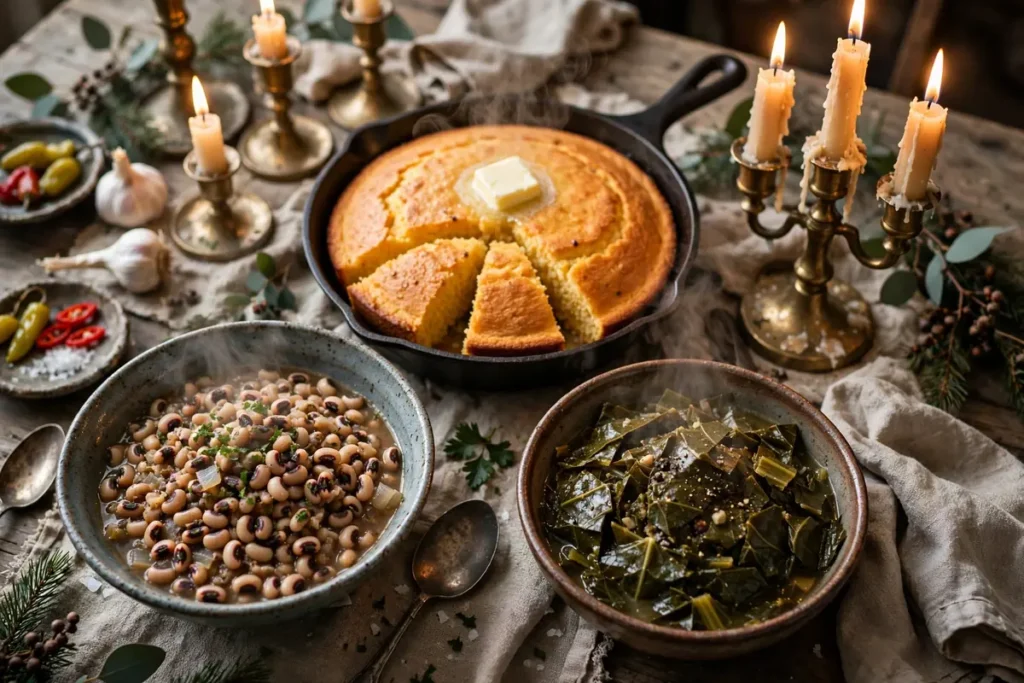
A table of lucky New Year's foods from around the world: grapes, lentils, black-eyed peas, and greens arranged festively.
Watch: New Year's Day Superstitions: What Not to Do
New Year's superstitions and folklore — dark traditions, lucky foods, and family customs from Kentucky and beyond.
At a Glance: New Year's Day Superstitions: What Not to Do
Famous New Year's superstitions and their origins.
| Superstition | Where | The belief |
|---|---|---|
| Twelve grapes at midnight | Spain | One grape per clock chime brings luck for each month |
| No laundry | Southern United States | Washing clothes is said to 'wash away' a loved one or your luck |
| Black-eyed peas and greens | Southern United States | Peas for coins, greens for cash — prosperity foods |
| Lentils | Italy | Round lentils resemble coins and promise wealth |
| Don't sweep | China | Sweeping on New Year's Day sweeps good fortune out the door |
| First-footing | Scotland | A tall, dark first visitor after midnight brings luck |
| Wear red | Many cultures | Red symbolizes luck and vitality for the new year |
Frequently Asked Questions
What should you not do on New Year’s Day?
Tradition’s answer: don’t sweep or clean (you’ll sweep away luck), don’t wash hair or do laundry, don’t lend money, don’t cry or argue, don’t break anything, and don’t let the pantry sit empty. The practical answer: don’t start the year exhausted, broke, or fighting — the folklore is mostly that, dressed up.
Why do Spanish people eat 12 grapes at midnight?
The uvas de la suerte tradition dates to 1909, when grape growers in Alicante had a bumper harvest and marketed the idea of eating one grape per midnight bell-stroke for luck. It stuck — and spread across Latin America and beyond.
What is first-footing?
The Scottish tradition that the first person to enter your home after midnight determines the year’s luck — ideally a dark-haired man bearing symbolic gifts (coal, shortbread, whisky). It likely originates in memories of Viking raids, when fair-haired strangers meant danger.
Is it bad luck to clean on New Year’s Day?
In Chinese tradition, yes — sweeping on the first day sweeps away good fortune, so homes are cleaned thoroughly beforehand. Similar “don’t clean” customs appear in several European traditions. Whether or not you believe it, a cleaning-free January 1 is its own reward.
Do New Year’s superstitions actually work?
Not by magic — but rituals measurably reduce anxiety, bond groups, and boost confidence, which genuinely improves outcomes. The luck is psychological, and psychological luck counts.
Which superstition is the most fun to try?
The Danish plate-smashing (with friends’ consent and old crockery), the Colombian suitcase run, and the Brazilian seven waves all make excellent party traditions — they’re social, photogenic, and harmless. Just smash the pomegranate outside.
Superstitions are humanity’s way of negotiating with uncertainty — small, strange contracts with the future, signed at midnight. Whether you eat the grapes, smash the pomegranate, or simply go to bed early, the real magic of January 1 is the same: a fresh page, and the collective human decision to believe the next chapter can be better.
The Skeptic’s Compromise
Don’t believe in any of it? You can still participate — anthropologists call it “ritual without belief,” and it’s completely legitimate. Eat the grapes because they’re delicious. Jump the waves because the ocean is there. Wear the red underwear because it’s festive. The social and psychological benefits of ritual don’t require metaphysical commitment; they require only showing up. The most rational position on New Year’s superstitions isn’t dismissal — it’s joyful, ironic, full-hearted participation in something humans have done together for millennia. Knock on wood. You’ll feel better.