The Swedish julbord Christmas buffet is Scandinavia’s greatest holiday institution — a lavish, multi-course smörgåsbord served through December, where pickled herring, cured salmon, meatballs, ham, and sausages arrive in a strict traditional order, accompanied by glögg, julmust, and aquavit. More than a meal, the julbord is a ritual of abundance: the Christmas table that Swedish families, restaurants, and workplaces lay out again and again all season long.
This guide walks you through the complete Swedish julbord Christmas buffet: the traditional five-course order (and why it matters), every essential dish from sill to risgrynsgröt, the drinks, the history, regional variations, and how to host your own julbord. See our Christmas traditions in Sweden and Christmas dinner ideas for more.
What Is a Julbord? The Christmas Table Tradition
Julbord literally means “Christmas table” — and that’s exactly what it is: a table laden with Christmas food, from which guests serve themselves in rounds. The julbord season runs from late November through Christmas (and often into January): restaurants serve julbord lunches and dinners all December, companies host julbord parties for staff, and families lay out the julbord on Christmas Eve (julafton, December 24 — Sweden’s main Christmas day).
The julbord is not a free-for-all buffet. It follows a traditional order of courses — typically five “rounds” (turer) — and eating them out of sequence marks you as a novice. The order has logic: cold fish first (with crispbread and aquavit), then cold meats and salads, then hot dishes (meatballs, ham, sausages), then cheese, then dessert. Each round gets a fresh plate — this is ironclad julbord law.
The julbord’s roots run deep: the medieval Christmas fast-breaking, the 19th-century bourgeois smörgåsbord, and the 20th-century restaurant julbord (popularized by Stockholm’s grand hotels) all feed into the modern tradition. Today the julbord is big business — Swedes eat millions of julbords each December — and a beloved ritual: the taste of Swedish Christmas itself.
Round One: Sill — The Herring Course
The julbord opens with sill (pickled herring) — and this is not optional. The herring board features multiple varieties: inlagd sill (classic pickled in vinegar, onion, and spices), senapssill (mustard herring), skärgårdssill (archipelago herring, with sour cream and chives), löksill (onion herring), and modern flavors (curry, tomato, garlic). Each is eaten on knäckebröd (crispbread) or tunnbröd (thin flatbread) with boiled new potatoes, chopped egg, chives, and sour cream.
The herring course is paired with aquavit (snaps) — the caraway-and-dill spirit drunk in small chilled shots, accompanied by snapsvisor (drinking songs). The classic Christmas aquavit: O.P. Anderson (aged, with caraway, anise, and fennel). Beer (a dark Christmas lager, julöl) follows the snaps. The rule: herring, potato, snaps, song — in that order, repeated as desired.
Gravlax and Smoked Fish
Alongside the herring: gravlax (salmon cured with salt, sugar, dill, and pepper) with hovmästarsås (mustard-dill sauce), smoked salmon (rökt lax), smoked eel (rökt ål — a southern Swedish delicacy), and pickled salmon. Shrimp (räkor) with mayonnaise and lemon appear on coastal julbords. This is the cold fish round — delicate, briny, and the julbord’s most Swedish course.
Round Two: Cold Cuts, Patés, and Salads
The second round moves to cold meats: julskinka (Christmas ham — served cold, sliced, with mustard) makes its first appearance here (it returns hot in round three), alongside leverpastej (liver pâté), kalvsylta (jellied veal brawn), pressylta (pressed pork brawn), and smoked sausages.
Salads and accompaniments: Rödbetssallad (beetroot salad with apples in crème fraîche — the shocking-pink julbord icon), sillsallad (herring and beet salad), potato salad, pickled cucumbers (pressgurka), pickled beets, and red cabbage. Cheese sometimes sneaks in early: a sharp Västerbottensost (the “king of Swedish cheeses”) with quince or figs.
Round Three: The Hot Dishes — Meatballs, Ham, and Sausages
Köttbullar: The Swedish Meatball
Köttbullar — the Swedish meatball — are the julbord’s most famous hot dish: small (smaller than Italian-American meatballs), made with mixed pork and beef (sometimes veal), breadcrumbs soaked in cream, onion, and allspice, fried in butter and served with cream sauce (gräddsås), lingonberry jam (lingonsylt), and mashed potatoes or boiled potatoes. The lingonberry-meatball-cream trinity is the flavor of Swedish Christmas. Homemade vs. bought: Swedes debate this fiercely — the purists hand-roll (with cream-soaked breadcrumbs for tenderness), while pragmatists buy good frozen (even IKEA’s, in a pinch) and focus energy on the sauce (pan drippings, cream, a splash of soy for depth) and the lingonberries (stirred, not too sweet).
Julskinka: The Christmas Ham
Julskinka — the Christmas ham — is Sweden’s Christmas roast: a cured ham (traditionally boiled, then coated in mustard, egg, and breadcrumbs and gratinéed) served hot in round three (after its cold appearance in round two). The griljerad (mustard-grilled) crust is the prize. Families order the ham from butchers (the Christmas ham rush is real — order by early December); the first slice is ceremonial, and the leftover ham becomes smörgåsar (open sandwiches) for days. The griljering — the mustard-egg-breadcrumb crust, scored in a diamond pattern — should be deeply golden and slightly crisp.
Prinskorv, Janssons Frestelse, and More
Prinskorv (small “prince” sausages, fried), Janssons frestelse (“Jansson’s temptation” — the anchovy-and-potato gratin with cream, the julbord’s most addictive dish; the “anchovies” are actually sprats, ansjovis), lutfisk (lye-treated cod — the notorious Christmas fish, gelatinous and beloved-or-loathed, served with white sauce, peas, and allspice), kåldolmar (cabbage rolls), and revbensspjäll (glazed pork ribs) complete the hot round. Red cabbage and Brysselkål (Brussels sprouts) appear as vegetables.
Round Four: Cheese
The cheese round: Västerbottensost (aged 14+ months, crystalline, intense — Sweden’s great cheese), herrgårdsost (manor cheese), prästost (priest’s cheese), cheddar-style Swedish cheeses, blue cheeses (blåmögelost), and brie-style whites. Served with crispbread, grapes, figs, and nuts. The cheese round is quieter — a breather before dessert — and pairs with port or the last of the julöl.
Round Five: Dessert — Risgrynsgröt and Christmas Sweets
Risgrynsgröt and Ris à la Malta
Risgrynsgröt — the Christmas rice porridge (rice slowly cooked in milk, served hot with cinnamon, sugar, and cold milk) — is the julbord’s traditional dessert, and it carries the almond game: a single blanched almond is hidden in the porridge, and whoever finds it gets a prize (traditionally marriage within the year). Ris à la Malta (cold rice porridge folded with whipped cream and served with orange sauce or lingonberries) is the elegant chilled version.
Pepparkakor, Lussekatter, and Julgodis
Pepparkakor (thin ginger thins — the Swedish gingersnap, often heart- or star-shaped) with blue cheese (the classic pairing — try it) or as pepparkakshus (gingerbread houses). Lussekatter (saffron buns, technically for St. Lucia Day, December 13, but present all season). Knäck (Christmas toffee with almonds), ischoklad (ice chocolate), marsipan (marzipan pigs — the marsipangris is the traditional prize), saffransskorpor, and polkagrisar (the red-and-white peppermint sticks of Gränna). Clementines — the Christmas orange — appear everywhere.
Drinks: Glögg, Julmust, and Snaps
Glögg
Glögg — Sweden’s mulled wine (red wine or spirits heated with cinnamon, cloves, cardamom, ginger, orange, and sugar) — is the pre-julbord ritual: served hot in small glasses with raisins and blanched almonds (“med russin och mandel”), alongside pepparkakor and blue cheese. Glögg parties (glöggmingel) run through December — offices, churches, and neighborhoods all host them. Homemade glögg: heat (don’t boil) red wine with cinnamon sticks, cloves, cardamom pods, dried ginger, orange peel, and sugar, then spike with vodka or brandy to taste. Non-alcoholic svagdricka-based glögg exists for children — and the raisins and almonds go in the glass first, so every sip ends with a boozy bite.
Julmust
Julmust — the Christmas soda — is Sweden’s most distinctive holiday drink: a dark, malty, spiced soft drink (the recipe is a closely guarded secret, licensed to breweries) that outsells Coca-Cola in December. Swedes drink millions of liters; the påskmust (Easter version) is the same drink rebranded. Julmust with the julbord is non-negotiable for many families.
Snaps, Julöl, and Coffee
Snaps (aquavit) with the herring course, julöl (dark Christmas lager) through the hot dishes, port with cheese — and coffee with dessert (Sweden’s fika culture demands it). The julbord is well-lubricated; the snapsvisor (drinking songs) are essential equipment.
The History of the Julbord
The julbord’s ancestors: the medieval Christmas fast (broken with a feast), the 19th-century smörgåsbord (the bourgeois buffet, with its brännvinsbord — aquavit table — as the herring course’s direct ancestor), and the restaurant julbord pioneered by Stockholm’s grand hotels in the early 1900s. The 20th century democratized it: workplace julbords became standard, restaurants competed on julbord lavishness, and the home julbord standardized around the five rounds.
The julbord’s economics are remarkable: Swedes spend billions of kronor on julbords each December; restaurants do a huge share of annual revenue in the julbord season. And the tradition evolves: vegetarian julbords (with beet “gravlax,” mushroom “meatballs,” and halloumi), sustainable julbords (less waste, local sourcing), and takeaway julbords (the pandemic’s legacy) all have their place — but the five rounds endure.
Regional Variations
Scania: Goose and Eel
Scania (Skåne) — Sweden’s southern tip, historically Danish — serves roast goose (Mårten Gås, St. Martin’s goose, November 10, extends into Christmas) and smoked eel (rökt ål) on the julbord. The Scanian julbord is the most continental — closer to Danish and German Christmas tables.
Norrland: The Northern Julbord
The north adds game: reindeer (ren — smoked, dried, or as suovas), moose (älg), and cloudberries (hjortron) with whipped cream for dessert. Fermented herring (surströmming) is not Christmas food (it’s August) — but northerners will tell you about it anyway.
Gotland and the Islands
Gotland contributes saffranspannkaka (saffron pancake with dewberry jam, salmbärssylt) — the island’s famous dessert — and smoked lamb. Island julbords lean sheep and fish.
How to Host a Julbord: The Practical Guide
Planning
A home julbord for 8–12 is ambitious but doable. Buy: herring varieties (or make inlagd sill — it’s easy), gravlax (or cure your own — 2 days), julskinka (order from the butcher), sausages, cheeses, crispbread, and julmust. Make: köttbullar (or buy good frozen — no shame), Janssons frestelse (essential, and easy), rödbetssallad, risgrynsgröt, pepparkakor (or buy), and glögg. Timeline: cure gravlax 2 days ahead; make herring and salads 1 day ahead; cook hot dishes Christmas Eve morning; lay the table in rounds (don’t put everything out at once — the courses are the point).
The Order of Service
Glögg on arrival (with pepparkakor). Then Round 1 (herring + fish, with snaps and songs). Fresh plates. Round 2 (cold cuts + salads). Fresh plates. Round 3 (hot dishes — the main event). Fresh plates. Round 4 (cheese). Fresh plates. Round 5 (dessert + coffee). Donald Duck (Kalle Anka — the Disney Christmas special that all of Sweden watches at 3 PM on Christmas Eve) interrupts or follows the julbord — plan around it.
Vegetarian Julbord
The modern vegetarian julbord: beet gravlax (cured beets, dill, mustard sauce), pickled herring replaced by pickled mushrooms, mushroom “meatballs” with cream sauce and lingonberries, Janssons frestelse (already vegetarian — just check the ansjovis), kale salad (grönkålssallad), cheese round as usual, and risgrynsgröt. Many Swedish families now serve a mixed julbord — the vegetarian dishes so good nobody notices.
Lutfisk: The Julbord’s Most Notorious Dish
Lutfisk — dried cod (or ling) reconstituted in lye (lut), then boiled or baked into a gelatinous, translucent fish — is the julbord’s great divider. Its origins are medieval: dried fish was the Lenten and Advent protein of the Catholic north, and the lye treatment (originally from ash) made rock-hard stockfish edible. The result is unlike any other food: quivering, mild, faintly soapy if mishandled, sublime if done right.
Proper lutfisk is served hot with white sauce (vit sås), boiled potatoes, green peas, allspice, and melted butter — and, crucially, it must be well-rinsed (the lye must be fully washed out) and not overcooked (it dissolves). Norwegians eat it too (it’s arguably their dish), and Swedish-Americans in Minnesota hold lutfisk suppers that are equal parts dinner and endurance test. At the julbord, lutfisk is optional but traditional — the brave take a spoonful; the wise take it with plenty of white sauce and aquavit. Either way, it’s talked about more than any other dish — which is, arguably, its real function.
Snapsvisor: The Drinking Songs
No julbord is complete without snapsvisor — the drinking songs sung before each round of aquavit. The canon: “Helan går” (“the whole goes down” — sung before the first snaps, and every Swede knows it), “Halvan går” (the second), and “Tersen” (the third, for the ambitious). The songs are short, bawdy, and communal — the whole table sings, drinks, and sings again.
The etiquette: the host (or the toastmaster) proposes the snaps; everyone makes eye contact (“skål!”), drinks, and makes eye contact again. Never drink your snaps without the song — it’s like skipping grace. Print the lyrics for non-Swedish guests (phonetic versions exist); the attempt matters more than the pronunciation. And pace yourself: the herring round’s snaps are just the beginning — the julbord is a marathon, not a sprint.
Julbord Etiquette: The Unwritten Rules
The julbord has laws. Fresh plate every round — never carry food between courses. Fish before meat — the order is sacred. Small portions — you can always go back (and you will); the julbord rewards grazing, not loading. Bread (crispbread, thin bread, Christmas vörtbröd — the wort-flavored Christmas loaf) is always on the table. Butter is real butter — this is not the occasion for substitutes.
Glögg comes before the julbord, not during. Coffee comes with dessert, not before. The almond in the risgrynsgröt is hidden fairly (stirred in, not placed). Children get julmust and svagdricka, not snaps. And Kalle Anka (the Disney Christmas special) at 3 PM on Christmas Eve is inviolable — the julbord pauses, the nation watches, and then the eating resumes. These rules aren’t written — they’re inherited, which makes them stronger.
Aquavit Guide: Choosing Your Snaps
The julbord’s aquavit deserves its own briefing. O.P. Anderson — the Christmas aquavit, aged in oak with caraway, anise, and fennel — is the classic. Skåne Akvavit (caraway-forward, the herring pairing), Herrgårds Aquavit (mellow, aged), and Gammal Norrlands are staples. Flavoured snaps — dill, elderflower, blackcurrant — are modern and festive. Serve ice-cold (from the freezer), in small glasses, with the songs. And for the non-drinkers: julmust and lingonberry cordial (lingondricka) keep the toasts inclusive — the skål matters more than the spirit.
In Pictures: Swedish Julbord Christmas Buffet
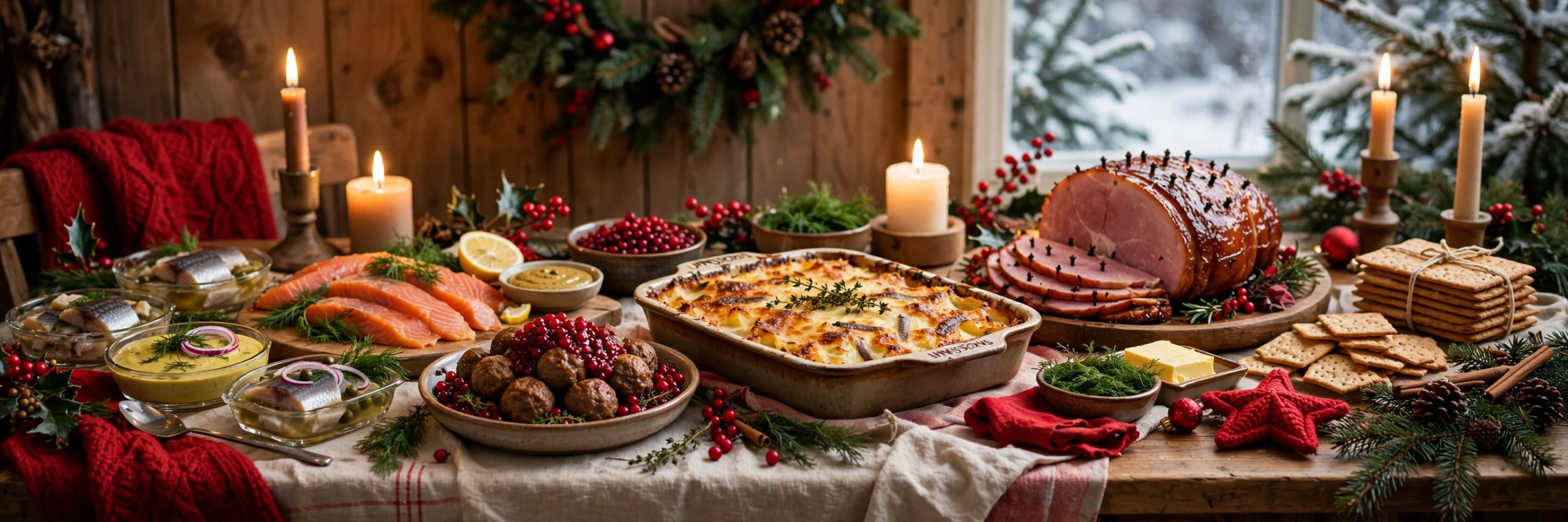
The julbord is Sweden’s Christmas table — eaten in courses, from cold herring through ham and hot dishes to dessert.

A Swedish julbord: pickled herring jars, glazed Christmas ham, meatballs, gravlax, sausages and cheese in a candlelit rustic room.
Watch: Swedish Julbord Christmas Buffet
At our Neighbour’s Table visits a family in Jämtland for a legendary Christmas buffet — julskinka, fish, meat, sweets and all.
At a Glance: Swedish Julbord Christmas Buffet
The rounds of the Christmas table.
| Dish | When | Key detail |
|---|---|---|
| Julbord | 24 December | The “Christmas table” — eaten in rounds, cold fish first, desserts last |
| Sill & gravlax | 24 December | Pickled herring and cured salmon — the traditional opening round |
| Julskinka | 24 December | The glazed Christmas ham — the buffet’s centerpiece |
| Hot dishes | 24 December | Meatballs, prinskorv sausages and Janssons frestelse |
| Dopp i grytan | 24 December | “Dip in the pot” — bread dipped in ham broth, an old tradition |
| Glögg & julmust | December | Spiced mulled wine and the seasonal soda — julmust outsells Coca-Cola at Christmas |
| Risgrynsgröt | 24 December | Rice porridge with a hidden almond — legend says the finder marries next |
Frequently Asked Questions
What is a Swedish julbord?
A julbord (“Christmas table”) is Sweden’s traditional Christmas buffet — served at restaurants, workplaces, and homes through December, with Christmas Eve as the main day. It follows five traditional rounds: herring and fish, cold cuts and salads, hot dishes (meatballs, ham, sausages), cheese, and dessert — each on a fresh plate.
What do you eat at a julbord?
Pickled herring (multiple varieties), gravlax, smoked salmon, julskinka (Christmas ham), köttbullar (meatballs with lingonberries), prinskorv (sausages), Janssons frestelse (anchovy-potato gratin), lutfisk, cheeses (Västerbottensost), risgrynsgröt (rice porridge with the almond game), pepparkakor, and clementines — with glögg, julmust, snaps, and julöl to drink.
What is the correct order for a julbord?
Cold fish first (herring, gravlax — with snaps), then cold meats and salads, then hot dishes (meatballs, ham, sausages), then cheese, then dessert — with a fresh plate for each round. Eating out of order is the classic julbord faux pas.
What is glögg?
Glögg is Sweden’s mulled wine — heated with cinnamon, cloves, cardamom, ginger, and orange, served hot with raisins and almonds. It’s the pre-julbord ritual drink of December, served at glögg parties with pepparkakor.
What is julmust?
Julmust is Sweden’s Christmas soda — a dark, malty, spiced soft drink that outsells Coca-Cola every December. The recipe is secret; Swedes drink millions of liters. It’s the non-alcoholic julbord essential.
Can I make a vegetarian julbord?
Absolutely — beet “gravlax,” mushroom meatballs with lingonberries, Janssons frestelse (naturally vegetarian), kale salad, the full cheese round, and risgrynsgröt make a complete vegetarian julbord. Many Swedish families now serve mixed julbords.
Day Two: The Julbord Leftovers
The julbord keeps giving: Christmas Day (December 25) in Sweden is quiet — the big day was the 24th — and it’s built for grazing the leftovers. Julskinka sandwiches (ham, mustard, and pickled cucumber on vörtbröd), köttbullar reheated in cream sauce, Janssons straight from the dish, cheese and pepparkakor, and the last of the risgrynsgröt (fried in butter for breakfast — trust the Swedes on this). The herring keeps for days; the glögg reheats. Many Swedes insist the 25th’s lazy leftover julbord — eaten in pajamas, no ceremony — is the best meal of the season.
God Jul — The Table That Is Christmas
The Swedish julbord Christmas buffet is more than a meal — it’s December itself, eaten in five rounds: the herring and snaps, the meatballs and lingonberries, the ham and Janssons, the cheese and the porridge with its hidden almond. Whether you lay out the full traditional spread or borrow its best ideas (Janssons frestelse alone is worth the effort), the julbord’s spirit is abundance shared slowly — with fresh plates, good songs, and no rushing. For more Scandinavian Christmas, see our Christmas traditions in Sweden, compare with our Polish Wigilia’s twelve dishes, and browse Christmas gift ideas for the julbord host. God jul — och glöm inte snapsvisorna!