Christmas traditions in Norway are shaped by deep fjords, Arctic nights, and a culture that treats the darkest month of the year as an invitation to gather close. In Norway, Christmas — jul — is the undisputed high point of the year, a season when families return to mountain cabins and coastal hometowns, when the smell of ribbe (pork belly) and pinnekjøtt (dried lamb ribs) fills kitchens, and when centuries-old customs sit comfortably alongside modern Norwegian life. Like its Scandinavian neighbors, Norway celebrates Christmas Eve as the main event, but the Norwegian jul has its own distinct flavor: the Christmas beer brewed since Viking times, the little gnomes called nisser who demand their porridge, and a “romjul” week between Christmas and New Year that is practically sacred. Here are the essential Norwegian Christmas traditions, counted down in a listicle built for browsing — plus the food, travel tips, and answers you need to understand how Norway does Christmas.
The Norwegian Christmas Season at a Glance
Before we dive into the list, it helps to understand the rhythm of Christmas traditions in Norway. The season begins with Advent in late November, when Norwegians light candles, hang the Christmas star in the window, and children open their julekalender (Advent calendars). December 23 is lille julaften — Little Christmas Eve — a cozy day of last-minute preparations, decorating the tree, and often eating risengrynsgrøt (rice porridge) as a family.
December 24, julaften, is the main celebration: church bells ring in Christmas at 5 p.m., families eat the Christmas dinner, and gifts are exchanged. December 25 and 26 (første and andre juledag) are quiet days for church, walks, and family visits. Then comes romjulen — the “in-between days” from December 27 to New Year’s Eve — a stretch of skiing, cabin life, and leftovers that Norwegians guard jealously. The season closes with New Year’s Eve fireworks and, for many, the Epiphany period in early January.
What makes the Norwegian jul distinctive is its blend of the hearty and the hushed: enormous festive meals followed by silent, starlit walks; ancient pagan midwinter echoes beneath Lutheran church traditions; and a national insistence that Christmas should be koselig — the Norwegian cousin of hygge, meaning cozy, warm, and content. Our guide to Christmas traditions in Denmark explores the Danish version of that coziness, while Christmas traditions in Sweden covers Norway’s closest holiday cousin.
20 Timeless Norwegian Christmas Traditions
1. Julaften: Christmas Eve Is the Main Event
The single most important of all Christmas traditions in Norway is that the celebration peaks on December 24, not December 25. At 5 p.m., church bells across the country ring in Christmas — a moment so iconic that even non-churchgoers pause to listen. Families then sit down to the Christmas dinner, exchange gifts afterward, and often attend or have attended a family church service earlier in the day. If you are invited to a Norwegian Christmas, the invitation will almost certainly be for julaften.
2. The Julebord: Norway’s Christmas Feast Party
Like Sweden’s julbord, Norway has the julebord — but the Norwegian version leans more toward a festive party than a formal buffet. Throughout December, workplaces, clubs, and groups of friends hold julebord dinners: long, laughter-filled evenings of traditional Christmas food, Christmas beer (juleøl), aquavit, singing, and speeches. Attending multiple julebords in December is a point of pride — and a test of stamina.
3. Ribbe: The Christmas Pork Belly
The most popular Norwegian Christmas dinner is ribbe — pork belly or pork ribs roasted until the crackling is shatteringly crisp. Achieving perfect crackling (svor) is a matter of national honor, and families debate techniques (scoring, salting, steaming, high-heat finishing) with the intensity of a sports rivalry. Ribbe is served with sauerkraut or red cabbage, boiled potatoes, pork sausages, and a rich gravy. Surveys consistently show ribbe as the Christmas dinner of choice for the majority of Norwegians.
4. Pinnekjøtt: Dried Lamb Ribs, Steamed Over Birch
The great rival to ribbe is pinnekjøtt — salted, dried lamb ribs, soaked overnight, then steamed for hours over birch sticks. Dominant in western and northern Norway, pinnekjøtt has a deep, gamey, almost smoky flavor that devotees consider the true taste of Christmas. It is served with mashed swede (kålrabistappe) and potatoes. The ribbe-versus-pinnekjøtt debate is one of Norway’s great friendly divides — ask a Norwegian which their family serves, and you will learn something real about their regional roots.
5. Lutefisk: The Love-It-or-Hate-It Classic
Lutefisk — dried whitefish (usually cod) reconstituted in lye — is the most divisive of Norwegian Christmas foods. Its jelly-like texture and pungent aroma inspire devotion in some and horror in others, but it remains a fixture of many families’ December tables, often served with bacon, peas, and potatoes. Even Norwegians who would not touch it respect its place in the tradition. Trying lutefisk at least once is considered a rite of passage.
6. The Nisse: Porridge for the Barn Gnome
Among the most charming Christmas traditions in Norway is the nisse — a small, bearded gnome-like creature from folklore who protects the farm and home. According to tradition, the nisse must be given a bowl of rice porridge with butter on Christmas Eve, or he will play tricks on the household. Today, nisse figurines with red caps decorate Norwegian homes, and the porridge custom survives in many families, especially those with children. The almond hidden in the porridge — whoever finds it wins a marzipan pig — adds a sweet competitive edge.
7. Juleøl: Christmas Beer Since Viking Times
Brewing Christmas beer is one of Norway’s oldest continuous traditions, stretching back to Viking-era juleøl brewed for midwinter feasts — and, remarkably, once required by law under King Håkon the Good in the 900s. Today’s juleøl is a dark, malty, spiced seasonal beer brewed by Norway’s major breweries and countless microbreweries. Its release in early November is a minor national event, and the beers are rated, debated, and collected with enthusiasm.
8. Gingerbread Houses and Pepperkaker
Norwegians bake pepperkaker (gingerbread cookies) in enormous quantities every December, and building gingerbread houses is a beloved family activity. The city of Bergen takes this to spectacular heights with Pepperkakebyen — the world’s largest gingerbread town, built annually since 1991 from contributions by schools, kindergartens, and businesses. Thousands of miniature gingerbread houses, churches, trains, and landmarks form a sweet-smelling miniature city that draws visitors from around the world.
9. The Christmas Tree With Norwegian Flags
Norwegian Christmas trees are often decorated with small Norwegian paper flags strung in chains among the baubles and lights — a patriotic touch that surprises visitors. The tradition dates to the 19th century and remains widespread. Real spruce or fir is the norm, and in many families the tree is decorated on lille julaften (December 23), often as a family event with gløgg for the adults.
10. Dancing Around the Tree
After the Christmas dinner on julaften, many Norwegian families join hands and dance around the Christmas tree, singing carols like “Glade jul” (Silent Night) and “Deilig er jorden” (Fair Is the Earth). It is a custom shared with Denmark and Sweden, and it transforms the post-dinner hour into something joyful and physical — especially welcome after the richness of ribbe.
11. Julenissen: Norway’s Santa Claus
Julenissen — literally “the Christmas nisse” — is Norway’s gift-bringer, a figure who blends the old barn gnome with the modern Santa Claus. On Christmas Eve, children wait for the sound of knocking at the door, and a family member (or a hired julenisse) appears with a sack of gifts. Unlike the American Santa who comes down the chimney at night, the julenissen often makes a personal appearance — which is both thrilling and, for the youngest children, slightly terrifying.
12. Julehefter: The Christmas Comic Books
A uniquely Norwegian tradition is the julehefte — special Christmas editions of comic magazines, published annually since the early 1900s. Titles like Knoll og Tott, Smørbukk, and Donald Duck Christmas specials are bought as stocking stuffers and read during the lazy romjul days. For many Norwegians, the arrival of the year’s julehefter in shops is a sure sign that Christmas is near.
13. The 5 p.m. Church Bells of Julaften
Even in secular Norway, the ringing of church bells at 5 p.m. on Christmas Eve is a powerful collective moment. Known as juleringing, the bells proclaim that Christmas has officially begun. Many families time their Christmas dinner to begin right after the bells, and the sound rolling across a snow-covered town or fjord village is one of the most atmospheric experiences of the Norwegian jul.
14. Romjul: The Sacred In-Between Days
Romjulen — the days between Christmas and New Year — is fiercely protected downtime in Norway. Offices run on skeleton crews, families retreat to cabins (hytter), and the national pastime becomes cross-country skiing followed by hot chocolate. Romjul is when Norwegians visit friends they missed at Christmas, eat their way through leftovers, read their julehefter, and generally refuse to hurry. If you visit Norway in late December, expect a country gloriously at rest.
15. Skiing on Christmas: The Outdoor Tradition
No list of Christmas traditions in Norway would be complete without skiing. A Christmas Day or romjul ski trip — whether a gentle family outing on prepared trails or a demanding mountain tour — is practically obligatory for many Norwegians. The tradition reflects the deep Norwegian identity as a skiing nation: Christmas is not just an indoor holiday but a celebration of winter itself, best experienced moving through a snow-covered landscape.
16. Multekrem: Cloudberries With Cream
For dessert, many Norwegian Christmas tables feature multekrem — whipped cream folded with cloudberries (molter), the golden Arctic berries foraged in summer and hoarded for special occasions. It is a taste of the Norwegian wilderness in the depths of winter, and its sweet-tart flavor cuts beautifully through the richness of the Christmas meal. Rice pudding with raspberry sauce (riskrem) is the other classic, complete with the hidden-almond game.
17. Aquavit and Christmas Toasts
The Christmas dinner is accompanied by aquavit (akevitt), the caraway-flavored spirit aged in oak — the finest varieties having crossed the equator in sherry casks (linjeakevitt). Toasts are formal affairs: eye contact, a raised glass, the singing of snaps songs, and precise rituals of sipping. Christmas is the peak season for aquavit, and the toasts are as much a part of the meal as the food.
18. Christmas Church Services: Julaftensgudstjeneste
Attending church on Christmas Eve afternoon is one of the most widely observed Christmas traditions in Norway, drawing even infrequent churchgoers. The julaftensgudstjeneste (Christmas Eve service) features beloved hymns like “Deilig er jorden” and “Glade jul,” candlelight, and the Nativity story. Churches are often full to bursting, with extra services added to accommodate the crowds.
19. Nyttårsaften: Fireworks Over the Fjords
New Year’s Eve (nyttårsaften) is celebrated with festive dinners — often turkey, game, or seafood — followed by fireworks at midnight. In cities like Oslo and Bergen, and in fjord villages where the sound echoes off the mountainsides, the fireworks are spectacular. Many Norwegians also watch the King’s New Year’s speech, a tradition of quiet national reflection before the revelry.
20. Trettendedag Jul: Epiphany and the Season’s End
The Norwegian Christmas season traditionally extends to January 6, trettendedag jul (the Thirteenth Day of Christmas, Epiphany). While modern celebrations wind down earlier, some families keep their decorations up until this date, and it remains the formal end of the jul season in church tradition — a gentle bookend to seven weeks of celebration.
Norwegian Christmas Food: The Classics at a Glance
The Christmas traditions of Norway revolve around food, so here is a quick-reference table of the essentials you will encounter on a Norwegian December table:
- Ribbe — roast pork belly with crackling; the majority’s Christmas dinner
- Pinnekjøtt — dried, salted lamb ribs steamed over birch; western Norway’s favorite
- Lutefisk — lye-treated dried cod; the divisive classic
- Rakfisk — fermented trout, more common in eastern valleys
- Medisterkaker & julepølse — pork meatballs and Christmas sausage
- Surkål & rødkål — sauerkraut and red cabbage accompaniments
- Risengrynsgrøt / riskrem — rice porridge and rice-cream dessert with hidden almond
- Multekrem — cloudberries folded into whipped cream
- Pepperkaker — gingerbread cookies, baked by the tray-load
- Juleøl & akevitt — Christmas beer and aquavit for toasts
- Marsipangris — the marzipan pig awarded to the almond-finder
If this feast has whetted your appetite for Nordic holiday cooking more broadly, our Christmas traditions in Finland and Christmas traditions in Sweden guides cover their neighbors’ tables — and our Christmas dinner ideas collection brings global inspiration to your own kitchen.
Christmas in Oslo, Bergen, Tromsø, and Beyond
Norway’s cities each offer a distinct December experience. Oslo’s Jul i Vinterland (Christmas in Winterland) transforms the city center with markets, a Ferris wheel, and an ice rink, while the traditional market at Spikersuppa and the windows along Karl Johans gate draw strolling crowds. Bergen pairs its harbor-side Christmas market with the extraordinary Pepperkakebyen gingerbread town — worth the trip alone.
For the ultimate Arctic Christmas, head north to Tromsø, where the polar night lasts from late November to mid-January. Christmas markets, the Arctic Cathedral’s candlelit concerts, dog sledding, and — with clear skies and luck — the northern lights make Tromsø one of the most magical December destinations on earth. It regularly appears on lists of the best places to spend Christmas, and deservedly so.
Practical note for visitors: like elsewhere in Scandinavia, Christmas Eve and Christmas Day are family days — book restaurants well ahead, expect limited hours on December 24–26, and plan major sightseeing for the days before. Check official tourism and transport sites for current 2026 schedules, as holiday timetables vary by region.
Norwegian Christmas Decorations: Straw, Flags, and Nisser
The visual language of Christmas traditions in Norway is rustic, natural, and unmistakably Nordic. The Christmas tree takes pride of place — almost always a real spruce or fir — decorated with white lights, glass baubles, and the signature chains of small Norwegian paper flags (flagglenker) strung among the branches. Straw ornaments (halmfigurer) — goats, stars, and angels woven from rye straw — nod to the country’s agricultural past and the pagan midwinter roots beneath the Christian celebration.
Nisser — the red-capped gnomes — appear on shelves, doorsteps, and in windows, sometimes arranged in mischievous scenes for children to discover each morning. Advent candlesticks and glowing stars light the windows from late November, and many families hang a Christmas sheaf (julenek) — a bundle of grain on a pole — outside for the birds, a custom rooted in old agrarian generosity toward wildlife in winter. It is a small, lovely gesture: even the birds get a Christmas dinner in Norway.
Outdoor decorations lean toward the restrained: strings of white lights in trees and along eaves, lanterns by the door, and occasionally an illuminated star on the barn or boathouse. The Norwegian aesthetic is less-is-more — the snow and the darkness do most of the work, and the decorations simply add warmth. For a broader look at Nordic decorating styles, our Christmas decoration ideas include Scandinavian looks alongside traditions from around the world.
A Norwegian December, Week by Week
For visitors or the curious, here is how a typical Norwegian December unfolds:
Late November: Advent preparations begin. The first Advent candle is lit, juleøl (Christmas beer) hits the shelves, and the first julebord parties are held. Christmas markets open in Oslo, Bergen, and Trondheim.
Early December: Pepperkaker baking intensifies. Children open their julekalender daily. Workplaces hold their julebord dinners — the peak season for these festive parties.
December 13: St. Lucia Day is observed, especially in kindergartens and schools, with processions and lussekatter (saffron buns) — a tradition shared with Christmas traditions in Sweden, where it is even bigger.
December 23 (lille julaften): Little Christmas Eve — the tree is decorated, the house is cleaned, and many families eat rice porridge together. Travel peaks as Norwegians head for cabins and hometowns.
December 24 (julaften): The main event — church bells at 5 p.m., Christmas dinner (ribbe, pinnekjøtt, or lutefisk), dancing around the tree, and gifts from the julenissen.
December 25–26: Quiet days for church, walks, and family visits.
December 27–30 (romjul): The sacred in-between days — skiing, cabin life, leftovers, and rest.
December 31 (nyttårsaften): New Year’s Eve dinners and midnight fireworks.
In Pictures: Christmas in Norway
Norway’s Christmas is built around Julaften — gifts on Christmas Eve, candles against the polar dark, and a feast of ribbe and pinnekjøtt.
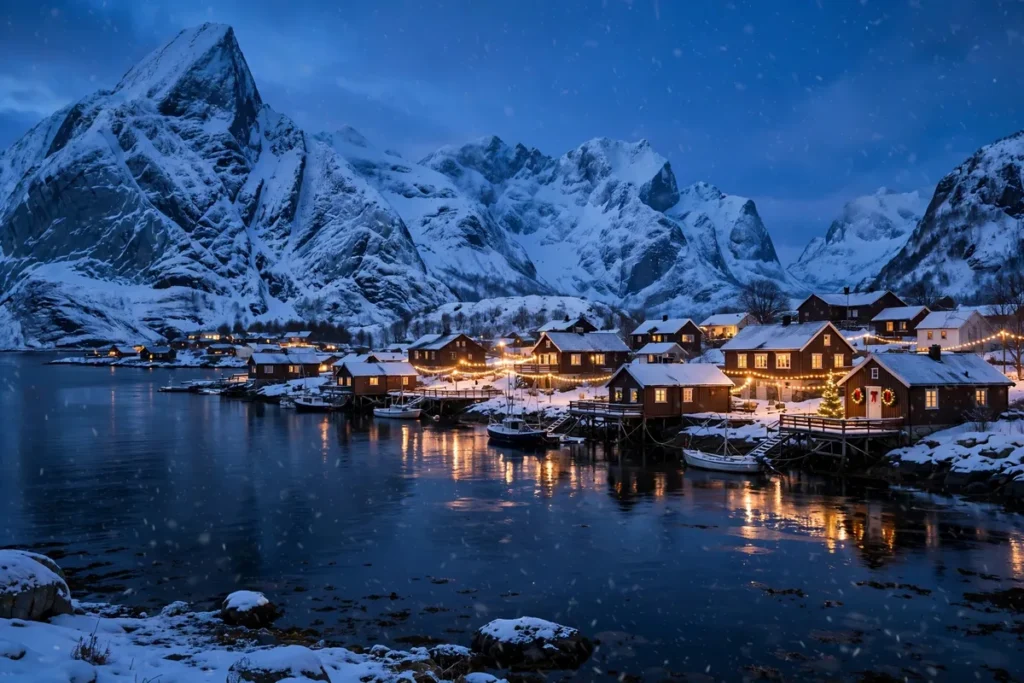
A Norwegian fjord village at Christmas during blue hour: wooden houses with glowing windows along a snowy shore, mountains across the dark water.
Watch: Christmas in Norway
A warm look at Norwegian Christmas traditions — the Christmas Eve feast of ribbe, pinnekjøtt and lutefisk, family gatherings, and the customs that set Norway apart.
At a Glance: Christmas in Norway
The customs of a Norwegian jul.
| Tradition | Date | Key detail |
|---|---|---|
| Julaften | 24 December | Christmas Eve is the main celebration — the bells ring at 5 PM and everyone heads home for the feast |
| Lillejulaften | 23 December | “Little Christmas Eve” — tree decorating, gingerbread houses and the Kvelden før kvelden TV show |
| Gifts on Christmas Eve | 24 December | Norwegians exchange gifts on the 24th, not the morning of the 25th |
| Around the tree | 24 December | After dinner the family joins hands, walks around the tree and sings carols |
| Ribbe & pinnekjøtt | 24 December | The Christmas feast: pork rib roast, salted lamb ribs and lutefisk, with aquavit and gløgg |
| The almond in the porridge | 24 December | A single almond is hidden in the rice porridge — the finder wins a marzipan pig |
| Gløgg | December | Spiced mulled wine served through the season — alongside julebrus and malty Christmas beer |
Frequently Asked Questions
What do Norwegians eat for Christmas dinner?
The two dominant Christmas dinners in Norway are ribbe (roast pork belly with crisp crackling) and pinnekjøtt (dried, salted lamb ribs steamed over birch sticks). Lutefisk (lye-treated cod) is a traditional third option. Desserts include riskrem (rice cream with raspberry sauce) and multekrem (cloudberries with whipped cream).
Do Norwegians celebrate Christmas on December 24 or 25?
Like Sweden and Denmark, Norway celebrates primarily on December 24 (julaften). Church bells ring in Christmas at 5 p.m., families eat the Christmas dinner, and gifts are exchanged in the evening. December 25 and 26 are quieter days for church, walks, and family visits.
What is romjul in Norway?
Romjul (also spelled romjulen) refers to the days between Christmas and New Year, roughly December 27–30. It is a cherished period of rest in Norway: families retreat to cabins, go cross-country skiing, visit friends, and enjoy leftovers. Many workplaces operate minimally during romjul.
What is a nisse?
A nisse is a small gnome-like creature from Norwegian folklore who protects the home and farm. Tradition holds that the nisse must receive a bowl of rice porridge on Christmas Eve, or he will cause mischief. Nisse figurines with red caps are popular Christmas decorations, and Norway’s Santa figure is called julenissen — “the Christmas nisse.”
What is juleøl?
Juleøl is Norwegian Christmas beer — a dark, malty, often spiced seasonal brew. The tradition of brewing Christmas beer stretches back to Viking times, and its annual release in early November is a celebrated event, with breweries large and small competing for the season’s best ratings.
When does the Christmas season start and end in Norway?
The season begins with Advent in late November and builds through December, peaking on Christmas Eve (December 24). It traditionally extends through romjul to Epiphany on January 6 (trettendedag jul), though many families take down decorations in the first days of January.
Christmas traditions in Norway prove that the darkest season can be the brightest — if you fill it with firelight, feast food, and the people you love. Whether you are steaming pinnekjøtt in Bergen, skiing through romjul silence, or simply raising a glass of juleøl to the polar night, the Norwegian jul is a masterclass in winter joy. God jul!