Christmas traditions in Germany are the reason the modern holiday looks the way it does across much of the world. The Christmas tree, the Advent calendar, the Advent wreath, and the Christmas market itself are all German inventions, exported over the centuries by immigrants, royalty, and eventually popular culture. But in Germany, Christmas — Weihnachten — remains a deeply domestic, quietly reverent affair: four weeks of candlelight and anticipation, a single magical evening when the tree is revealed, and two full public holidays for family, food, and long walks in the winter air. If you have ever wondered where the “traditional Christmas” of carols and candlelight actually comes from, this is its birthplace.
Whether you are planning a December trip to a German Christmas market, tracing family roots, or simply borrowing a few customs to make your own holiday richer, this guide walks through the entire German Christmas season — from the first Advent Sunday to Epiphany — so you can understand not just what Germans do at Christmas, but why they do it.
Christmas Traditions in Germany: Why This Country Is the Heart of Christmas
Long before Christmas looked like a Coca-Cola advertisement, it looked like a German living room in December. Historians credit Germany with an astonishing number of the customs English-speaking countries now consider universal:
- The Christmas tree (Tannenbaum) — decorated firs appeared in German guild halls and homes by the 1500s; the custom reached Britain in the 1840s through Prince Albert, Queen Victoria’s German consort, whose illustrated family tree made it fashionable overnight.
- The Advent wreath (Adventskranz) — invented in 1839 by Johann Hinrich Wichern, a Hamburg pastor who mounted candles on a wagon wheel to help orphanage children count down to Christmas. Today families light one more candle on each of the four Advent Sundays.
- The Advent calendar — first printed in Munich in the early 1900s, evolving from chalk marks on doors to the chocolate-filled calendars now sold worldwide.
- The Christmas market (Weihnachtsmarkt) — documented as far back as 1384 in Bautzen and 1434 in Dresden’s Striezelmarkt, still running today and among the oldest in the world.
- Beloved carols — “Silent Night” (Stille Nacht) was written in Austria in 1818, but “O Christmas Tree” (O Tannenbaum) is pure German, and Germany’s carol tradition is centuries older still.
This density of origin stories is why German Christmas traditions feel both familiar and slightly different to outsiders: you recognize everything, yet the rhythm is its own. The season is longer, quieter, and more structured than the American holiday — and understanding that rhythm is the key to celebrating it well.
The German Christmas Season Calendar: From Advent to Epiphany
Unlike countries where Christmas effectively means December 25, Germany celebrates a six-week season. Here is how it unfolds, step by step.
First Advent Sunday: The Season Begins
The German Christmas season opens not in December but on the First Advent Sunday (Erster Advent), which falls on the Sunday closest to November 30 — in 2026, that is November 29. On this day, families place the Advent wreath on the table and light the first of its four candles. Churches hold special services, and towns switch on their street illuminations. Many families also put up the first decorations, though the tree itself usually waits.
Advent calendars appear on children’s bedroom doors — Germany still loves the classic paper calendars with little doors, though chocolate and even beer calendars are now common. The word Advent comes from the Latin adventus, meaning “arrival,” and the four Sundays are a deliberate countdown to the arrival celebrated at Christmas.
St. Barbara’s Day and the Cherry Branches (December 4)
A lesser-known custom with real charm: on St. Barbara’s Day (Barbaratag), December 4, families cut branches from cherry trees and place them in water indoors. Kept warm through December, the branches bloom around Christmas — a symbol of new life in the darkest month. If you see bare branches standing in vases in German homes in December, this is why.
St. Nicholas Day (December 6): The Children’s Highlight
Nikolaustag is one of the most beloved Christmas traditions in Germany, and for children it rivals Christmas Eve itself. On the evening of December 5, children polish their shoes and leave them outside the front door. Overnight, St. Nicholas (der Nikolaus) — a bishop in red robes with a long white beard, quite distinct from the American Santa — fills the shoes with nuts, oranges, chocolate, and small gifts.
Well-behaved children receive treats; according to tradition, naughty children receive a bundle of twigs from Nicholas’s companion, Knecht Ruprecht — a much older and darker figure than the American “coal” threat. In many towns, a costumed Nikolaus visits kindergartens and schools on December 6, asking children to recite a poem before handing out treats. Adults often exchange small Nikolaus gifts at work too.
Christmas Markets Season (Late November – December 23)
From the last week of November until just before Christmas, nearly every German town hosts a Weihnachtsmarkt. The great historic markets — Nuremberg’s Christkindlesmarkt, Dresden’s Striezelmarkt, Cologne’s markets beneath the cathedral, Munich’s Marienplatz market — draw millions of visitors, but locals will tell you the small-town markets are the soul of the season.
A German Christmas market runs on ritual: you arrive as dusk falls, buy a mug of Glühwein (mulled wine) or Kinderpunsch for the kids, and pay a small deposit (Pfand) on the collectible mug. You wander between wooden stalls selling Lebkuchen (gingerbread), Stollen (fruit bread), roasted almonds, bratwurst, and handcrafted ornaments — the wooden nutcrackers and smoking men (Räuchermännchen) of the Erzgebirge region are the classics. Brass bands play carols; the air smells of cinnamon and pine.
Travelers often compare these markets to American ones — and there is no comparison, really. For a sense of how the tradition translates across the Atlantic, see our roundup of the best Christmas markets in the USA, which owe their entire concept to these German originals.
Christmas Eve (December 24): The Main Event
Here is the single biggest difference between German and American Christmas: the celebration happens on Christmas Eve (Heiligabend), not Christmas morning. December 24 is a half-day — shops close in the early afternoon — and families spend the day in quiet preparation. Many attend an afternoon church service, including the beloved children’s Krippenspiel (nativity play).
The tree, hidden from children until the last moment in traditional households, is decorated and lit — with real candles in many homes, a breathtaking and slightly nerve-wracking sight. Then comes the Bescherung: the gift-giving ceremony. A bell rings, the living-room doors open, and the family gathers around the glowing tree to exchange gifts. Depending on the region, the gifts were brought by the Christkind (the Christ Child, depicted as a golden-haired angel) or the Weihnachtsmann (a Santa-like figure) — more on that rivalry below.
After the gifts, families sit down to the Christmas Eve meal. Traditionally this was a simple dish — potato salad with sausages, or carp — so the cook could attend church, but today many families serve the full festive spread. The evening ends late, often with a midnight church service (Christmette) for the devout.
First and Second Christmas Days (December 25–26)
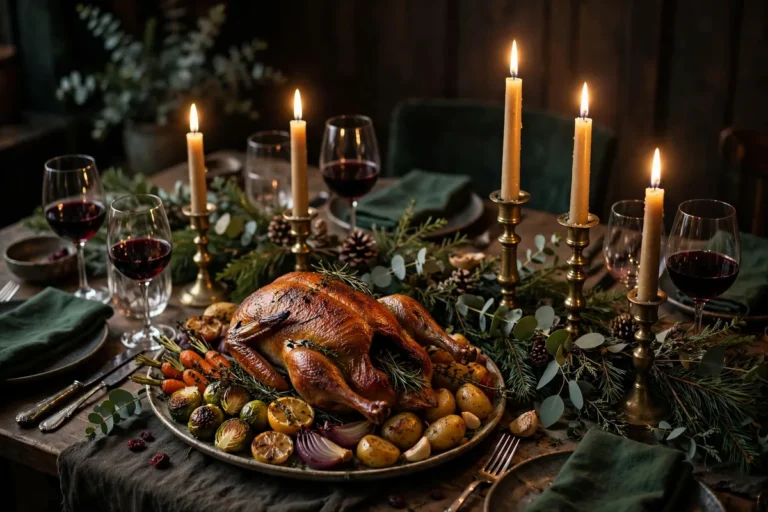
Both December 25 (Erster Weihnachtsfeiertag) and December 26 (Zweiter Weihnachtsfeiertag) are full public holidays in Germany. These are slow, family-centered days: the big festive meal — roast goose (Weihnachtsgans) with red cabbage and dumplings is the classic centerpiece — long afternoon walks (Weihnachtsspaziergang), board games, and visits to grandparents. Nothing is open, and that is entirely the point. The country collectively exhales.
For menu inspiration beyond the German table, our Christmas dinner ideas roundup collects festive mains from many traditions — useful if you are blending a German-style celebration with your own family’s favorites.
New Year’s Eve and Epiphany (December 31 – January 6)
The season does not end at Christmas. New Year’s Eve (Silvester) is a major celebration with fireworks, fondue or raclette dinners, and the traditional Bleigießen — pouring molten lead (now usually wax, for safety) into cold water and reading fortunes in the shapes. Then on January 6, Epiphany (Heilige Drei Könige), children dressed as the Three Kings go door to door singing and collecting for charity, marking the doors with blessed chalk: the year plus C+M+B (for Christus Mansionem Benedicat, “Christ bless this house”). In Catholic regions it is a public holiday, and only then do the trees finally come down.
Christkind vs. Weihnachtsmann: Who Brings the Gifts?
Ask a German child who brings the presents and the answer depends on where you ask. In the predominantly Catholic south and west, it is the Christkind — a radiant, golden-haired angelic figure representing the Christ Child, who arrives invisibly while the family waits in another room. In the Protestant north and east, it is the Weihnachtsmann, a fur-clad, Santa-like figure who more closely resembles the American Santa Claus.
The Christkind is the older tradition, introduced by Martin Luther himself in the 16th century as a Protestant alternative to St. Nicholas. Ironically, the Weihnachtsmann — popularized in the 19th century and later commercialized — has been gaining ground even in the south. Nuremberg’s famous Christmas market is still called the Christkindlesmarkt (“Christ Child market”), and each year a young woman is chosen to appear as the Christkind in a golden crown to open the market — a ceremony unchanged for generations.
German Christmas Foods: Beyond the Market Stalls
German Christmas cuisine is hearty, spiced, and built for cold weather. The centerpiece meal varies by family, but the canon is well established:
- Weihnachtsgans — roast goose with crispy skin, served with Rotkohl (braised red cabbage) and Knödel (potato or bread dumplings) and plenty of gravy. The undisputed king of the German Christmas table.
- Stollen — the dense, buttery fruit loaf dusted with powdered sugar, with Dresden’s Dresdner Stollen holding protected status. Families buy one from the bakery or bake their own in early December so it matures by Christmas.
- Lebkuchen — German gingerbread, from Nuremberg’s soft Elisenlebkuchen (made with nuts and almost no flour) to the decorated hearts sold at markets.
- Plätzchen — the universe of small Christmas cookies: Vanillekipferl (vanilla crescents), Zimtsterne (cinnamon stars), Spitzbuben (jam-filled), and dozens more. Baking Plätzchen with children on Advent weekends is a core family ritual.
- Glühwein and Feuerzangenbowle — mulled wine, and its theatrical cousin where a rum-soaked sugarloaf is set ablaze over the punch bowl.
We have a dedicated deep-dive into the full festive menu — from goose to Stollen — in our guide to the traditional German Christmas dinner.
Decorations: The Tree, the Pyramid, and the Crib
German Christmas decorating has its own vocabulary. The Tannenbaum is dressed with glass ornaments (Christbaumkugeln — the glass bauble was invented in Lauscha, Thuringia, in the 1840s), Lametta (tinsel), wooden ornaments, and often real wax candles clipped to the branches. A pickle-shaped ornament — the famous Weihnachtsgurke — hides in the branches in some families, though historians note the “German pickle tradition” is largely an American invention retroactively attributed to Germany.
Two decorations are distinctly German and worth knowing:
- The Christmas pyramid (Weihnachtspyramide) — a multi-tiered wooden carousel from the Erzgebirge mountains, with a propeller on top turned by candle heat, rotating nativity figures on each level. Large outdoor pyramids anchor many town squares.
- The Schwibbogen — an arched candle holder placed in windows, originating with Saxon miners whose lamps the arch shape echoes. Entire streets glow with them in December.
Nativity scenes (Krippen) are displayed in churches and many homes, and Advent wreaths hang on front doors. If you are decorating in the German style, our Christmas decoration ideas include natural, candlelit looks that pair beautifully with these traditions.
How to Celebrate a German-Style Christmas at Home
You do not need to be German to borrow the best parts of the season. Here is a practical way to layer German Christmas traditions into your own December:
- Start on the First Advent Sunday. Buy or make an Advent wreath with four candles and light one each Sunday. The ritual reframes December as a countdown rather than a shopping sprint.
- Do St. Nicholas Day. Put polished shoes outside the door on December 5 — children love it, and it spreads gift-giving across the month.
- Bake Plätzchen on an Advent weekend. Pick two or three cookie types, double the batches, and give tins to neighbors. This single habit captures the German spirit better than any decoration.
- Hold a market night at home. Make Glühwein, roast almonds, play brass-band carols, and eat bratwurst — a living-room Weihnachtsmarkt.
- Move the main celebration to Christmas Eve. Even shifting gift-opening to the evening of the 24th, by candlelight after a good meal, transforms the holiday’s energy.
- Take the Christmas walk. The Weihnachtsspaziergang on the 25th or 26th — a long, unhurried walk regardless of weather — is Germany’s simplest and most restorative tradition.
Germany’s southern neighbor keeps many parallel customs with its own Alpine flavor — see our guide to Christmas traditions in Austria for the Krampus runs and mountain-market traditions that complement this guide.
Regional Differences: How Christmas Varies Across Germany
Germany’s federal patchwork means Christmas traditions in Germany shift noticeably from state to state — and knowing the differences makes both travel and celebration richer.
- Bavaria leans Catholic and Alpine: elaborate Krippen (nativity scenes) carved from wood, the Christkind as gift-bringer, and mountain villages where Perchten — masked, bell-clanging figures — parade in early January to drive out winter spirits.
- Saxony is the craft heartland. The Erzgebirge (“Ore Mountains”) produces the nutcrackers, smoking men, and Christmas pyramids found in German homes everywhere; Dresden’s Striezelmarkt, running since 1434, is the city’s proud claim as Germany’s oldest Christmas market.
- Franconia and Nuremberg center on the Christkindlesmarkt, opened each year by a young woman crowned as the Christkind, and on Nürnberger Lebkuchen, the soft spiced gingerbread the city has baked for centuries.
- The Rhineland (Cologne, Düsseldorf) hosts some of Germany’s largest and most visited markets beneath the cathedral, with a more carnival atmosphere — and Reibekuchen (potato pancakes) competing with bratwurst as the essential market snack.
- Northern Germany is Protestant, maritime, and more restrained: the Weihnachtsmann brings gifts, decorations skew simpler, and coastal towns add touches like ships’ masts strung with lights in the harbor.
- Berlin, ever its own case, runs dozens of markets with distinct personalities — from the nostalgic lanes of the Gendarmenmarkt market to the Scandinavian-tinged Lucia market in the Kulturbrauerei.
Religious balance matters too: in Catholic-majority areas Epiphany (January 6) is a public holiday and the season visibly runs into January, while in Protestant regions the season winds down faster after New Year. Travelers planning a market trip should pick their region to match their taste — storybook medieval (Nuremberg, Rothenburg), grand cathedral city (Cologne, Dresden), or Alpine village (Garmisch, Oberammergau).
German Christmas Words Worth Knowing
A few phrases unlock the season, whether you are traveling or sending cards: Frohe Weihnachten (Merry Christmas), Fröhliche Weihnachten (the common variant), Besinnliche Feiertage (contemplative holidays — the most characteristically German wish), and Guten Rutsch ins neue Jahr (literally “a good slide into the new year,” i.e., Happy New Year). Cards often close with besinnlich — reflective, mindful — a word that captures the German Christmas mood better than any decoration.
In Pictures: Christmas in Germany
Germany is the heart of Christmas — the Christmas tree, the Advent calendar, and the world’s most famous Christmas markets all began here.
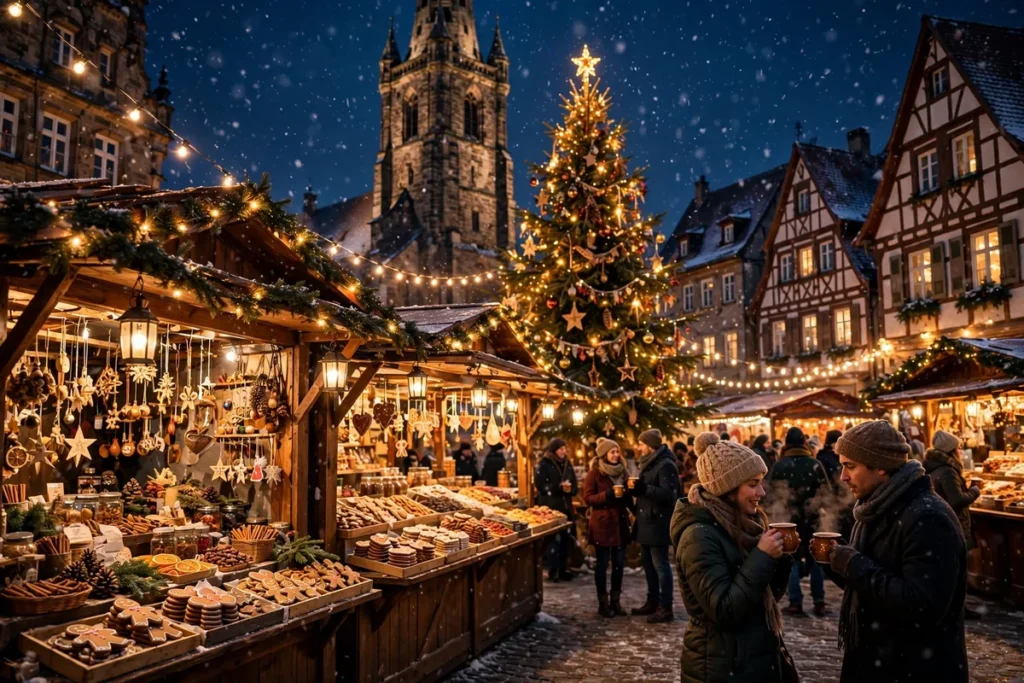
A German Christmas market at night: rows of glowing wooden stalls selling ornaments and gingerbread, a giant tree, and steaming mugs of Glühwein under falling snow.
Watch: Christmas in Germany
A tour of the Nuremberg Christkindlesmarkt — the Christkind’s opening prologue, Elisenlebkuchen, and the little city of wood and cloth in the old town.
At a Glance: Christmas in Germany
The traditions Germany gave to the world’s Christmas.
| Tradition | Date | Key detail |
|---|---|---|
| Advent | Four Sundays before Christmas | The Adventskranz wreath with four candles — one more lit each Sunday — plus the 24-window Advent calendar |
| Christkind vs. Weihnachtsmann | 24 December | In much of Germany the angelic Christkind (white gown, gold crown) brings the gifts on Christmas Eve, not Santa |
| St. Nicholas Day | 6 December | Children polish boots and leave them out; good ones wake to sweets, naughty ones to coal — or a visit from Krampus |
| The Christmas tree | 24 December | Germany gave the world the decorated Christmas tree — a custom recorded in the Rhineland since the 17th century |
| Stollen & Lebkuchen | December | Christstollen (fruit-studded sweet bread) and Lebkuchen gingerbread are the season’s signature bakes; Glühwein warms the markets |
| Christkindlesmarkt | Late Nov – 24 Dec | Nuremberg’s famous market; Dresden’s Striezelmarkt, running since 1434, is Germany’s oldest |
| Three Kings Day | 6 January | C+M+B (Caspar, Melchior, Balthazar) is chalked above doors with the blessing “Christus mansionem benedicat” |
Frequently Asked Questions
What is the most famous Christmas tradition in Germany?
The Christmas market (Weihnachtsmarkt) is Germany’s most famous export-tradition, with the Nuremberg Christkindlesmarkt and Dresden Striezelmarkt among the oldest and most visited in the world. At home, though, Germans would more likely name the Advent wreath, St. Nicholas Day shoe-filling, and the Christmas Eve Bescherung gift ceremony as the heart of the holiday.
Do Germans celebrate Christmas on December 24 or 25?
The main celebration is on December 24, Christmas Eve (Heiligabend), when families exchange gifts around the tree in the evening. December 25 and 26 are both public holidays reserved for festive meals and family visits — quieter, slower days rather than the main event.
Who brings Christmas gifts in Germany — Santa Claus?
It depends on the region. In southern and western Germany, the Christkind (an angelic Christ Child figure) brings the gifts; in the north and east, the Weihnachtsmann (a Santa-like figure) does. St. Nicholas fills children’s shoes separately on December 6.
What do Germans eat for Christmas dinner?
The classic centerpiece is roast goose (Weihnachtsgans) with red cabbage and dumplings, served on December 25 or 26. Christmas Eve dinner is traditionally simpler — potato salad with sausages or carp — though many families now serve a full meal. Sweets include Stollen, Lebkuchen, and homemade Plätzchen cookies.
When do German Christmas markets open in 2026?
Most major German Christmas markets open in the last week of November — typically around November 23–27 — and run until December 23 or Christmas Eve. Exact 2026 opening dates are announced by each city in autumn, so check the official tourism site of the city you plan to visit before booking travel.
Is “Silent Night” a German Christmas carol?
“Silent Night” (Stille Nacht) was written in Austria in 1818, but it is sung in German across the German-speaking world and is central to German Christmas Eve services. Germany’s own beloved carols include O Tannenbaum (“O Christmas Tree”) and Leise rieselt der Schnee.
German Christmas is not a single day but a season — four weeks of deliberate, candlelit anticipation that makes the celebration itself feel earned rather than rushed. Borrow the wreath, the markets, the Eve-centered celebration, or simply the long Christmas walk, and you will understand why the world keeps copying Germany every December. Frohe Weihnachten — and may your Advent be as unhurried, candlelit, and sweet with Plätzchen as a Bavarian evening.