

Looking for the best Black Friday home security camera deals 2026 means shopping one of the most consequential categories of the sale season — these are the eyes of your home, and the difference between a good system and a bad one is not just convenience but genuine safety. The market is crowded with options spanning battery-powered wire-free cameras, wired workhorses, video doorbells, indoor monitors and full multi-camera systems, each with different power needs, subscription models and privacy implications. This guide explains every type, the specifications that determine real-world effectiveness, and how to build a system that actually protects your home without drowning you in subscription fees or false alerts.
Black Friday 2026 is Friday, November 27, with Cyber Monday on November 30. Security camera deals start in late October and intensify through November — this is a category retailers discount aggressively because cameras are gateway products: once you buy one, you tend to buy more, plus the subscription. Expect the strongest pricing on multi-camera bundles and previous-generation models in Black Friday week. If you are planning a whole-home system, November is unambiguously the time to buy the hardware — but read the subscription section before the discounts make the decision for you.
We never claim a specific camera is on sale at a specific retailer. Instead: the complete buying framework — camera types compared, the specs that matter, placement strategy, subscription economics, privacy essentials, worldwide shopping guidance and discount verification. For the season overview, see our best Black Friday deals hub and Black Friday 2026 shopping guide.
Camera types compared: battery, wired, indoor and doorbell
Every security camera falls into a power-and-placement matrix. Understanding it prevents the most common buying error: purchasing cameras your home cannot support.
| Type | Power | Installation | Strengths | Weaknesses |
|---|---|---|---|---|
| Battery wire-free | Rechargeable battery | DIY, minutes | Place anywhere; renter-friendly | Charging chores; slower wake-up; subscription often needed |
| Wired (mains/PoE) | Continuous power | DIY or pro; cabling needed | 24/7 recording; fastest alerts; most reliable | Installation effort; less flexible placement |
| Indoor cameras | Plug-in | DIY, trivial | Cheap; pet/kid monitoring; package-room watch | Privacy considerations; limited deterrence |
| Video doorbells | Battery or wired | DIY, moderate | Front-door coverage + intercom in one | Narrow field of view; one location only |
| Floodlight cameras | Mains wired | DIY or electrician | Light + camera + siren deterrent combo | Needs existing wiring point |
Battery cameras: convenience with chores
Wire-free battery cameras are the bestsellers for a reason: mount one anywhere in minutes with no wiring. They are ideal for renters and for covering spots without power. The trade-offs are real, though. Batteries need recharging every few months (more often in cold weather or high-traffic areas), most use motion-triggered clips rather than continuous recording, and wake-up latency means the first second of an event can be missed. Solar panel accessories reduce the charging chore significantly and are worth buying with the camera. Treat battery cameras as flexible supplements, not the backbone of a serious system.
Wired cameras: the reliability backbone
Mains-powered or PoE (power-over-Ethernet) cameras record continuously, wake instantly, and never need charging. For the perimeter of an owned home — front, back, sides — wired is the professional choice and the most reliable. Installation is the hurdle: running cables through walls is either a weekend DIY project or an electrician’s visit. If you are renovating or building, run the cables now; it is the cheapest reliability you will ever buy. During Black Friday, multi-camera wired bundles offer the best per-camera value in the industry.
Indoor cameras: the honest conversation
Indoor cameras serve real purposes — checking on pets, kids arriving home, elderly relatives — but they are cameras inside your private spaces, so the privacy bar is higher. Buy from reputable brands with strong security track records, use unique passwords and two-factor authentication, consider models with physical privacy shutters, and have an explicit household conversation about where they point and who can view the feed. Never buy no-name indoor cameras; the savings are not worth the risk profile.
The specifications that determine real effectiveness
Resolution: 2K is the sweet spot
1080p is the minimum for identifying faces and license plates at close range; 2K (roughly 4MP) is the current sweet spot, capturing meaningfully more detail without the storage and bandwidth appetite of 4K. 4K cameras impress on paper but demand more from your WiFi, your storage and your wallet — and most of the benefit is lost on a phone screen. Prioritize 2K with good low-light performance over 4K with poor night vision.
Night vision: where cheap cameras fail
Most incidents happen in the dark, so night vision quality separates effective cameras from decorative ones. Infrared night vision renders black-and-white footage; color night vision (via large sensors or built-in spotlights) preserves detail like clothing color. Check independent sample footage, not marketing claims — and remember that floodlight cameras solve night vision by simply adding light. Position cameras to avoid pointing directly at bright lights, which blinds the sensor.
Field of view and placement geometry
A wide field of view (130°+) covers more area per camera but with less detail at distance; narrower views capture faces and plates better. Plan placement before buying: entry points first (front door, back door, ground-floor windows), then driveways and yards. Mount cameras 8–10 feet high — out of easy reach but low enough for facial detail — angled slightly downward. One well-placed camera beats three poorly placed ones.
Smart detection: the difference between security and noise
A camera that alerts you every time a cat crosses the yard will be muted within a week — and a muted camera protects nothing. Modern cameras use on-device or cloud AI to distinguish people, vehicles, packages and animals, and this detection quality is the single biggest real-world differentiator between models. Prioritize cameras with person detection at minimum; package detection matters if deliveries are frequent; vehicle detection suits driveway monitoring. Activity zones — masking off the public sidewalk so passing pedestrians do not trigger alerts — are essential in urban settings and should be non-negotiable in your requirements. Some advanced detection sits behind subscriptions, which brings us to the money question.
Two-way audio and deterrence features
Two-way talk lets you speak through the camera — warning off a porch pirate, telling a courier where to leave a parcel, or checking in with family. Sirens and spotlights on floodlight cameras add active deterrence. These features work best when response time is fast, which favors wired cameras and strong WiFi. Test the talk latency during the return window; a ten-second delay makes the feature useless.
Subscriptions: the true cost of camera ownership
This is the section that saves readers the most money. Most camera brands offer a free tier (typically live viewing and basic motion alerts) and paid plans unlocking cloud recording history, smart detection, and longer video retention. Before buying any discounted camera, map the subscription: what is free forever, what costs monthly, and whether features you assumed were included actually require payment. Then compute the three-year total: hardware plus subscription. A budget camera with a mandatory-feeling subscription frequently costs more over three years than a premium camera with generous free local storage.
Prefer cameras offering local storage (microSD slot or base-station storage) even if you also use cloud — local recording keeps working during internet outages and without any subscription. Some systems offer fully subscription-free operation with local storage; these deserve serious consideration despite higher upfront cost. And watch for the lock-in pattern: a cheap camera whose best features need the subscription is a pricing strategy, not a bargain. Black Friday hardware discounts are designed to make you forget this math — do not let them.
Storage options: cloud, local, or both
| Storage type | How it works | Pros | Cons |
|---|---|---|---|
| Cloud subscription | Clips uploaded to brand servers | Off-site safety; easy sharing; smart features | Monthly cost; needs internet; privacy trust |
| microSD local | Recording to card in the camera | No fees; works offline | Card can be stolen with camera; limited capacity |
| Base station / hub | Local storage in a hub indoors | No fees; thief cannot grab it easily | Higher upfront cost; brand-locked |
| Hybrid | Local plus cloud backup | Best of both; redundancy | Highest total cost |
For most homes, the pragmatic answer is local storage as the foundation with cloud as backup for critical cameras (front door). Whatever you choose, confirm the retention period: a system that overwrites after three days may miss the event you discover on day five.
Placement strategy: the room-by-room security audit
Before buying, walk your property and plan camera positions on paper. The priority order that security professionals recommend:
- Front door and porch: the most common entry point and the package zone. A video doorbell plus or minus a dedicated camera — see our Black Friday video doorbell guide for the doorbell deep-dive.
- Back door and patio: the second most targeted entry, often less visible from the street.
- Driveway and garage: vehicle protection and approach monitoring; vehicle detection earns its keep here.
- Ground-floor windows (sides): side passages are intruder favorites — out of street view.
- Interior (selective): main living area or hallway for pet checks and as a last layer — with the privacy conversation had first.
Mounting height of 8–10 feet, angled to capture faces rather than the tops of heads. Avoid pointing cameras directly into sunrise/sunset glare or at reflective surfaces. And check local regulations: in many jurisdictions, recording public spaces or neighbors’ property has legal limits — audio recording in particular is restricted in some regions. A quick check of local rules beats an awkward dispute later.
WiFi and power: the infrastructure cameras depend on
Cameras are only as reliable as the network beneath them. Outdoor cameras at the property’s edge often sit in WiFi dead zones — test signal strength at each planned mount point with your phone before buying, and budget for a network upgrade if needed (our Black Friday WiFi router guide is timely companion reading). Wired cameras sidestep this entirely, which is another point in their favor. For battery cameras, cold climates deserve special attention: lithium batteries lose capacity in freezing temperatures, shortening recharge intervals significantly — factor that chore into the decision, or choose wired for exposed positions.
Where to shop for security camera deals worldwide
In the US, Amazon, Best Buy, Walmart and Target all run camera promotions, with multi-camera bundles seeing the steepest cuts — see our Amazon Black Friday guide, Best Buy Black Friday guide, Walmart Black Friday guide and Target Black Friday guide. Manufacturer-direct stores bundle subscriptions (free months) that add real value. In the UK, Amazon UK, Currys and Argos lead; across Europe, MediaMarkt, Saturn, Fnac and Amazon’s national stores; in Australia, JB Hi-Fi, Officeworks and Bunnings. Wherever you shop, compare bundle contents carefully — “4-camera system” bundles vary in what’s included (mounts? solar panels? subscription trial?), and the headline price is meaningless without the inventory.
Verifying the discount
Camera pricing is heavily promotional year-round, making Black Friday claims hard to trust at face value. Use CamelCamelCamel and Keepa for Amazon price history — many cameras have a “sale” price that is simply the normal price with a strikethrough. Honey catches coupons at other retailers. Track bundle prices from October, since bundle compositions change and “new lower price” sometimes means fewer accessories. And always compute the subscription-inclusive three-year cost as your true comparison metric — it is the number the discount is trying to distract you from.
Nine mistakes to avoid when buying security cameras on Black Friday
- Ignoring the subscription math. Compute the three-year hardware-plus-subscription total before comparing. The cheapest camera is often the priciest system.
- Buying cameras your WiFi cannot support. Test signal strength at each mount point first. Dead-zone cameras are decorative.
- Choosing battery for 24/7 needs. Battery cameras do motion clips, not continuous recording. For always-on perimeter coverage, go wired.
- Skimping on night vision. Most incidents happen in darkness. Check real night sample footage, not marketing renders.
- Mounting too high or poorly angled. Above 10 feet you get hats, not faces. Angle for facial capture at entry points.
- Forgetting local laws. Audio recording and filming neighbors’ property are restricted in many regions. Check before installing.
- Buying no-name indoor cameras. Cameras inside your home demand reputable brands with real security practices. No exceptions.
- Disabling alerts out of annoyance. Tune activity zones and detection sensitivity instead of muting — a silenced camera protects nothing.
- Skipping the security basics. Unique password, two-factor authentication, firmware updates. A hacked camera is worse than no camera.
Privacy and security essentials
Security cameras create security responsibilities. Use a unique, strong password for the camera account — credential-stuffing attacks on reused passwords are the most common camera compromise. Enable two-factor authentication everywhere it is offered. Keep firmware updated; unpatched cameras are recruited into botnets. Consider a separate IoT WiFi network so cameras cannot reach your computers. For indoor cameras, use physical privacy shutters or scheduled off-times, and be transparent with everyone in the household about what is recorded and who can view it. And research each brand’s data practices: where footage is stored, how long it is retained, and whether it is shared with third parties or law enforcement without a warrant — policies differ enormously, and this is part of what you are buying.
Weather ratings: IP codes explained
Outdoor cameras live in rain, dust, heat and frost — the IP (Ingress Protection) rating tells you how well they survive it. Look for IP65 or higher for exposed outdoor mounting: the “6” means dust-tight, the “5” means it withstands water jets from any direction. IP66 and IP67 go further, surviving powerful jets and temporary immersion. Operating temperature range matters equally — check the low end if you get hard freezes, since batteries and lubricants suffer in extreme cold. Do not mount an indoor-rated camera under an eave and hope for the best; humidity kills electronics slowly, and warranty claims on misused indoor cameras are routinely denied. When a Black Friday bundle mixes indoor and outdoor cameras, confirm the rating of each unit — not just the headline model.
The deterrence factor: visibility, lights and signage
Here is something the spec sheets never mention: a visible camera prevents more incidents than a hidden one records. Security research consistently shows that visible cameras, motion-triggered lights and signage deter opportunistic intruders — which is most of them. Mount cameras where they are clearly visible from approach paths, pair them with motion lighting (floodlight cameras do both jobs), and consider the classic security sign. The goal is for a would-be intruder to choose a different house before anything happens. This also argues against hiding cameras: concealment helps only if you specifically need evidence of someone who was not deterred. For most homes, obvious, well-lit coverage is the winning strategy — and it is free.
The first-week test drill
Once installed, test like an intruder: walk every approach path day and night, trigger each camera, check alert speed on your phone, review the recorded clips for facial clarity, and confirm activity zones are masking correctly. Fix gaps now — during the return window — not after an incident reveals them.
Frequently asked questions about Black Friday security camera deals
When do Black Friday home security camera deals start in 2026?
Camera discounts typically begin in late October and build through November, with the strongest bundle pricing in Black Friday week — Black Friday is November 27, 2026, Cyber Monday November 30. Multi-camera systems see the deepest cuts; buy the hardware in November but decide on subscriptions with a cool head.
Do security cameras need a subscription?
Not necessarily — but check before buying. Many cameras offer free live viewing and basic alerts, charging for cloud recording history and smart detection. Cameras with local storage (microSD or hub) can operate subscription-free. Always map the free-vs-paid split and compute the multi-year total before choosing.
Are battery-powered cameras reliable enough?
For flexible, renter-friendly coverage — yes, with caveats: expect motion-triggered clips rather than continuous recording, periodic recharging (worse in cold weather), and slight wake-up latency. For 24/7 perimeter reliability, wired cameras remain the professional standard. Solar accessories meaningfully reduce the charging chore.
How many cameras does a home need?
Most homes are well covered by three to five: front door/porch, back door/patio, driveway/garage, and one or two covering side approaches or ground-floor windows. Start with entry points and expand based on real blind spots, not anxiety. One well-placed camera outperforms three poorly placed ones.
Can security cameras work without WiFi?
Wire-free battery cameras need WiFi for alerts and cloud features, though some record locally to SD cards during outages. Fully offline systems exist (local NVR/DVR with wired cameras) for those wanting zero cloud dependence — they cost more upfront but have no subscriptions and keep working through internet outages.
Is it legal to record my neighbors or the street?
It depends on your jurisdiction. Many places allow filming your own property including incidental public areas, but audio recording faces stricter rules in numerous regions, and some jurisdictions limit recording neighbors’ property. Check local laws before installing, use activity zones to minimize capturing others’ property, and when in doubt, consult local guidance.
Conclusion: plan the system, verify the total cost, buy in November
The best Black Friday home security camera deals 2026 reward systematic shoppers: audit your property, prioritize entry points, choose wired where reliability matters and battery where flexibility matters, and — above all — compute the subscription-inclusive total cost before the hardware discount makes the decision for you. Verify prices against history, secure the system properly from day one, and respect both household privacy and local law. Done right, a November camera system is years of genuine peace of mind.
Complete your home security with our Black Friday video doorbell guide and our Black Friday smart home guide — and keep our best Black Friday deals hub bookmarked for standouts across every category.
In Pictures: Black Friday Home Security Camera Deals 2026
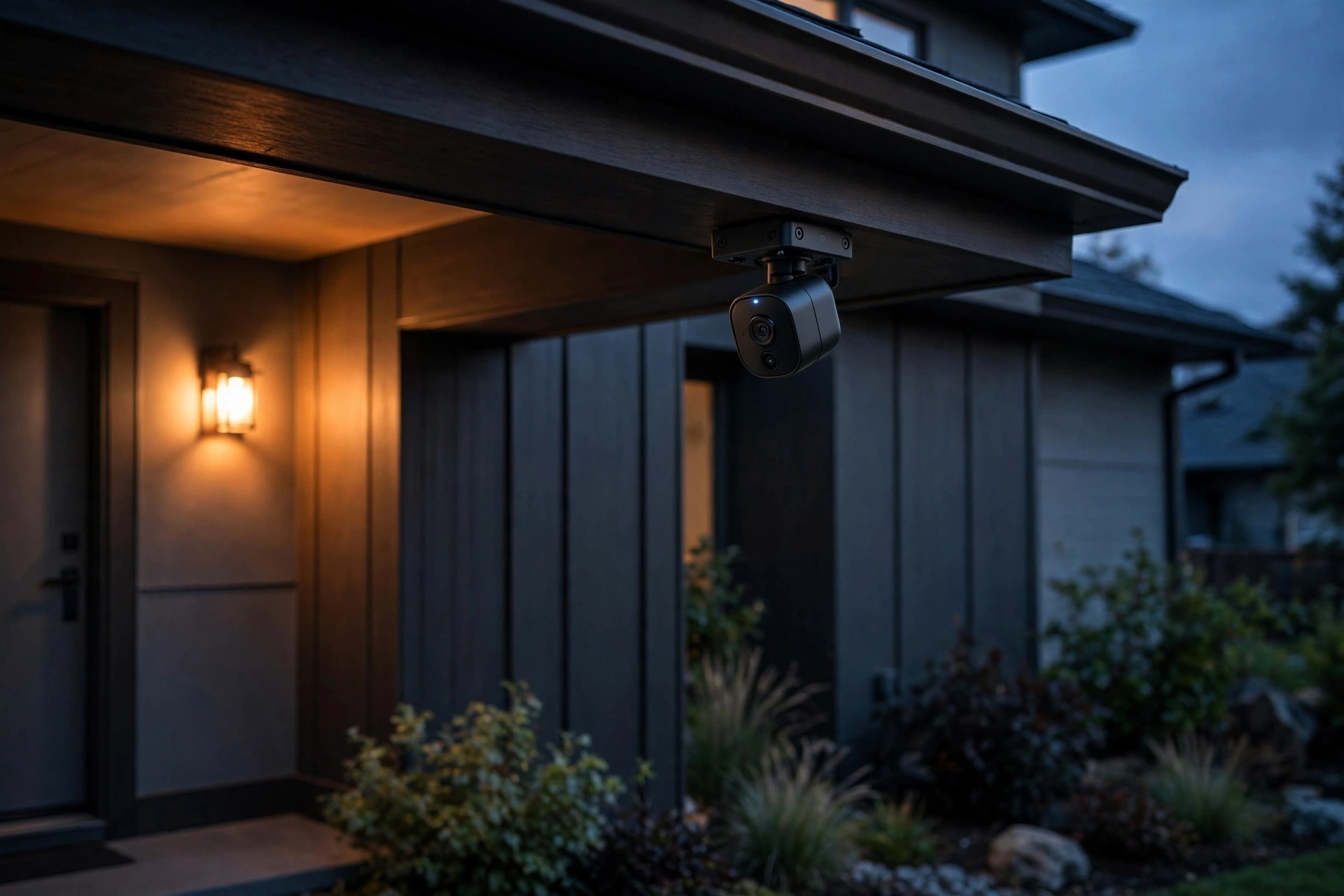
The best security camera deal is the one with no monthly fee attached — local storage is the quiet hero of Black Friday. Watching the porch, even at dusk.

A home's front porch at dusk, a wall-mounted security camera watching over a delivered package in warm porch light. Placement beats resolution — a well-placed 2K camera outperforms a badly placed 4K one every night of the week.
Watch: Black Friday Home Security Camera Deals 2026
The five best home security cameras of 2026 tested head-to-head — EufyCam 3, Google Nest Cam, Wyze Cam v4, Arlo Essential and Ring — on real-world value, subscriptions and which one is actually worth your money.
At a Glance: Black Friday Home Security Camera Deals 2026
Types, specs, subscriptions and the placement audit.
| What to check | What to expect | Why it matters |
|---|---|---|
| Battery vs wired | Battery is easier to place; wired never needs charging | High-traffic spots drain batteries fast — wired wins for front doors, battery for outbuildings |
| Resolution | 2K is the practical standard; 4K helps identify faces at distance | Above 2K, placement and lighting matter more than pixels |
| Smart detection | Person/vehicle/package detection separates security from noise | Dumb motion alerts train you to ignore the app — detection quality is the real feature |
| Subscription cost | Many brands charge monthly for video history and smart features | Two years of fees can double the 'deal' price — local-storage models (eufy, Reolink, Tapo) skip the fee |
| Night vision | Colour night vision is now common even at budget prices | Check night footage specifically — it's where cheap cameras fall apart |
| Ecosystem | Match Alexa, Google Home or HomeKit to your household | A camera that won't talk to your smart home is a second app you'll stop opening |
| Electronics peak discount (Adobe, 2025 season) | 30.9% measured peak — security cameras and multi-packs historically see 25–40% off, with bundle kits the best value | |


