If you are hunting for the best Black Friday headphone deals 2026, you have picked one of the smartest categories to shop during the year’s biggest sale. Headphones are discounted more consistently and more deeply than almost any other consumer electronics category, because the market is fiercely competitive: dozens of major brands fight for the same shelf space, and new flagship models arrive every autumn, pushing last season’s excellent hardware into deep discount territory. Whether you want noise-cancelling over-ears for a long-haul flight, a reliable pair of work-from-home cans, or a budget set that simply sounds great, Black Friday 2026 is the moment to buy.
This guide is built to help you shop with confidence rather than impulse. You will learn how the three main headphone types compare, which features are actually worth paying for, how the budget, mid-range and premium tiers differ, and how to tell a genuine discount from a manufactured one. You will also get a practical shopping strategy: when the sales actually start, which retailers to watch worldwide, and how to track prices like a professional deal hunter. Black Friday 2026 falls on Friday, November 27, but the best headphone deals often appear weeks earlier and continue through Cyber Monday on November 30.
A note on how this guide works: we never invent prices, discount percentages, or claim specific models are on sale. Deals change by the hour and vary by country, so instead of fake “was/now” tables we teach you how to verify any deal yourself in under two minutes. That skill is worth more than any single price listing, and it works every Black Friday from now on. If you are shopping the wider electronics sale, our best Black Friday deals hub and the complete Black Friday 2026 guide round up every category in one place.
Why Headphones Are a Star Category on Black Friday
Not every product category gets meaningfully cheaper on Black Friday. Some are barely discounted at all, with retailers relying on hype rather than real savings. Headphones are different. Year after year, personal audio sits at the very top of the genuinely discounted categories, and there are solid structural reasons for that.
First, competition is brutal. The headphone market has no single dominant player in the way smartphones do. Sony, Bose, Apple, Sennheiser, JBL, Audio-Technica, Beats, Jabra, Anker and a dozen others all compete across every price tier. When that many brands chase the same shoppers during the same four weeks, aggressive pricing is the only weapon that works. Retailers amplify this by using flagship headphones as “halo deals” — headline discounts designed to pull you into the store, where you will hopefully fill the rest of your basket.
Second, the product cycle works in your favor. Premium headphones typically get refreshed every two to three years, and the refreshes land in late summer or early autumn — just before Black Friday. That means the previous generation, which is usually 90 percent as good as the new one, gets heavily discounted to clear stock. A flagship that launched eighteen months ago is not outdated; it is simply last year’s model of an excellent product, and Black Friday is when retailers need it gone.
Third, headphones are compact, high-margin, and easy to ship, which makes them ideal for online doorbusters. They do not require installation, they rarely need technical support, and return rates are low compared to complex electronics. Retailers love selling them, and that enthusiasm shows up in the pricing. Add in the gift factor — headphones are one of the most gifted electronics items at Christmas, so November is when retailers stock up and compete hardest — and you have a perfect storm of genuine savings.
Over-Ear vs On-Ear vs In-Ear: Which Type Suits You?
Before you look at a single deal, decide which form factor fits your life. This one decision eliminates roughly two-thirds of the options and stops you from buying an excellent product that is wrong for you. Each type has real strengths and real compromises.
Over-Ear Headphones
Over-ear headphones have large earcups that fully enclose your ears, creating a seal that passively blocks outside noise even before any electronics get involved. They are the comfort kings: because nothing presses directly on your ears, they are the easiest type to wear for eight hours straight, which makes them the default choice for office work, long flights, and focused listening sessions at home. Sound quality also tends to be the best in this category, because the large drivers and spacious earcups give engineers room to tune rich, full audio.
The trade-offs are size and heat. Over-ears are bulky — they need a case and a bag — and in warm weather the sealed earcups can get sweaty during a commute. They are also the type where premium noise cancellation shines most, and that premium tier is where Black Friday discounts are often deepest in absolute terms. If your primary use is at a desk, on a plane, or at home, start your search here. Commuters who carry light bags or exercise while listening should look at the next category.
On-Ear Headphones
On-ear headphones rest on your ears rather than enclosing them. They are lighter and more portable than over-ears, folding flatter for a bag, and they keep you slightly more aware of your surroundings, which some commuters and city walkers actually prefer. They sit in an interesting middle ground: more comfortable than earbuds for long sessions, more portable than over-ears.
The compromise is pressure. Because the earcups press directly on your ears, some people find them uncomfortable after a couple of hours, and the looser seal means both less passive noise isolation and more sound leakage — your seatmate on a quiet train may hear your music. On-ear models are a shrinking category as true wireless earbuds have eaten their lunch, which paradoxically makes them a Black Friday bargain: retailers discount them aggressively to move stock, and you can find genuinely good pairs at entry-level prices.
In-Ear and True Wireless Earbuds
True wireless earbuds have become the default headphone for most people, and Black Friday reflects that — the sheer volume of earbud deals dwarfs everything else. Their advantages are obvious: pocketable, great for exercise, no wires, and increasingly excellent noise cancellation in flagship models. If you want one pair of headphones for commuting, the gym, and calls, this is almost certainly your category.
The compromises are battery life per charge (a few hours versus dozens for over-ears, though the case extends this), a fit that varies wildly between ear shapes, and the ever-present risk of losing a tiny earbud. Sound quality at the top end is now genuinely close to over-ears, but you pay a premium for it. We have a dedicated guide to the best Black Friday wireless earbuds deals 2026 if this is your category — it goes deep on fit, ANC performance, and codec support.
Features That Actually Matter (and Marketing Terms to Ignore)
Headphone marketing is dense with jargon designed to make every model sound revolutionary. Here is what genuinely affects your daily experience, and what you can safely ignore when comparing deals.
Active Noise Cancellation (ANC)
ANC uses microphones to sample ambient noise and generate an opposite sound wave that cancels it out. It is transformative for low, constant sounds — airplane engines, air conditioners, train rumble — and it is the single most important feature for frequent travelers and open-office workers. The gap between the best ANC and mediocre ANC is enormous, much larger than the gap in raw sound quality between tiers. If you fly more than a few times a year or work in a noisy environment, prioritize ANC quality over everything else, and Black Friday is the one time premium ANC becomes affordable.
Be aware of the terminology trap: “noise isolation” is passive (the physical seal), “noise cancellation” is active (the electronics). A product advertised with “noise reduction” may have neither — read the spec sheet, not the headline. Also note that ANC quality cannot be judged from specs; it is the area where professional reviews matter most, so check two or three trusted reviews before committing.
Sound Quality: Drivers, Codecs, and Tuning
Driver size gets the marketing attention, but tuning — how the manufacturer balances bass, mids, and treble — matters far more than the millimeter count. A well-tuned 40mm driver beats a poorly tuned 50mm one every time. For wireless headphones, the Bluetooth codec determines how much quality survives the wireless hop: standard SBC is the baseline, AAC is better on Apple devices, and aptX variants and LDAC preserve more detail on supported Android devices. If you are an Android user with a large lossless music library, LDAC or aptX Adaptive support is worth seeking out. If you mostly stream compressed audio on Spotify or YouTube, any modern codec is fine and you should not pay extra for alphabet soup.
Battery Life and Charging
For over-ears, anything above 30 hours with ANC on is excellent and anything above 40 is outstanding; most people charge weekly at that point. For earbuds, look at both the per-charge figure (5–8 hours is typical, more is better) and the total with the charging case (24+ hours is the modern standard). Fast charging — often marketed as “10 minutes gives 5 hours” — is genuinely useful in real life and worth a small premium. Multipoint connection, which keeps the headphones paired to your laptop and phone simultaneously, is one of those features you do not appreciate until you have it; it is common in mid-range and premium models and a good tiebreaker between two similar deals.
Comfort, Build, and the Details That Decide
Comfort is personal and cannot be fully judged online, but the signals are clamping force, earcup depth, weight, and materials. Shallow earcups that let the driver touch your ears will annoy you within an hour; check reviews specifically for comfort mentions if you wear glasses, since temple arms change the fit equation. For build, look for metal or reinforced hinges on folding models — the hinge is the most common failure point on over-ears. Water resistance (IPX ratings) matters for earbuds used in workouts; over-ears rarely need it. Finally, check the app: modern headphones are tuned and updated through a companion app, and a good app with a real equalizer lets you fix tuning you dislike, while a bad app can make great hardware frustrating.
Budget vs Mid-Range vs Premium: Where the Value Lives
Headphones fall into three broad tiers, and Black Friday reshuffles the value equation within each. Understanding the tiers stops you from overpaying for features you will not use — or underbuying and replacing a cheap pair twice.
| Tier | Typical strengths | Typical compromises | Best for |
|---|---|---|---|
| Budget | Surprisingly good sound, long battery, low financial risk | Basic or no ANC, plasticky build, average microphones | Students, gym use, kids, backup pairs |
| Mid-range | Strong ANC, good comfort, multipoint, solid apps | Not the absolute best noise cancelling or materials | Commuters, remote workers, most buyers |
| Premium | Class-leading ANC, refined tuning, premium materials | High cost even on sale; diminishing returns | Frequent flyers, audiophiles, professionals |
The budget tier has improved dramatically in recent years. Established value brands now deliver sound quality that would have cost three times as much five years ago, and battery life is often better than premium models because there is no power-hungry ANC to feed. Where budget models still lag is noise cancellation — it exists on paper but is usually weak — and microphone quality for calls. If your use is mostly music and podcasts in quiet-ish places, a budget pair bought on Black Friday is one of the best value purchases in all of consumer tech.
The mid-range is the sweet spot for most people and the tier where Black Friday creates the most interesting decisions. Mid-range models frequently inherit last year’s premium features, and Black Friday often pushes premium models down into mid-range pricing, which blurs the line. Our rule of thumb: if a premium flagship from one or two generations ago is discounted into your mid-range budget, take the older flagship. It will have better ANC, better build, and better long-term support than a current mid-range model at the same price.
The premium tier is for people who know exactly why they need it: weekly flyers, audio professionals, and anyone who has tried great ANC and cannot go back. The discounts here are real but proportionally smaller, and you should be extra careful about verifying the deal (more on that below) because inflated “was” prices are most common at the top end. Never buy premium at launch in November — wait for the Black Friday pricing, which is typically the lowest of the year for flagships.
When to Buy: The 2026 Headphone Deal Timeline
Black Friday 2026 is Friday, November 27, but treating it as a single day is the fastest way to overpay or miss out. Headphone deals follow a predictable four-phase timeline, and knowing which phase you are in changes your strategy.
Phase 1 — Early deals (late October to mid-November). Retailers now launch “Black Friday preview” sales weeks ahead of the event. For headphones, these early deals are genuinely good, not teasers: retailers use popular audio products to build momentum, and stock is plentiful. If you see a model on your shortlist discounted in early November and the price matches or beats its historical low, buy it — waiting rarely improves headphone prices and often just costs you the color or model you wanted.
Phase 2 — Black Friday week (November 23–27). This is the main event. The deepest headline discounts land here, including doorbusters on flagship over-ears and aggressive bundle offers. The catch is stock: the best deals on the most popular models can sell out within hours on Friday morning. Have your shortlist ready, know your target price (verified against price history, not the retailer’s claimed “was” price), and be prepared to buy early in the week rather than gambling on Friday itself.
Phase 3 — Cyber Monday (November 30). Online-focused and strong for headphones, especially earbuds and value brands that sell primarily through marketplaces. Prices are often identical to Black Friday week — Cyber Monday is more of a second chance than a second sale. If you missed a deal on Friday, check again Monday morning before assuming it is gone.
Phase 4 — The aftermath (early December). Leftover stock gets cleared, and you will see some excellent prices on less popular colors and configurations. But the flagship models everyone wanted are usually gone or back at full price. Do not plan your main purchase for this phase; treat it as a bonus round.
Where to Shop: Retailers Worth Watching Worldwide
We never claim a specific retailer has a specific deal — inventory and pricing move too fast, and they differ by country. Instead, here is how to think about where to look, wherever you live.
In the United States, the big generalists — Amazon, Best Buy, Walmart, and Target — drive headphone pricing, and they aggressively match each other, which is good for you. Manufacturer stores (Sony, Bose, Apple, and others) run their own Black Friday sales that sometimes beat retailers, especially on bundles and previous-generation flagships, and they usually offer longer return windows. Do not overlook warehouse clubs if you are a member; their headphone prices are quietly among the best and rarely advertised.
In the United Kingdom, Currys and Argos anchor the market, with Amazon UK and John Lewis competing hard on premium audio. In continental Europe, MediaMarkt and Saturn (Germany and neighbors), Fnac and Boulanger (France), and Amazon’s country stores set the pace. In Australia, JB Hi-Fi is the traditional Black Friday audio battleground, with Kogan and Amazon AU undercutting on value brands. In Canada, Best Buy Canada and Amazon Canada lead, with Costco Canada strong for bundles. Wherever you are, check the manufacturer’s local store too — regional pricing quirks mean the brand’s own site sometimes wins.
One worldwide tip: marketplace sellers on large platforms can offer tempting prices, but for headphones, buy from the retailer itself or a clearly authorized seller. Counterfeit premium headphones are a real and growing problem, and Black Friday’s urgency is exactly what counterfeiters exploit. If a flagship is dramatically cheaper from an unknown third-party seller than everywhere else, that is not a deal — it is a warning. Our Amazon Black Friday 2026 guide and Best Buy Black Friday 2026 guide cover retailer-specific tactics in more depth.
How to Spot a Fake Discount in Two Minutes
The uncomfortable truth about Black Friday is that some “deals” are manufactured. A retailer raises the reference price in October, then “discounts” it back to the normal price in November. Headphones are a frequent target because the category has high list prices and wide margins. Here is how to protect yourself.
First, check the price history. Tools like CamelCamelCamel and Keepa show Amazon’s historical pricing as a chart — if the “deal” price matches what the product sold for all summer, it is not a deal. The Honey browser extension and similar tools do the same across more retailers. This single step takes two minutes and eliminates the vast majority of fake discounts. Make it a habit for every purchase over a trivial amount.
Second, be suspicious of unfamiliar model numbers. Some brands produce “derivative” models — exclusive variants made for big retailers that look like the flagship but cut key features (weaker ANC, cheaper drivers, no multipoint). They exist so the retailer can advertise a dramatic discount against a comparison price that was never real. If you cannot find professional reviews of the exact model number, walk away. Buy the standard model that reviewers actually tested.
Third, compare the “was” price against other retailers, not just the one advertising the deal. If four stores sell a headphone at the same price year-round and one store claims that price is a 40 percent discount, the claim is fiction. Real deals show up as genuinely lower than the prevailing market price across multiple sellers. Finally, watch for bundle inflation: a “free” case or stand bundled with the headphones is only valuable if you would have bought it anyway — do not let a cheap accessory justify a mediocre headphone price.
Mistakes to Avoid When Buying Headphones on Black Friday
Buying for the discount instead of the use case. A 50 percent discount on over-ears is worthless if you needed gym earbuds. Write down your primary use case before you browse, and filter every deal through it.
Ignoring the return policy. Fit and comfort are personal, and you cannot fully evaluate headphones in a store demo. Only buy from retailers with a generous return window — ideally through January, which many offer over the holidays — so you can live with the headphones for a week and return them if the fit is wrong.
Overlooking refurbished and open-box. Manufacturer-refurbished premium headphones, sold with a full warranty, are often available during Black Friday at prices that beat new mid-range models. If the warranty is the real manufacturer warranty (not a third-party one), refurbished flagships are one of the smartest buys in audio.
Forgetting about codec and device compatibility. That LDAC-supporting flagship is wasted on an iPhone, which does not support LDAC. Match the headphone’s strengths to your actual devices: AAC optimization for Apple users, LDAC/aptX for Android, low-latency modes for gaming and video.
Waiting for a better price that never comes. Analysis paralysis is the silent budget killer of Black Friday. If a headphone on your researched shortlist hits its historical low in early November, buy it. The few dollars you might save by waiting until Friday are not worth the risk of stock running out — and many retailers will refund the difference if the price drops further within the return window anyway.
In Pictures: Black Friday Headphone Deals 2026
Over-ear headphones are one of Black Friday's most predictable performers — here is what a genuinely good deal looks like up close, before the sale banners go up.
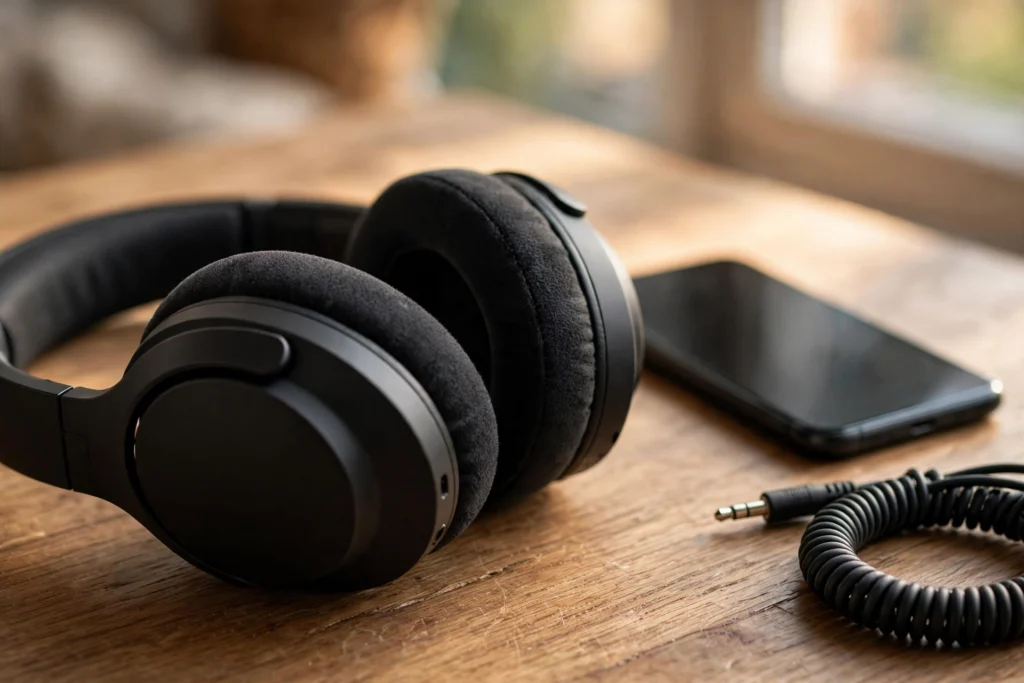
A pair of matte-black over-ear wireless headphones on a wooden desk, plush ear cushions and a coiled cable in frame. When the discounts land, comfort and battery life matter far more than brand badges — check the spec sheet, not just the strikethrough price.
Watch: Black Friday Headphone Deals 2026
Crutchfield's headphone specialist walks through the most comfortable over-ear models of 2026, from the Sony WH-1000XM6 to the Bose QuietComfort Ultra — useful context to have before prices start moving.
At a Glance: Black Friday Headphone Deals 2026
What the discount data says about headphone season, and the specs worth checking before you buy.
| What to check | What to expect | Why it matters |
|---|---|---|
| Electronics peak discount (Adobe, 2025 season) | 30.9% — the measured peak across US retail sites | Headphones sit inside the electronics category, so this is your benchmark for a 'real' deal |
| Flagship noise-cancelling models | Often 20–30% off list in recent years | The biggest brands discount least; a $100+ drop is usually the signal |
| Mid-range wireless models | Frequently 25–40% off | This tier historically offers the best price-to-performance on Black Friday |
| Budget over-ears | Often 30–50% off advertised prices | Verify against a price tracker first — list prices are frequently inflated before the sale |
| Battery life claims | Flagships typically claim 30–40 hours per charge | Manufacturer claims are usually optimistic; real-world use with ANC on runs lower |
| Bluetooth version | 5.3 or newer is the current mainstream | Older 5.0/5.2 models are still fine, but should be priced accordingly |
| Return window check | Best Buy's standard window is 15 days; holiday purchases usually earn an extended January deadline | Confirm the current year's dates at checkout — activatable devices often keep a shorter 14-day window |
Frequently Asked Questions
When do Black Friday headphone deals start in 2026?
Early headphone deals typically appear from late October, with the main wave landing during Black Friday week (November 23–27). Black Friday itself is November 27, 2026, and deals continue through Cyber Monday on November 30. For popular flagship models, the best strategy is to buy when your shortlisted model first hits its historical low — waiting for Friday itself risks stockouts rather than better prices.
Are Black Friday headphone deals actually good, or are prices inflated first?
Headphone discounts are among the most genuine in all of Black Friday, but inflated reference prices do exist, especially on premium models. Protect yourself by checking the price history on CamelCamelCamel or Keepa before buying, and compare the sale price against at least two other retailers. If the “deal” price matches the everyday price from the past few months, it is not a deal.
Should I buy last year’s flagship or this year’s mid-range model?
Almost always, buy last year’s flagship when it is discounted into mid-range pricing. A previous-generation premium headphone typically has better noise cancellation, better build quality, and longer software support than a current mid-range model at the same price. The main thing you give up is the newest features, which are usually incremental in audio.
How much should I spend on Black Friday headphones?
It depends entirely on your use case. For casual listening, a discounted budget pair delivers remarkable value. For commuting or office work, the mid-range is the sweet spot — this is where you get genuinely good ANC without premium pricing. Only go premium if you fly frequently, work in very noisy environments, or are particular about sound. Set your budget before you browse, and do not let a bigger discount tempt you into a higher tier you did not need.
Is it safe to buy headphones from marketplace sellers on Black Friday?
Stick to the retailer itself or clearly authorized sellers. Counterfeit premium headphones are common, and Black Friday urgency is exactly what counterfeiters exploit. If a flagship is dramatically cheaper from an unknown third-party seller than everywhere else, treat it as a warning sign, not a bargain. Check seller ratings and return policies carefully.
Do I need to worry about Black Friday-specific “derivative” models?
Yes — this is one of the most common traps. Some brands make retailer-exclusive variants that resemble flagships but cut key features like ANC quality or multipoint connection, allowing dramatic advertised discounts. Always verify the exact model number against professional reviews. If reviewers never tested that specific variant, buy the standard model instead.
Conclusion: Buy the Right Headphones, Not Just the Cheapest
The best Black Friday headphone deals 2026 are not the ones with the biggest percentage off — they are the ones that put the right headphones on your head at the lowest price of the year. Decide your form factor first, prioritize the features that match your daily life (ANC for travelers, fit and water resistance for exercisers, comfort for desk workers), set a budget tied to a tier rather than a specific model, and verify every deal against price history before you click buy.
Start watching prices in late October, keep a shortlist of two or three models per use case, and be ready to act when one hits its historical low — whether that happens on November 5 or November 27. And remember that headphones are just one part of the sale: pair your audio upgrade with our Black Friday TV deals guide for a full home entertainment refresh, or browse the wireless earbuds deals guide if you decide portability matters more than over-ear comfort. Happy listening — and happy saving.