Ask any kid about their favorite Halloween party memory and they will not mention the decorations. They will tell you about the game — the mummy race they won, the pumpkin they decorated, the treasure hunt that felt like a real adventure. Games are the heartbeat of a kids’ Halloween party, and the right ones turn twenty sugar-fueled children from chaos into pure, shrieking joy.
This guide delivers 25 Halloween games for kids’ parties with complete, parent-tested instructions — classics with a spooky twist, high-energy outdoor games, calm crafty games, toddler-safe options, and tween-approved challenges. You will find a party-length game schedule, a game-picker table by age and energy, prize strategies, tips for managing meltdowns, and a video packed with family game ideas. Every game includes what you need, how to play, and how to adapt it — because the only thing worse than a bored kid at a party is a host without a plan.
The Rules of Fun: What Makes Kids’ Games Work
Kids’ games succeed or fail on five principles. Explain in 30 seconds: if the rules take longer than half a minute, simplify. Demonstrate rather than describe — kids learn by watching one round. Everyone plays, no one waits: elimination games are out (nobody wants to watch for twenty minutes); use points, teams, or rapid rounds so losers immediately rejoin. Short and sweet: ten to fifteen minutes per game is the max; quit while they are begging for more, not after they wander off.
Winning is optional, fun is mandatory: for under-sevens, consider cooperative games or “everyone wins” formats — the goal is joy, not ranking. For older kids, friendly competition is thrilling, but keep prizes small and participation rewards universal so no one leaves empty-handed. Match energy to the moment: active games when they arrive with wiggles, calm games after food, and a gentle wind-down game at the end. Fighting the energy curve is how parties derail; riding it is how they soar.
The Halloween theme supercharges every game on this list. “Hot potato” is fine; “Pass the Pumpkin” with spooky music is an event. Musical chairs is classic; “Musical Tombstones” with kids freezing like statues is unforgettable. Lean into the theme hard — it costs nothing and multiplies the fun. For the broader party framework, our Halloween party ideas for kids guide covers themes, timelines, and food that pair with these games.
Classic Games with a Halloween Twist
Do not reinvent the wheel — just paint it orange. These beloved classics need only a spooky reskin to feel brand new.
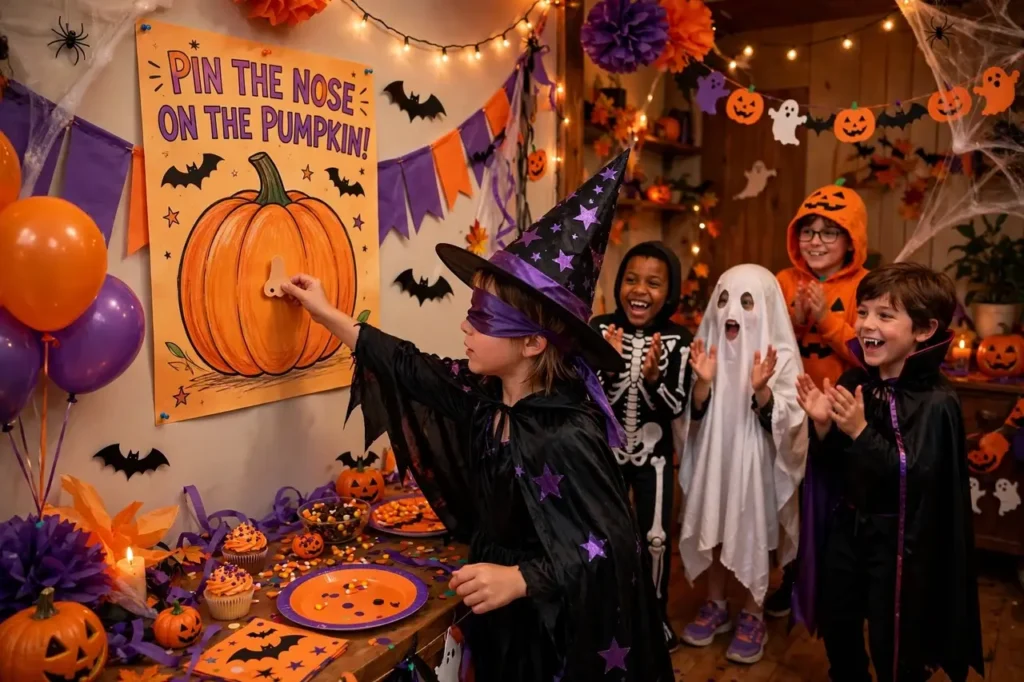
Pin the Nose on the Pumpkin
The birthday-party staple, Halloween-ified. Draw or print a large jack-o’-lantern face (minus the nose), blindfold each child, spin gently, and let them stick a paper triangle nose. Closest wins. For under-fives, skip the blindfold or use a sheer scarf — full blindness frustrates littles. Cost: poster board + paper, under $3. This game has survived decades because it delivers: anticipation, silliness, and a wall of gloriously misplaced noses.
Pass the Pumpkin (Hot Potato)
Kids sit in a circle passing a mini pumpkin while Halloween music plays. When the music stops, the holder is “out” — or, better for young kids, performs a silly forfeit (ghost dance, witch cackle) and stays in. Removing elimination keeps everyone playing to the end. Use a soft plush pumpkin for indoor play. The music is half the fun — build suspense with dramatic pauses.
Musical Tombstones
Musical chairs with foam tombstones (or paper ghosts) on the floor instead of chairs. When the music stops, kids freeze on a tombstone — one is removed each round. For non-elimination play, the child without a tombstone does a “monster mash” dance break and rejoins. Cardboard tombstones from craft stores cost about $1 each and double as decor.
Duck-Duck-Ghost
Duck-duck-goose, but the “goose” is a “ghost” who chases while moaning spookily. The ghost framing makes the chase deliciously dramatic — kids ham it up enormously. Play outdoors or in a large cleared space; establish boundaries before starting. This is the rare game that works for ages 3 to 10 with zero modification.
Active & Outdoor Games
Burn the wiggles. These high-energy games are perfect for the first half of the party, especially outdoors.
Mummy Wrap Race
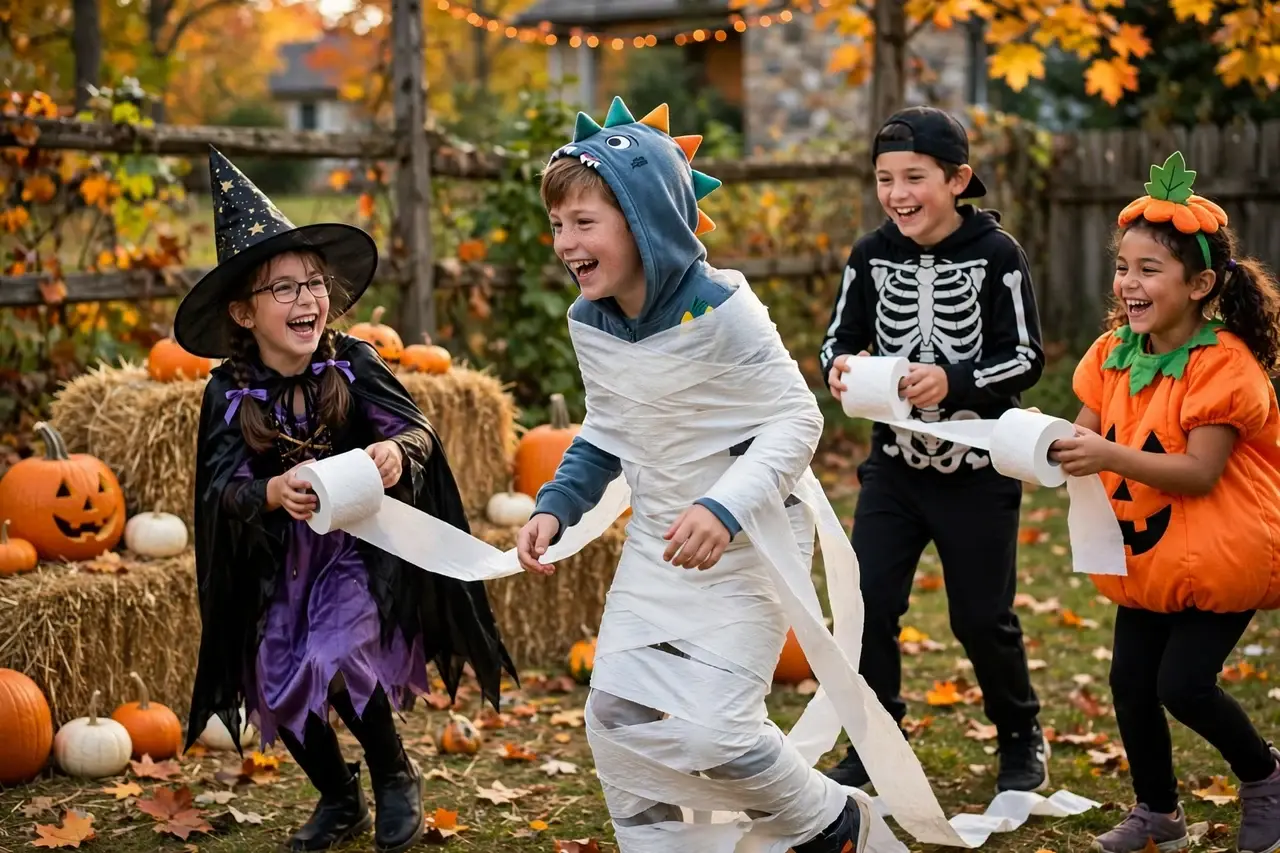
Teams of three: one mummy, two wrappers. On “go,” teams race to wrap their mummy head-to-toe in toilet paper or crepe streamers. First fully-wrapped (and still standing) team wins — judged on speed and coverage. Then the mummies race to a finish line. Cost: $1 per team in toilet paper. Keep faces clear, keep the race short, and prepare for the loudest ten minutes of your party. For indoor play, use crepe streamers (less mess than toilet paper).
Pumpkin Relay Race
Teams race to roll a mini pumpkin with a broom (or carry it on a spoon) around a cone and back. The pumpkin’s wobble makes every leg unpredictable — dropped pumpkins must be retrieved before continuing. Variations: balance the pumpkin on your head, pass it without hands, or race while wearing oversized witch shoes. Cones, brooms, mini pumpkins: under $15 total, endlessly reusable.
Ghost Tag
One child is the “ghost” (give them a white sheet or cape for drama). Tagged players become ghosts, joining the hunt. Last human wins — then becomes the first ghost of round two. For a twist, “safe zones” are “haunted houses” (hula hoops on the ground) where players can rest for five seconds. Boundaries are essential; use cones or rope. This game scales from six kids to thirty without losing steam.
Halloween Scavenger Hunt
Hide Halloween items (plastic spiders, mini pumpkins, ghost cutouts) around the yard or house with picture clue cards for pre-readers. Teams race to find them all; the final clue leads to the “treasure” (favor bags or a pinata). Tailor difficulty to age: ten obvious items for toddlers, twenty tricky ones with riddles for tweens. The hunt doubles as free-range exploration — kids love the autonomy. Budget thirty minutes; it always takes longer than you think.
Calm & Crafty Games
After the sugar hits, switch gears. These seated games channel excitement into creativity — and most produce take-home treasures.
Halloween Bingo
Print or buy Halloween bingo cards (ghosts, bats, pumpkins, witches instead of numbers). Use candy corn as markers — edible game pieces are genius. Play three to four rounds; winners choose from a prize basket. For pre-readers, use picture-only cards. Cost: free printables + candy corn. Bingo’s beauty is its scalability: five kids or fifty, the game works identically.
Pumpkin Decorating Contest
Give each child a mini pumpkin and access to decorating supplies: paint, markers, stickers, googly eyes, glitter glue. No carving — safe for all ages. Set a twenty-minute timer, then vote on categories: spookiest, silliest, most creative. Every pumpkin goes home as the favor. Cost: $2 per pumpkin plus shared supplies. The time limit is magic — it produces gloriously unhinged art and keeps the game moving.
Guess the Candy Jar
Fill a large jar with candy corn (or mixed Halloween candy) and have kids guess the count. Closest guess wins the jar. It runs all party long in the background — kids revisit their guesses, debate counting strategies, and crowd around for the reveal. For fairness with big age gaps, do two jars: one for under-sevens, one for older kids. Cost: one bag of candy and a jar you own.
Storytelling Circle: Build-a-Ghost-Story
Sit in a circle with a flashlight. Each child adds one sentence to a collaborative ghost story, passing the flashlight like a talking stick. The host starts with an atmospheric opener (“On the spookiest night of the year, twelve kids gathered in a haunted house…”). Keep it silly-scary, not genuinely frightening — the host guides the tone. Shy kids can pass; most join by round two. It is screen-free, imagination-fueled, and weirdly captivating.
Games for Little Ones (Ages 2–4)
Toddlers need simple, short, and sensory. Forget competition — think delightful activities with a game-ish structure.
Sticker Station Hunt
Hide large Halloween stickers around one room; toddlers “hunt” and stick them on a group poster or their own paper. No winners, no losers, just joyful discovery. Ten minutes of engagement per round — repeat as needed. Cost: pennies.
Ghost Bowling
Stack empty plastic bottles decorated as ghosts; toddlers roll a soft ball to knock them down. No scoring, no turns enforced — just gleeful knocking and restacking. The restacking is the game for this age. Use lightweight bottles so little arms can succeed.
Monster Dance Freeze
Play Halloween music; kids dance like monsters. When the music stops, freeze! Anyone moving does a silly monster roar and keeps dancing — no elimination, ever. Toddlers adore this because dancing is the reward and “freezing” is the game. Play in short bursts between other activities.
“The best kids’ game is the one where every child is playing, laughing, and included — all at the same time. If half the kids are watching, redesign the game.”
Games for Tweens (Ages 8–12)
Tweens demand sophistication — or at least the appearance of it. These games respect their maturity while keeping the Halloween spirit.
Escape Room Challenge
Set up a 20-minute escape challenge in one room: combination-locked box, hidden clues in Halloween props, blacklight messages, coded locks. Teams of four race the clock. Printable kits ($15–$25) include everything; DIY versions use luggage locks and handwritten clues. Tweens take this very seriously — the focus and teamwork are remarkable to watch. It is the rare party game they will talk about at school on Monday.
Fear Factor Taste Test
Blindfolded taste tests of mystery foods with spooky names: peeled grapes (“eyeballs”), cold spaghetti (“worms”), tapioca pudding (“frog eggs”). Kids guess what they are eating. Keep everything genuinely edible and allergy-safe — the “gross” is in the naming, not the food. Voluntary participation only; have a spit cup and water ready. The reactions are priceless, and brave tasters earn serious cred.
Murder Mystery Lite
A simplified social-deduction game: one “vampire” secretly chosen, who “bites” (winks at) players; players must identify the vampire through discussion and voting. Rounds take ten minutes; play best-of-five. The bluffing and accusations are sophisticated fun that makes tweens feel grown-up. No supplies needed beyond slips of paper.
Game Schedule by Party Length
- 90-minute party (ages 2–5): Arrival activity (coloring/tattoos) → Monster Dance Freeze → Snack → Pumpkin Decorating → Goodbyes. Three games max.
- 2-hour party (ages 5–8): Arrival game (Pass the Pumpkin) → Active block (Mummy Wrap + Scavenger Hunt) → Food → Calm block (Bingo + Decorating Contest) → Wind-down story → Goodbyes.
- 3-hour party (ages 8–12): Arrival (Guess the Candy Jar opens) → Active (Ghost Tag + Relay) → Food → Escape Room → Fear Factor → Trivia or Karaoke wind-down → Goodbyes.
The pattern: active before food, calm after food, gentle landing at the end. Never schedule the highest-energy game last — you want kids leaving happy-tired, not feral. For drink and snack pairings between games, our Halloween mocktails and cookie decorating guide (a game in itself) keep the fuel fun.
Bonus: Four More Crowd Favorites
Witch Hat Ring Toss
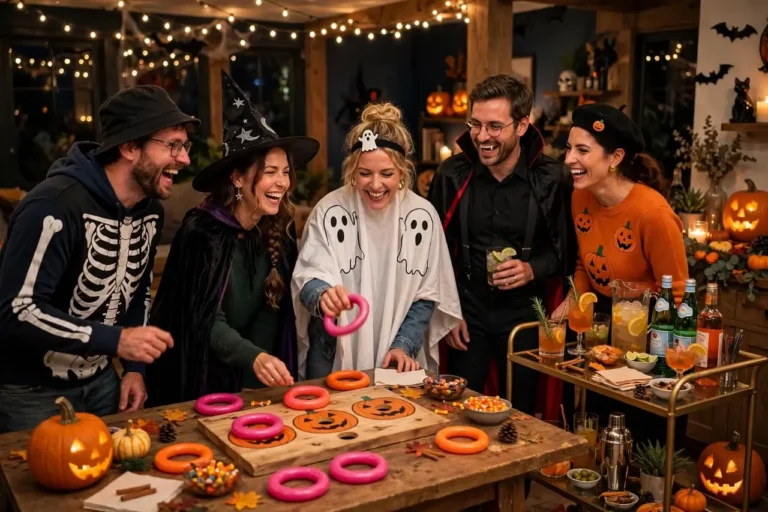
Stand witch hats (party hats or cones) upright and toss glow bracelets or rope rings onto them from a line. Score by distance or hat: 10 points for close hats, 25 for far. Play in teams across three rounds, totaling scores. The escalating challenge keeps tension building, and glowing rings under dimmed lights look magical. Cost: hats + rings, about $12. Works beautifully indoors in a hallway or outdoors on a lawn.
Eyeball Spoon Race
The egg-and-spoon race, Halloween edition: players carry plastic eyeballs on spoons around a cone course. Drop it? Pick it up and continue — or, for older kids, go back to the start. Run as a relay for teams. The eyeballs’ wobble makes every step suspenseful, and the sight of twelve kids creeping in total concentration, tongues out, is comedy gold. Plastic eyeballs cost about $5 for a bag of twenty.
Monster Mash Statues
Play “Monster Mash” (or any Halloween tune); kids dance wildly as monsters. When the music stops, they freeze as statues. The host — playing “the curator” — walks among them trying to make them laugh without touching. Anyone who laughs joins the curator for the next round. No elimination, just escalating silliness. This game never fails because the premise (adults trying not to laugh at frozen monster children, and vice versa) is inherently hilarious.
Pumpkin Patch Stomp
Tie orange balloons (“pumpkins”) to each child’s ankle with short strings. On “go,” kids try to stomp others’ balloons while protecting their own. Last pumpkin intact wins — or play non-elimination where popped players become “ghosts” who can still tag but not be popped. It is loud, physical, and gleefully chaotic. Do this one outdoors or in a large clear space, and have extra balloons ready — they pop fast.
Game Picker: Match Games to Your Party
| Game | Best Ages | Energy | Players | Cost |
|---|---|---|---|---|
| Pin the Nose on the Pumpkin | 3–8 | Low | 5–25 | $3 |
| Pass the Pumpkin | 3–10 | Low | 6–20 | $5 |
| Musical Tombstones | 4–9 | Medium | 6–20 | $10 |
| Mummy Wrap Race | 5–12 | High | 6–24 | $8 |
| Pumpkin Relay Race | 5–12 | High | 8–24 | $15 |
| Ghost Tag | 4–12 | High | 6–30 | $0 |
| Scavenger Hunt | 4–12 | Medium | 5–25 | $10 |
| Halloween Bingo | 4–12 | Low | 5–50 | $5 |
| Pumpkin Decorating Contest | 3–12 | Low | 4–20 | $2/child |
| Escape Room Challenge | 8–12 | Medium | 4–12 | $20 |
| Fear Factor Taste Test | 8–12 | Low | 5–15 | $10 |
DIY Game Supplies: Make, Don’t Buy
Almost every game on this list can be built from household items — which keeps costs near zero and adds a satisfying craft-before-the-party dimension. Here is the DIY breakdown:
- Pin the Nose on the Pumpkin: draw a jack-o’-lantern on poster board, cut triangle noses from orange construction paper, use tape loops or sticky tack. Total: under $2.
- Ghost bowling pins: white plastic bottles + black marker ghost faces + a soft ball. Six pins for the price of a marker.
- Beanbag toss targets: cut monster mouths in a large cardboard box; beanbags from socks filled with rice, tied off. An afternoon craft that becomes a permanent party game.
- Ring toss: paper plates with centers cut out (rings) + taped-together paper towel rolls as posts, decorated as witch hats. Ten minutes of assembly.
- Scavenger hunt clues: hand-drawn picture cards for pre-readers, rhyming riddles for older kids. The personalization — clues referencing your house — makes it better than any printable.
Build these with your kids in the week before the party. The crafting becomes part of the celebration — anticipation is half the fun — and children take enormous pride in games they helped create. Store the reusable pieces (pins, beanbags, boxes) labeled in a “Halloween games” bin; next year’s setup takes minutes. For more make-it-yourself inspiration, our Halloween crafts for kids guide is full of projects that pull double duty as party games.
Including Every Child: Adaptive Game Tips
Great parties include everyone. A few thoughtful adaptations ensure no child sits out:
- Mobility differences: choose seated or stationary roles (the “caller” in bingo, the “judge” in decorating contests, the clue-reader in scavenger hunts). For relays, allow alternative movements — every child participates, just differently.
- Sensory sensitivities: warn before loud moments (pinata breaks, countdowns), keep music moderate, offer noise-reducing headphones without stigma, and maintain a quiet corner with coloring supplies. Flashing lights? Skip them or announce them.
- Attention differences: keep instructions to one sentence plus a demo, use visual cue cards for game steps, and build in movement breaks. Short rounds beat long explanations every time.
- Shyness: never force performance. Offer behind-the-scenes roles (scorekeeper, photographer, DJ) that are genuinely valuable. Many shy kids bloom by the third game once they feel safe.
- Food allergies: separate allergen-free prizes and treats, label everything, and brief any parent volunteers. Non-food prizes for game winners sidestep the issue elegantly.
A quick, private check-in with parents before the party (“Anything I should know to help your child have the best time?”) gives you the information you need without singling anyone out. Inclusive hosting is not extra work — it is just thoughtful work, and it is what separates good parties from great ones.
Watch: 16 Family Halloween Party Games
See sixteen kid-tested Halloween games demonstrated — including relays, tosses, and creative challenges you can set up with dollar-store supplies. Watch with your kids and let them vote on their favorites; giving them a say in the lineup builds anticipation and guarantees buy-in.
Prizes, Fairness & Managing Meltdowns
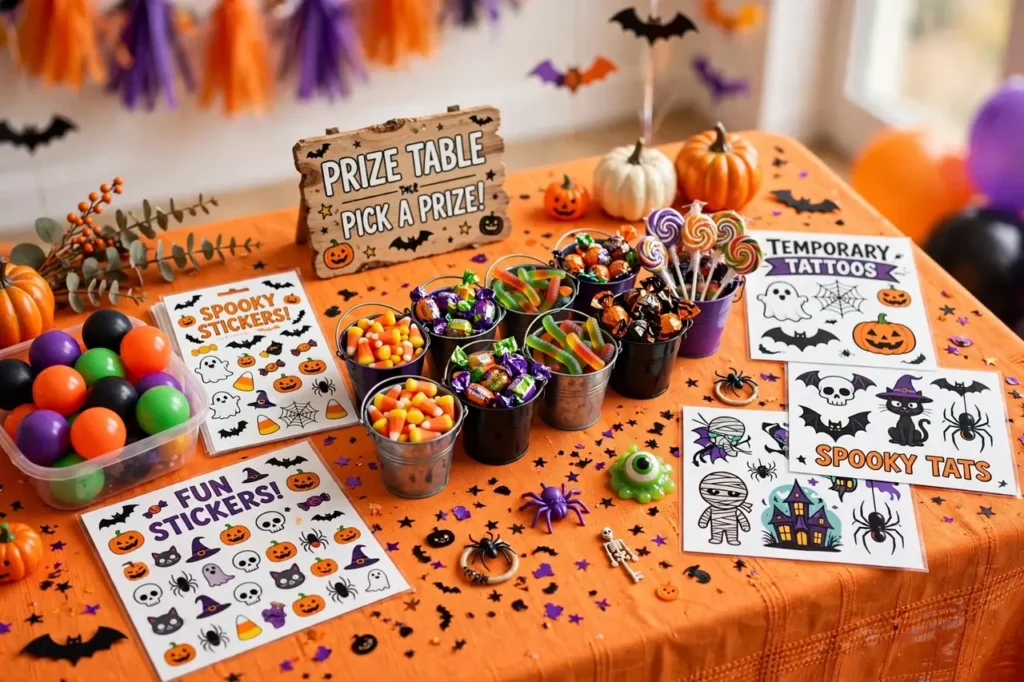
Prizes motivate, but they also cause 90% of party drama. The solution: everyone wins something. Winners choose first from the prize table; everyone else chooses after. Participation stickers or stamps for every game. The prize table itself: small toys, stickers, temporary tattoos, Halloween pencils — $1 to $2 items in bulk. Never make the grand prize dramatically better than the consolation; the gap is where tears live.
For competitive games with older kids, frame winning as luck-plus-skill and losing as “great playing.” Rotate winners naturally by varying game types — the fast kid wins the relay, the artistic kid wins decorating, the clever kid wins the scavenger hunt. Everyone gets a moment.
Meltdowns happen. A child loses, gets overwhelmed, or just hits the sugar-crash wall. Have a calm-down plan: a quiet corner with coloring and a beanbag, a buddy (parent volunteer) who can sit with them, and zero pressure to rejoin. Never force participation — “You can watch this round and jump in next time” preserves dignity. Most kids rejoin within ten minutes. And keep the schedule moving; lingering on a disputed game outcome amplifies drama, while the next exciting activity dissolves it.
For craft-based game ideas that double as favors, our Halloween crafts for kids collection is the perfect companion to this guide.
Frequently Asked Questions
How many games should I plan for a kids’ Halloween party?
Plan one game per 20–30 minutes of party time: three games for a 90-minute toddler party, four to five for a two-hour party, six for a three-hour tween party. Always have one backup game ready. Fewer, well-run games beat a frantic rotation — and free play between games is not wasted time, it is breathing room.
What if kids do not want to play the game I planned?
Do not force it — pivot. Have your backup ready and switch cheerfully: “Okay, new plan!” Kids smell desperation; they respond to flexibility. Often the issue is energy mismatch (a calm game when they need to run) rather than the game itself. Read the room, match the energy, and remember that free play with Halloween toys is a legitimate activity.
How do I handle different ages at the same party?
Choose games with built-in handicaps (older kids wrap with one hand, start farther back) or run parallel stations: an active game for big kids, a craft table for littles. Buddy-system pairing (each older child with a younger one) works beautifully for scavenger hunts and relays. When in doubt, pick the younger age’s game — older kids will still have fun, but younger kids cannot play up.
Are elimination games okay for kids’ parties?
Generally, no — elimination benches children who then watch everyone else have fun, which breeds resentment and restlessness. Convert elimination games to point-based or forfeit-based versions: instead of sitting out, the “out” player does a silly dance and rejoins. For tweens, brief elimination is acceptable if rounds are fast (under five minutes).
What prizes work best for kids’ party games?
Small, immediate, and universal: stickers, temporary tattoos, Halloween pencils, mini toys, candy. Budget $1 to $2 per prize and let winners choose from a prize table. Everyone gets a participation prize. Avoid one spectacular grand prize — it creates more tears than joy. The real prize is the game itself.
How do I keep games from descending into chaos?
Clear physical boundaries (cones, tape lines), clear verbal starts (“On your marks… GO!”), and a whistle or bell for attention. Demonstrate each game before starting. Keep groups small (split 20 kids into four teams of five). And always — always — have the next activity ready before the current one ends; transitions are where chaos breeds.
Can I do these games indoors if it rains?
Most adapt: mummy wrap works in a living room (use streamers), relay races become obstacle courses around furniture, scavenger hunts move inside with trickier hiding spots. Skip ghost tag indoors unless you have a large clear space. Have your rain plan decided before the party — confident pivots keep the energy up.
What is the single best game for a kids’ Halloween party?
The scavenger hunt — it works for ages 4 to 12, scales to any group size, fills 20–30 minutes, needs minimal supplies, and delivers genuine adventure. Tailor the clues to your age group (pictures for pre-readers, riddles for older kids) and end with a treasure. If you only run one game, make it this one.
The games are the gift you give every child at the party — the memory of laughing so hard their sides hurt, of winning the mummy race, of finding the last clue. The secret is not complicated: plan the arc, prep the supplies, keep everyone playing, include every child, and end while they are still begging for more. Do that, and the decorations fade into the background while the games become legend — retold in the car home, at school on Monday, and every October after. You are not just hosting a party; you are building the Halloween memory they will measure all future Halloweens against. Pick five games from this guide tonight, gather the supplies this week, and get ready for the best kind of chaos. Now go have fun — the kids certainly will.