Here is a secret the party industry does not want you to know: the naming ceremonies people remember most fondly are rarely the grand ones. Ask new parents about their favorite celebration from the newborn year and they will not describe the balloon arch or the caterer. They will describe the moment — in a living room, a backyard, a kitchen full of steam from a pot of soup — when someone they love said their baby’s name out loud for the first time, and everybody cried a little, and it was perfect.
Simple is not a compromise. Simple is a choice — and often the wiser one. A simple naming ceremony keeps the focus where it belongs (the child, the words, the people), respects the reality of life with a newborn (naps, feeding, sheer exhaustion), and leaves you with money still in the bank and joy still in the tank. This guide collects 20 simple naming ceremony ideas that prove less really is more: micro-ceremonies, heartfelt rituals that cost nothing, a real $300 budget breakdown, a complete ten-minute ceremony script you can use word for word, and answers to every practical question about keeping it beautifully low-key.
The Case for Simple: Why Less Means More
There is a particular kind of pressure that descends on new parents, and it arrives via social media: the gorgeously styled naming ceremony with the dessert table, the calligrapher, the string quartet. It looks effortless. It was not. Behind every one of those photos is a parent who spent the final month of pregnancy — or the first blurry weeks of parenthood — managing vendors instead of resting.
Consider what a newborn actually needs from their naming day: to be held, fed, and kept on something resembling a schedule. Consider what you need: to feel present rather than performative, to actually talk to the people who came, to end the day tired in the good way rather than depleted. Elaborate productions routinely fail all three tests. Simple ceremonies pass them by design.
The research on memory backs this up, too. Psychologists who study autobiographical memory find that emotionally intense, socially connected moments encode far more vividly than visually impressive ones. Your child will not one day cherish the memory of artisanal place cards; they will cherish the story of their grandmother’s shaking voice, the letter their father wrote at midnight, the way the whole small room said their name together. Emotion is the decor that lasts.
Simple also buys you something money cannot: flexibility. A living-room ceremony can move to the porch if the weather turns. A backyard gathering can shrink to the kitchen if the baby melts down. When you have invested thousands and coordinated dozens of vendors, every deviation feels like a disaster; when your plan is “the people we love, some food, and a few true words,” almost nothing can go wrong. And in the newborn season, that resilience is worth more than any centerpiece.
This is not an argument against beauty — simple ceremonies can be stunning. It is an argument for proportion: let the scale of the celebration match the scale of what a new family can genuinely enjoy. The ideas below show you how.
20 Simple Naming Ceremony Ideas
Each of these stands alone — pick five or six and you have a complete celebration. They are ordered roughly from the most intimate to the most social, so you can stop wherever your energy runs out.
The living-room circle. Arrange your sofas and borrowed chairs in a circle, place the baby’s bassinet or a blanket in the center, and let the ceremony happen at floor level, eye to eye. A circle has no head table and no back row; everyone is equally close to the baby, and the intimacy is automatic. Ten to fifteen guests fit comfortably in most living rooms.
One perfect reading. Instead of a program of readings, choose a single piece that wrecks you (in the good way) — a poem, a paragraph from a beloved book, the lyrics of a song that carried you through pregnancy. Have the person who loves words most in your family read it slowly. One perfect reading outperforms five pretty good ones every time.
The name story, told simply. Before announcing anything formal, tell the story of the name: where you found it, who it honors, what it means, the runners-up that lost. Name stories are inherently fascinating — guests lean in for them the way they lean in for birth stories. This five-minute telling is often the emotional centerpiece of the entire day.
Handwritten wishes on index cards. Buy a pack of blank index cards and a few good pens. Ask each guest to write one hope, blessing, or piece of advice for the baby. Collect them in a wooden box or a simple envelope. Index cards feel unprecious, which paradoxically makes people write more honestly than they do on fancy stationery.
A potluck with assigned dishes. The oldest crowd-feeding technology in existence still works: ask each family to bring one dish, and assign categories (mains, sides, desserts, drinks) so you don’t end up with nine potato salads. Potlucks distribute both cost and labor, and the spread always ends up more interesting — and more loved — than a single catered menu.
The morning-after brunch. Host the ceremony at 10 a.m. and roll straight into brunch: a big egg bake, a fruit platter, bagels and good coffee. Morning events are merciful to babies’ schedules, the light is beautiful for photos, and by 1 p.m. everyone — including you — is home for naps. The brunch naming ceremony may be the single most parent-friendly format ever devised.
Blessings in a circle, popcorn style. After the name is announced, go around the circle and let anyone who wants to offer a one-sentence blessing or hope for the child. No order, no pressure, no microphone — just voices. Keep it moving gently; the accumulation of twenty sincere sentences is overwhelming in the best way. Have someone record it on a phone.
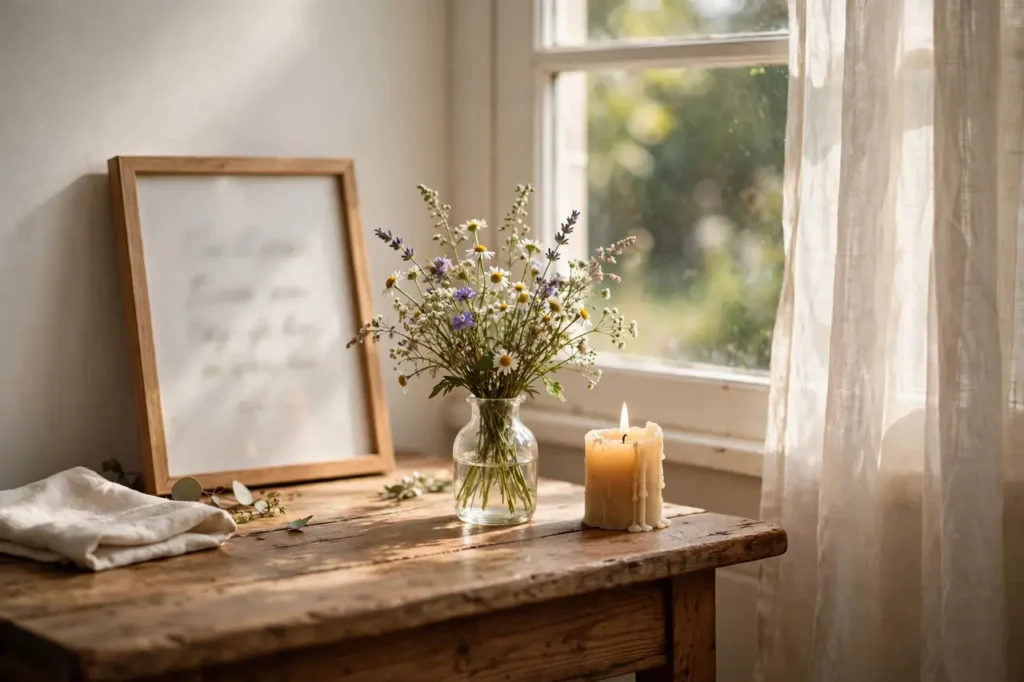
A single symbolic act. Choose one ritual and do it well: light a candle together, plant a small potted tree, press the baby’s handprint into clay, or pour water from two small vessels into one bowl to symbolize two families becoming one. One ritual gives the ceremony a visual anchor and a keepsake; three rituals make it feel like a talent show.
The family recipe table. Ask grandparents and beloved relatives to make the dish they’re famous for, and tent-card each one with its story: “Aunt Rosa’s empanadas — the recipe she brought from Colombia in 1987.” The food becomes a storytelling device, older relatives feel honored rather than sidelined, and the meal carries a meaning no caterer can replicate.
Backyard, blankets, no chairs. Skip rentals entirely: spread blankets and quilts on the lawn, scatter floor cushions, and let people lounge picnic-style. It costs nothing, children love it, and the informality puts everyone at ease within minutes. Add one shade sail or pop-up canopy for the baby’s spot, and you’re done.
The ten-minute ceremony. Write it, time it, and protect it fiercely: welcome (1 min), name story (3 min), one reading (2 min), the naming and blessing (3 min), toast (1 min). Ten focused minutes hold a room spellbound; thirty meandering minutes lose the baby and half the guests. Brevity is not shallowness — it is respect for everyone’s attention, including the guest of honor’s.
Grandparents as officiants. Ask a grandparent to lead the ceremony. It costs nothing, it honors them profoundly, and their voice — weathered, trembling slightly, full of decades — will move the room more than any hired professional. Give them the script in large print a week ahead, and rehearse once. They will be nervous; they will also be magnificent.
The walk-and-name. For the truly minimal: gather your smallest circle at a favorite park or beach, take a slow walk together, and at a beautiful spot, stop, form a circle, and speak the naming. No decor, no food beyond a thermos and cookies, no cleanup. Some families report this as the most meaningful hour of their entire first year — just the people, the place, and the words.
Video blessings from the far away. Text your distant loved ones a week ahead: “Send a 30-second video saying [baby’s name] and one wish for them.” Play the compilation on a laptop or TV during the gathering. It takes an afternoon to assemble, costs nothing, and reliably produces the day’s biggest tears — especially when an elderly relative appears on screen.
The memory table. Clear one small table and cover it with framed photos: the parents as babies, the grandparents’ wedding day, the ultrasound print. Add the baby’s hospital bracelet and a copy of the birth announcement. It takes twenty minutes to assemble from things you already own, and guests will spend the whole party drifting over to it, telling stories.
Homemade cake, store-bought dignity. Bake the cake yourself or assign it to the family’s best baker — but buy the pretty cake stand, the gold candles, and the nice serving plates. Presentation elevates homemade food enormously; a simple vanilla cake on a beautiful stand with fresh flowers looks intentional, not cheap. Write the baby’s name across the top in your own handwriting.
The group photo, done right. Fifteen minutes before the end, gather everyone for one proper group photo with the baby front and center. Assign one bossy, beloved relative to arrange people — this is a sacred role. Take ten frames. Print the best one large and hang it; in twenty years, it will be the photograph everyone points to when they tell the story of naming day.
End with a song. Close the formal part by singing something together — a lullaby, a hymn everyone knows, “You Are My Sunshine,” whatever your family sings. Group singing does something neurological: it synchronizes breathing and heart rates, and people leave feeling bonded in a way speeches never achieve. Off-key is not just acceptable; it is the point.
The quiet blessing at bedtime. After the last guest leaves and the dishes wait for morning, hold your baby in the dim nursery and say their full name aloud, slowly, three times — with everything you feel behind it. No audience, no camera. Parents consistently describe this private moment as the true ceremony, the one beneath all the others. Do not skip it.
Write it all down within 48 hours. While the details are fresh, write a one-page account of the day: who came, what was said, what the baby did, what you felt. Tuck it in the baby book. Memory is a leaky vessel and the newborn haze is real; this single page will become the primary source for every retelling of the story for the rest of your lives.
The $300 Naming Day: A Real Budget Breakdown
To prove the point, here is an actual workable budget for a beautiful simple naming ceremony for 25 guests at home. These are realistic U.S. averages; adjust for your area, and note how many lines are already zero because you own the thing.
| Item | Cost | Notes |
|---|---|---|
| Invitations (digital) | $0 | Free evite or a designed text message; paper optional |
| Food (potluck + host provides mains) | $80 | Two big-batch mains from the host; guests bring the rest |
| Drinks (lemonade, iced tea, coffee) | $25 | Batch dispensers; ask a friend to bring wine if wanted |
| Cake (homemade by family baker) | $20 | Ingredients only; borrow the stand and server |
| Decor (wildflowers, candles, printables) | $40 | Grocery-store blooms, candles you own, free printable signs |
| Paper goods & pens for wishes | $15 | Index cards, a nice box, decent pens |
| Keepsake (clay handprint kit) | $18 | One kit; the ritual and the keepsake in one |
| Photos (friend + shared album) | $0 | Ask your most camera-happy friend; set up a shared album |
| Buffer for surprises | $102 | Ice, extra napkins, the thing you forgot — it always exists |
| Total | $300 | A complete, beautiful, memorable celebration |
The point is not that you must spend $300 — it is that the meaningful parts of a naming ceremony (the words, the people, the rituals) are essentially free. Every dollar beyond this buys convenience or aesthetics, both legitimate, neither essential. Spend where it reduces your stress; save everywhere else without a flicker of guilt.
Seeing a real intimate ceremony — like the heartfelt family celebration above — helps you visualize your own: notice how little staging is required when the emotion is genuine, and how the camera naturally finds the meaningful moments without any production at all.
A Complete 10-Minute Ceremony Script
Use this word for word, or adapt it freely. It is written for a parent or grandparent to read aloud, and it runs almost exactly ten minutes at a natural pace.
[Welcome — 1 minute]
“Thank you all for being here — in our living room, which has never looked better and never will again. We’re gathered for the simplest and oldest reason: to welcome [baby’s full name] by name, surrounded by the people who will love them their whole life long.”
[The name story — 3 minutes]
“We want to tell you about this name. [Tell the story: who it’s for, what it means, how you chose it, the moment you knew.] Every time we say it, we think of [the person/meaning/story]. We hope [short name/nickname] grows into it the way you grow into a favorite coat — slowly, comfortably, until it’s unmistakably theirs.”
[One reading — 2 minutes]
“[Friend/family member’s name] is going to read something for us.”
[Read your chosen piece slowly. Let the last line land before moving on.]
[The naming and blessing — 3 minutes]
“And now the reason we’re here. [Hold the baby up, or have everyone gather close.] [Baby’s full name], we name you today in the presence of everyone who loves you. We promise to keep you safe, to tell you the truth, to teach you kindness, and to love you — loudly, daily, and without condition — for the whole of your life. [If doing a ritual: perform it now — light the candle, press the handprint, pour the water.] May your life be as full of love as this room is right now.”
[Toast — 1 minute]
“Please raise your glasses — of whatever you’ve got. To [baby’s name]! May we all be worthy of them.”
[Drink. Hug. Cry a little. The formal part is over — eat.]
That is the entire ceremony. Everything else — the food, the photos, the lingering conversations — is celebration, and it needs no script at all.
Simple Decor from Things You Already Own
The fastest way to decorate simply is to shop your own house first. Walk through it with fresh eyes and gather: every candle and holder, every small vase, every framed photo of family, every plant that can be moved, every piece of fabric with a nice texture — tablecloths, quilts, scarves. You will be astonished how much raw material you already have.
Build three focal points and leave the rest of the house alone. Focal point one: the ceremony spot — a quilt on the floor or a cleared coffee table with candles, one framed photo of the baby, and a small vase of whatever is blooming (or grocery-store flowers, $10). Focal point two: the food table — a tablecloth you love, the dishes arranged with some greenery tucked between them, a hand-lettered menu card. Focal point three: the welcome — a small table by the door with the wishes box, pens, and a sign in your own handwriting.
Three focal points, good lighting (open every curtain; light every candle as guests arrive), and music playing when the door opens. That is the entire decorating plan, and it will look and feel wonderful — because it looks like your home at its best, which is exactly what it should look like. For more inspiration on keeping family celebrations warm and personal, explore our Baby & Children celebrations and these practical tips for life with a new baby.
Frequently Asked Questions
How many people should we invite to a simple naming ceremony?
As many as you can genuinely enjoy hosting — for most families, that is 10 to 30. The test is simple: can you imagine having a real conversation with each person during the event? If the guest list has grown to the point where you’d spend the day managing rather than celebrating, trim it. The people who matter most will never mind a small gathering; they will feel honored to be among the few.
Do we need to send formal invitations?
No. A warm, detailed digital invitation — or even a well-crafted group text or email — is completely appropriate for a simple ceremony. Include the essentials: date, time, address, what to expect (“a short ceremony and lunch in our backyard”), and what to bring if it’s a potluck. Send it three to four weeks ahead so out-of-town loved ones can plan.
What if the baby cries through the whole ceremony?
Then you will have a funny story and a very human ceremony. Feed the baby right before the formal part begins, keep the ceremony short (this is the real reason for the ten-minute script), and designate someone — not a parent — as the official baby-soother who can step out and back in seamlessly. Guests do not mind a crying baby; they mind a stressed parent. If you stay relaxed, everyone will.
Can we do a simple ceremony if our families expected something big?
Yes — with one conversation held early. Tell your families what you’re planning and why, emphasizing what the day will include (everyone’s presence, meaningful words, good food) rather than what it won’t. Most resistance melts when people understand the choice is deliberate, not default. And consider throwing one small bone to tradition: the grandmother’s recipe, the family prayer, the heirloom outfit — a single traditional note satisfies nostalgia without changing your plan.
Should we hire a photographer for a simple ceremony?
It is the one splurge worth considering, because professional photos are the main thing you cannot recreate later. But it is not required: designate a talented friend, set up a shared photo album for all guests, and put one decent camera on a tripod for the ceremony itself. If you do hire someone, book just one to two hours — you don’t need (or want) all-day coverage for a simple event.
What do we do about gifts?
For a simple ceremony, “no gifts, please — your presence is the present” is the cleanest line, and most guests are relieved to hear it. If you prefer guidance, suggest a book for the baby’s library (with an inscription) or a contribution to a savings account. Whatever you choose, state it on the invitation — clarity is kindness.
How do we include people who can’t come?
Collect short video messages in advance and play them during the gathering, set up a simple video call for the naming moment itself, and send absentees a photo and a note afterward. For a simple ceremony, a single laptop on the mantel with grandparents on screen is not a compromise — it is often the most touching detail of the day.
Can a simple ceremony still feel special and sacred?
Special and sacred were never functions of budget or guest count. They are functions of attention: the care in the words chosen, the sincerity of the people gathered, the weight of the promise made. A ten-minute ceremony in a living room, spoken honestly to a roomful of love, carries more sacred charge than an hour of pageantry performed on autopilot. Trust the simplicity — it is not the absence of meaning. It is the frame that lets meaning show.
Small Day, Enormous Love
Years from now, when your child asks about their naming day, you will not describe the centerpieces. You will describe who was there, what was said, and how it felt to say their name aloud for the first time in a room full of love. That story is available at any budget, in any living room, on any ordinary Saturday made extraordinary by intention.
So keep it simple — not because you must, but because you can. Choose the five ideas from this guide that make your heart lift, release the rest without a second thought, and give yourself fully to the day instead of to its production. The baby will not remember the party. But they will grow up inside the love it was built from — and that, in the end, is the whole ceremony. Long after the last dish is washed and the candles are blown out, what remains is the quiet certainty that on one unremarkable Saturday, surrounded by the people who matter most, you gave your child the first great gift of their life: a name, spoken with love, witnessed with joy, and promised a lifetime of belonging. If you’re planning more low-key family moments, you may also enjoy our guide to celebrating as new parents and sweet baby’s first Halloween ideas for the seasons ahead.