If you are looking for christmas tree farms near Lincoln 2026, here is the good news: southeast Nebraska has one of the most genuine choose-and-cut cultures in the Midwest. Growing a Christmas tree on the Plains is not easy — the wind, the drought cycles, the alkaline soil — which is exactly why the farms that thrive here are run by people who truly love the work. Within about 30 minutes of downtown Lincoln you can walk into fields of Scotch pine, white pine, Canaan fir, and spruce, saw your own tree, and warm up afterward with free cocoa in a rustic log cabin while the crew shakes, bales, and loads your tree. This guide covers the five farms Lincoln families return to year after year, the species that actually grow well in Nebraska, and how to plan a visit that ends with the right tree strapped to your car and nobody’s fingers frozen.
Nebraska’s tree farms have a character all their own. Unlike the mountain states where firs grow almost by default, every evergreen on a Nebraska farm got there through deliberate effort — drip irrigation through dry summers, windbreaks, and decades of trial and error about which species tolerate the climate. That effort shows up in the experience: the owners tend to be hands-on, the operations family-run, and the traditions — tagging your tree in October, opening weekend the day after Thanksgiving, the wood stove in the cabin — run deep. Several of the farms near Lincoln are members of the Nebraska Christmas Tree Growers Association, and at least one has supplied trees to the governor’s office, which tells you something about the quality coming out of these fields.
What Makes a Great Tree Farm Near Lincoln
Before we get to the farms themselves, it helps to know what separates a great Nebraska tree farm from a mediocre one — because the differences matter more here than in regions where trees grow effortlessly.
First, look for species diversity with honesty about what is cut-your-own versus pre-cut. The best farms near Lincoln are upfront: Scotch pine, white pine, and spruce are the reliable choose-and-cut species on the Plains, while true firs (Fraser, Canaan, Concolor) are harder to grow here and often appear as pre-cut trees brought in from elsewhere. A farm that tells you exactly which rows are cut-your-own and which trees came from out of state is a farm you can trust.
Second, look for the services that make the day work: saws provided, tree wagons or carts, mechanical shaking to drop the dead needles, baling or netting for transport, and help loading. Every farm on this list offers most or all of these, but it is worth confirming, because hauling an unbaled eight-foot spruce across a windy parking lot is nobody’s idea of a holiday memory.
Third, consider the experience layer. Nebraska Decembers are genuinely cold, so the farms that thrive are the ones that give you somewhere warm to land — a heated cabin, free hot cocoa or cider, a gift shop or holiday barn to browse while the kids thaw out. That is not fluff; it is what turns a 20-minute tree errand into the family outing you will repeat for a decade.
Finally, check the practical stuff for the 2026 season: opening dates, daily hours, payment methods (several Nebraska farms are cash-and-check operations), and whether you can tag a tree early. Farm details change every year, so check official listings or call ahead for 2026 season hours before you drive out.
The Best Christmas Tree Farms Near Lincoln for 2026
Spilker’s Pineridge Tree Farm — Lincoln
Spilker’s Pineridge is the closest true choose-and-cut farm to most Lincoln households — right in the city on Fletcher Avenue, about a mile north of North 14th and Superior. If your search for christmas tree farms near Lincoln 2026 starts with “as close as possible,” start here. The farm grows Canaan, Concolor, Douglas, and Korean firs along with white pine and white spruce, and the operation is set up for families: hay and wagon rides, complimentary beverages, tree shaking, and a crew that cuts, shakes, nets, and loads your tree for you.
One of Spilker’s smartest traditions is the early tree-tagging event, typically held in October, when you can walk the fields, pick your tree, and tag it before the season rush. If you fall in love with a specific tree, tagging is the way to make sure it is still yours on opening weekend. For the 2026 season, watch the farm’s official announcements for the tagging dates — they are popular and worth planning around.
Because it is in town, Spilker’s works beautifully as a low-commitment outing: no highway driving, no full-day commitment, just a genuine cut-your-own experience fifteen minutes from home. As always, check official listings or call ahead for 2026 season hours and confirm which species are available for cutting versus pre-cut.
Walnut Grove Tree Farm — Raymond
About eight miles north of Lincoln, Walnut Grove Tree Farm in Raymond is the farm that local news crews visit on opening weekend — and the reason is the owner, Dennis Adams, who bought the farm in 1982, planted his first trees the following spring, and has been growing Christmas trees on the Nebraska Plains for over four decades. He has also served as president of the Nebraska Christmas Tree Growers Association, and his trees have won People’s Choice and Grand Champion awards at the Nebraska State Fair.
The farm plants thousands of trees across eight varieties — Austrian pine, Canaan fir, Colorado blue spruce, Concolor fir, white pine, Norway spruce, and Scotch pine — and the experience is built for lingering: the staff provides the saw, the tree wagon, and the measuring pole, then mechanically shakes, bales, and loads your tree free of charge. Afterward, you warm up by the wood stove in the rustic log cabin with free hot cocoa, coffee, or apple cider, and browse homemade wreaths, swags, centerpieces, jams, and crafts. There are free gifts for kids, which tells you everything about the farm’s priorities.
Walnut Grove typically opens for the first three weekends after Thanksgiving, but the opening-weekend crowds can be intense — the farm has described recent opening weekends as the busiest in its history, a sign of the real-tree renaissance happening across the country. For 2026, consider going on the second weekend for a calmer visit with still-excellent selection, and check official listings or call ahead for 2026 season hours. Note that the farm has historically accepted cash and check, so plan accordingly.
Yonkey Pine Plantation — Hickman
South of Lincoln in Hickman, Yonkey Pine Plantation offers the most traditional version of the choose-and-cut experience: grab a saw, walk the rows of Canaan fir, Scotch pine, white pine, and white spruce, cut your tree, and let the staff handle the cleaning and baling. The farm provides hay and wagon rides, restrooms, tree stands, and wreaths, and the setting — rolling southeast Nebraska countryside — is quietly beautiful in late November.
Yonkey’s season traditionally runs from the day after Thanksgiving through Christmas Day, with weekend and limited weekday hours. It is a cash-or-check operation, so hit the ATM beforehand. The farm’s straightforward, no-frills approach appeals to families who want the authentic cutting experience without a lot of commercial overlay: you, the field, the saw, and a really fresh tree.
For the 2026 season, confirm the exact schedule directly — hours and closing dates shift with the weather and the inventory. Check official listings or call ahead for 2026 season hours.
Windmill Pines Tree Farm — Seward
West of Lincoln in Seward, Windmill Pines has been growing Christmas trees since 1968, making it one of the oldest continuously operated tree farms in the region. Now managed by the second generation of the founding family, the farm runs about ten acres of trees as a primarily choose-and-cut operation, with a small shop selling ornaments, wreaths, stands, and Christmas goods.
The farm grows Canaan fir, Concolor fir, Fraser fir, Korean fir, Scotch pine, and white pine — a notably fir-heavy lineup for Nebraska, which speaks to decades of learning what works in local soil. Windmill Pines has supplied trees to the Nebraska governor’s office for multiple years running, which is about as strong a quality endorsement as a tree farm can get. The operation accepts credit and debit cards, offers cutting assistance, and provides the full baling, shaking, and stand service.
The drive from Lincoln to Seward is an easy one, and pairing the farm visit with Seward’s small-town holiday atmosphere makes for a lovely December Saturday. As with all the farms here, check official listings or call ahead for 2026 season hours before heading out.
Clover B Tree Farm — Crete
Southwest of Lincoln in Crete, Clover B Tree Farm bills itself as southeast Nebraska’s premier Christmas destination, and the experience backs it up. The farm opens Thanksgiving weekend with fresh-cut Fraser fir, Douglas fir, Scotch pine, and white pine, a “choose your tree” experience for the whole family, and a Holiday Barn to browse. The signature touch: miniature Christmas donkeys who love having their pictures taken, plus complimentary cocoa for kids of all ages.
If your family includes young children, Clover B deserves serious consideration — the donkeys, the barn, and the cocoa turn the tree hunt into a full morning of entertainment, and the staff leans into the festive atmosphere. It is the kind of place where the kids will ask to go back next year before you have even loaded the tree.
Clover B’s season is built around the Thanksgiving-weekend opening, and the best selection goes early. For 2026, check official listings or call ahead for 2026 season hours and opening-weekend details.
At a Glance: Lincoln-Area Tree Farms Compared
Five strong options, five slightly different experiences. Use this table to pick your match — then confirm 2026 details directly, since hours, dates, and payment policies change every season. Check official listings or call ahead for 2026 season hours.
| Farm | Location | Distance from Lincoln | Signature Species | Standout Feature |
|---|---|---|---|---|
| Spilker’s Pineridge Tree Farm | Lincoln (Fletcher Ave) | In town | Canaan, Concolor, Korean firs; white pine; white spruce | October early tree-tagging event; closest option |
| Walnut Grove Tree Farm | Raymond | ~8 miles north | Scotch pine, white pine, Canaan fir, blue spruce, Norway spruce | Rustic log cabin, free cocoa, 40+ year tradition |
| Yonkey Pine Plantation | Hickman | ~15 miles south | Canaan fir, Scotch pine, white pine, white spruce | Traditional no-frills cutting; cash or check |
| Windmill Pines Tree Farm | Seward | ~25 miles west | Canaan, Concolor, Korean, Fraser firs; Scotch and white pine | Since 1968; supplies the governor’s office |
| Clover B Tree Farm | Crete | ~25 miles southwest | Fraser fir, Douglas fir, Scotch pine, white pine | Miniature Christmas donkeys, Holiday Barn |
Tree Species That Actually Grow in Nebraska
Understanding what grows well on the Plains will make you a smarter shopper at any of the christmas tree farms near Lincoln 2026. Here is what you will find in the fields and why.
Scotch pine is the backbone of Nebraska choose-and-cut. It tolerates the climate, holds its needles well, and has stiff branches that handle heavy ornaments. The needles are sharp and the scent is strong and classic — this is the tree many Nebraskans grew up with. Wear gloves when handling it.
White pine is the soft-needled alternative: graceful, flexible branches, very little sap, and a gentle fragrance. It is less stiff than Scotch pine, so it suits lighter ornaments, but its soft texture makes it a favorite for households with small children who will be touching the branches.
Canaan fir is the rising star. Similar in look to a Fraser fir but more tolerant of Nebraska’s soil and climate swings, Canaan has become the fir of choice for Plains growers. If you want the dense, blue-green fir look from a locally grown tree, ask which rows are Canaan.
Concolor fir (white fir) brings something unusual: a citrusy scent when the needles are crushed, plus excellent needle retention and a full, layered shape. It is increasingly popular at Nebraska farms and worth seeking out if you want a tree that smells different from everyone else’s.
Spruces — white, Norway, and Colorado blue — grow well in Nebraska and make beautiful, traditional-looking trees, but they drop needles faster than pines and firs once indoors. If you choose a spruce, buy it as late in the season as you can and keep it meticulously watered. The payoff is a gorgeous, classic silhouette and, in the case of blue spruce, stunning silvery-blue color.
Fraser and Douglas fir (pre-cut) round out most farms’ offerings as shipped-in trees. They are the premium pre-cut option: Frasers for needle retention and branch strength, Douglas for fullness and sweet fragrance. Nothing wrong with choosing one — just know you are buying freshness-by-shipping-date rather than freshness-by-saw.
Whatever you cut, get it into water fast and keep the stand filled — a fresh Nebraska pine can drink heavily in its first day indoors. For the full timeline on setup, see our guide on when to put up Christmas tree decorations.
In Pictures: Cutting Season on the Plains
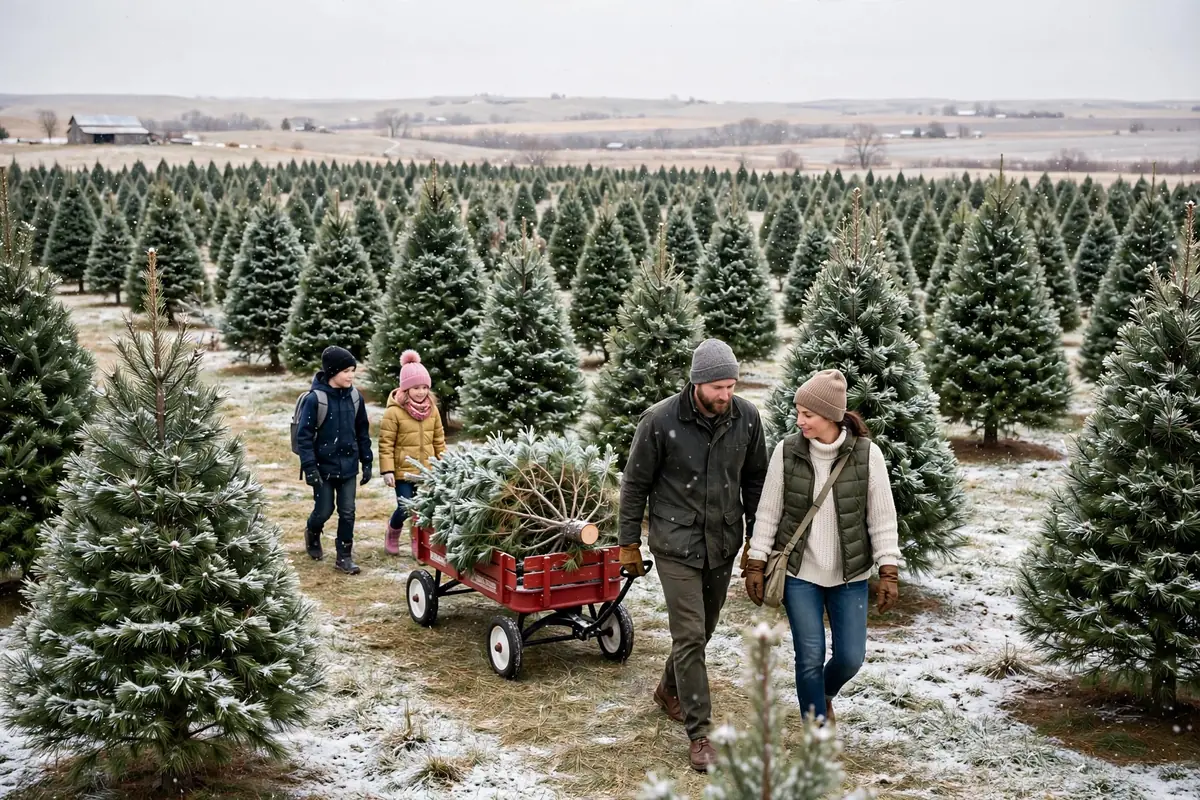
Nebraska tree farms in late November have a look all their own: big sky, rows of snow-dusted evergreens stretching to the horizon, and families hauling their trees back to the cabin on red wagons. It is worth braving the cold for.

Pro tip for photos: the light is best in the hour before sunset, and a snow-dusted field at golden hour is about as festive as a backdrop gets. Just keep the camera batteries warm — cold drains them fast.
Watch: Opening Weekend at a Nebraska Tree Farm
This local news segment captures opening weekend at Walnut Grove Tree Farm near Raymond — the crowds, the cabin, the wood stove, and an interview with the owner about four decades of growing Christmas trees on the Plains. It is the best ten-minute preview of what your own visit will feel like.
Notice how many families in the video mention tradition — that is the real product Nebraska tree farms sell. The tree is the souvenir; the morning in the field is the point.
Your Visit-Day Game Plan
Nebraska farm visits reward preparation more than most, because the weather is real and the farms are rural. Here is the game plan that works.
Time it right. Opening weekend — the days right after Thanksgiving — has the best selection and the most festive energy, but also the biggest crowds. The second weekend is the sweet spot for most families: still-great selection, shorter lines at the baler. By the third weekend, selection thins and some farms sell out. For 2026, confirm each farm’s exact opening dates — check official listings or call ahead for 2026 season hours.
Bring cash and checks. Multiple respected farms in the area operate cash-and-check only. Even at farms that take cards, rural card readers fail. Bring enough to cover the tree plus wreaths, stands, and cocoa money, and you will never be the family doing mental math at the register.
Dress warmer than you think. A calm 30-degree day in a windy, open field feels much colder, and you will be standing around while the crew shakes and bales your tree. Insulated boots, windproof outer layers, hats, and gloves are non-negotiable — especially for kids, who feel the cold first and complain loudest. Hand warmers in everyone’s pockets cost almost nothing and save the outing.
Measure at home first. Ceiling height minus the stand minus the topper — write it on your phone. Trees look dramatically shorter in an open field than in your living room, and “it looked smaller outside” is the most common regret farm owners hear. Also check your vehicle’s roof or bed length before you fall in love with a twelve-footer.
Bring the gear. Most farms provide saws and wagons, but bring your own work gloves, a tarp or old blanket for the roof, and rope or ratchet straps. If you are cutting, a folding pruning saw from home is often sharper than the communal farm saws — just check that the farm allows outside saws.
Make it a day. The Lincoln-area farms pair beautifully with the rest of the season. After the tree is home and watered, keep the momentum going: our guide to the best Christmas light displays and drive-throughs is the perfect evening follow-up, and the Christmas trivia questions make a great fireside activity while the tree settles. And if you grabbed a fresh wreath at the farm, our wreath ideas for the front door will help you style it.
Keeping a Nebraska Tree Fresh Indoors
Plains-grown pines are hardy, but indoor heat is the enemy of every cut tree. The protocol: fresh cut half an inch off the trunk the moment you get home, straight into a stand with a big water reservoir, and check the water every single day — a fresh-cut tree can drink a gallon in 24 hours, and once the trunk seals from dryness, no amount of watering reopens it. Keep the tree away from heating vents, fireplaces, and sunny south windows. Plain water only; the additives do not help. Done right, a Nebraska Scotch or white pine cut Thanksgiving weekend will still look full and smell great on Christmas morning.
Frequently Asked Questions About Christmas Tree Farms Near Lincoln
When do tree farms near Lincoln open for the 2026 season?
Most farms open the day after Thanksgiving or the weekend before it, and run through mid-December or until sold out. Early tree-tagging events, where offered, typically happen in October. Exact 2026 dates vary by farm — check official listings or call ahead for 2026 season hours.
How much does a cut-your-own tree cost near Lincoln?
Pricing is set by each farm at the start of the season and varies by species and height. Many Nebraska farms price by the foot. For accurate 2026 pricing, check the farm’s official listings or call ahead — and bring cash or a checkbook, since several farms do not take cards.
Which tree species are actually grown in Nebraska?
Scotch pine, white pine, Canaan fir, Concolor fir, and various spruces are the reliable locally grown species. True Fraser firs struggle in Nebraska’s climate, so they are usually sold as shipped-in pre-cut trees rather than cut-your-own. A good farm will tell you exactly which is which.
Can I tag a tree early and come back to cut it?
Some farms, notably Spilker’s Pineridge, offer early tagging events in the fall. Policies differ by farm, so ask directly — and if you tag, make sure you understand the farm’s rules about when you must return to cut.
Are the farms dog-friendly?
Policies vary. Some farms welcome leashed dogs in the fields; others do not allow pets. Confirm with the specific farm before bringing your dog.
What happens if it snows on the day we plan to go?
Nebraska farms operate in snow — it is part of the charm. Fields can get slippery and wagons harder to pull, so wear proper boots and give yourself extra time. Only severe weather closes farms, and they will announce it on their official pages.
Do I need to bring my own saw?
Most farms provide saws and wagons, but a sharp folding saw from home often cuts faster. Check the farm’s policy on outside saws first — and always supervise children around any cutting tools.
Make It Your Family’s Tradition
The christmas tree farms near Lincoln 2026 are not just retail outlets; they are working farms run by families who have spent decades learning how to grow evergreens on some of the most challenging tree-growing land in the country. Whether you choose the in-town convenience of Spilker’s, the log-cabin warmth of Walnut Grove, the traditional fields of Yonkey Pine, the heritage of Windmill Pines, or the donkeys and Holiday Barn of Clover B, you are buying more than a tree — you are buying the morning. Go early in the season, dress for the wind, bring cash, measure twice, and check official listings or call ahead for 2026 season hours. Then settle in for the season with the rest of our Christmas guides, from gingerbread house decorating tips to advent calendar activities for kids. Merry Christmas, and happy sawing.