Valentine’s Day in Scotland carries a flavor all its own. Alongside the familiar cards, flowers, and dinners, Scotland brings centuries of love tokens to the table: silver heart brooches pinned at betrothals, carved wooden love spoons, and old customs like the Valentine’s lottery, where names drawn from a hat decided who would be whose Valentine for the day. This guide explores Scotland’s Valentine’s traditions old and new, the love tokens that made them famous, and how modern Scots celebrate February 14 from Edinburgh to the Highlands.
Scotland’s relationship with Valentine’s Day runs deeper than most people realize. The country produced some of the earliest written valentines in English, nurtured a jewelry tradition built entirely around tokens of love, and preserved folk customs that turned February 14 into a community celebration rather than a purely couple-focused one. Even today, Scottish Valentine’s Day has a slightly different texture: more emphasis on tokens and keepsakes, more appetite for history, and a romantic imagination shaped by castles, glens, and a literary tradition that made love feel epic.
Scotland’s Old Valentine’s Customs
Long before Valentine’s Day became a card-and-chocolate holiday, Scotland had its own February 14 folk traditions. One of the most charming was the Valentine’s lottery or Valentine’s draw. In many communities, young people would gather and draw names from a hat: each person drew the name of someone of the opposite sex, and the two became Valentines for the day, exchanging small gifts and spending the celebration together. Some accounts describe the first person of the opposite sex encountered on the street on Valentine’s morning becoming one’s Valentine, a custom with parallels in parts of England.
These customs made Valentine’s Day a social occasion rather than an exclusively romantic one. The emphasis was on luck, play, and community: who you drew was fate’s business, and the day belonged to everyone. Traces of this communal spirit survive in the way Scottish schools and workplaces still treat the day with card exchanges and lighthearted games, and in the Scottish fondness for Burns Night-style conviviality applied to February 14. For a broader look at how the holiday evolved worldwide, see our guide to Valentine’s Day traditions around the world.
Scotland also has a claim on some of the earliest valentine writing. The literary culture of medieval and early modern Scotland was rich in love poetry, and the Scots language produced love lyrics of remarkable tenderness. Robert Burns, Scotland’s national bard, wrote some of the most enduring love poetry in the English language, and his songs remain a living part of Scottish Valentine’s culture: quoting Burns in a card is practically a national custom. “My Luve is like a red, red rose” may be the most borrowed Valentine’s line in Scotland.
The Luckenbooth: Scotland’s Great Love Token
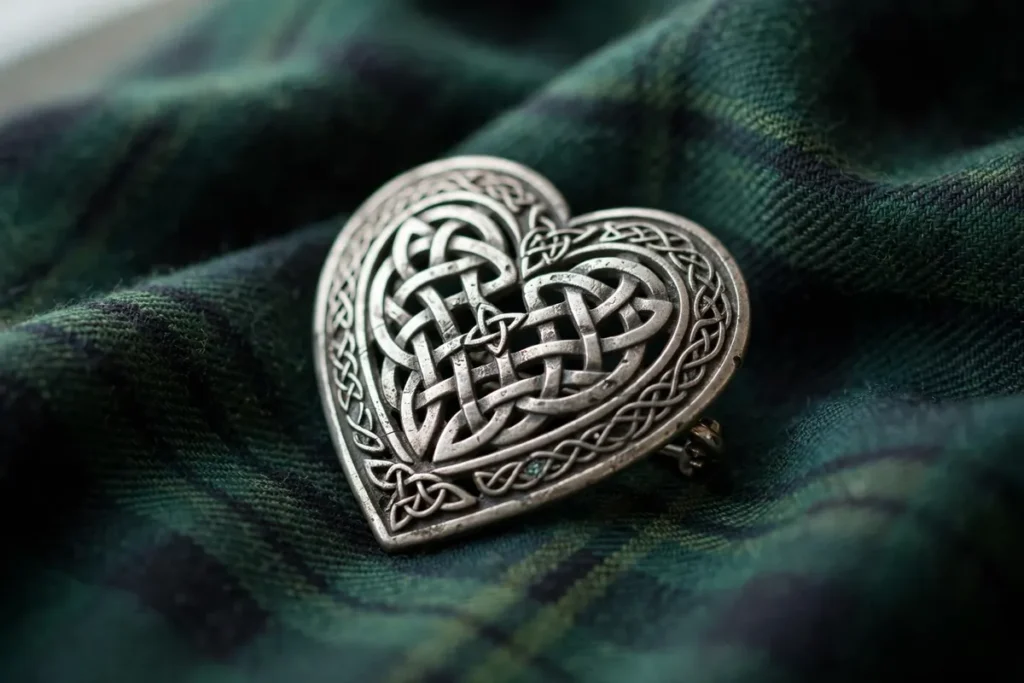
No symbol captures Scottish Valentine’s tradition better than the luckenbooth brooch. This heart-shaped brooch, often featuring two entwined hearts crowned with a royal crown, has been given as a token of love, betrothal, and marriage in Scotland for centuries. The earliest examples in Scotland’s national collections date back hundreds of years, and the design evolved from simple engraved silver hearts into elaborate pieces set with agate, garnets, and other stones.
The luckenbooth’s symbolism is layered. The heart (or hearts) stands for love; the crown stands for loyalty, and in some tellings for the royal favor of Mary, Queen of Scots, with whom the design is traditionally associated. Early brooches were often engraved with romantic mottoes. The brooch was given at betrothals and weddings, and it also served as a protective charm: pinned to a baby’s clothes to ward off the evil eye, or worn by nursing mothers as a talisman. Love, loyalty, and protection in a single object.
The name itself is part of the romance. The traditional story holds that it comes from Edinburgh’s Luckenbooths, the locked booths of the goldsmiths and jewelers on the Royal Mile where such brooches were sold. Modern scholarship has complicated that story, but the name stuck, and with it the image of lovers choosing tokens in the shadow of Edinburgh Castle. Today the luckenbooth is widely available from Scottish jewelers in silver and gold, from simple modern interpretations to Victorian-style agate pieces, and giving one remains one of the most distinctively Scottish Valentine’s gestures imaginable.
For couples drawn to meaningful jewelry rather than generic gifts, the luckenbooth tradition pairs naturally with our guide to Valentine’s Day jewelry gifts, which covers how to choose pieces that carry personal significance.
Love Spoons and Other Scottish Keepsakes
Scotland shares with Wales the tradition of carved love spoons, though the Welsh version is more famous. In both countries, young men carved wooden spoons as courtship tokens, decorating them with symbols: hearts for love, keys for security, wheels for hard work, bells for marriage. A spoon presented to a sweetheart was a declaration made in wood, and the finest examples are genuine folk art. Antique Scottish love spoons appear in museum collections and still inspire modern woodworkers.
Beyond spoons and brooches, Scotland’s love-token tradition includes engraved quaichs (the traditional Scottish drinking cup, often given at weddings and sometimes called the cup of love), Celtic knotwork jewelry symbolizing eternal love, and the handfasting cord: the ribbon used in the ancient Scottish custom of handfasting, in which a couple’s hands are bound together as a marriage rite. Handfasting has seen a modern revival, and many Scottish couples now incorporate it into weddings and commitment ceremonies, sometimes on Valentine’s Day itself.
What unites these tokens is a Scottish attitude toward love gifts: they should be made to last, carry meaning in their making, and preferably connect to something older than the couple. A luckenbooth brooch or a carved spoon is not a disposable gift; it is an heirloom in the making. That philosophy makes Scottish Valentine’s gifting feel weightier than the international norm, in the best way.
Key Facts: Scottish Valentine’s Traditions
| Tradition or token | What it is | Era |
|---|---|---|
| Luckenbooth brooch | Heart-shaped silver brooch, often crowned; betrothal and love token | 17th century onward (earlier heart brooches exist) |
| Valentine’s lottery | Drawing names from a hat to determine Valentines for the day | Folk custom, early modern period |
| Love spoons | Hand-carved wooden spoons with love symbolism, given in courtship | Centuries-old folk craft |
| Quaich | Traditional two-handled drinking cup exchanged at weddings | Traditional, still given today |
| Handfasting | Binding of hands with ribbon as a marriage rite | Ancient custom, modern revival |
| Burns love poetry | Quoting Robert Burns in cards and toasts | 18th century to present |
How Modern Scots Celebrate February 14
Modern Scottish Valentine’s Day will look familiar to anyone who knows the British version: cards, flowers, chocolates, restaurant dinners, and a great deal of last-minute panic buying on February 13. Scotland follows the UK pattern closely, with the holiday fully commercialized and widely observed by couples. Edinburgh and Glasgow see the same restaurant rush as London, and florists do the same brisk trade.
But Scottish distinctiveness peeks through. The appetite for experience over objects is strong: a Valentine’s walk up Arthur’s Seat at dawn, a weekend in a Highland lodge, a distillery tour for two, a ceilidh with a Valentine’s theme. Scotland’s tourism industry leans into February with romantic packages, and the country’s dramatic winter landscapes do half the work. A Scottish Valentine’s Day spent outdoors, in bracing air with spectacular views, has a character that no city dinner can match.
Food and drink play their expected role. Scottish restaurants offer Valentine’s menus, but many couples opt for the Scottish classics: a seafood dinner in a coastal town, a whisky tasting for two, or a home-cooked meal featuring local produce. Haggis is rarely on the Valentine’s menu, but smoked salmon, Aberdeen Angus beef, and a good single malt certainly are. The Scottish Valentine’s table is hearty rather than fussy.
Cards deserve a special mention because Scotland’s literary culture makes the written valentine matter more. A Scottish Valentine’s card is likelier to contain an actual message, a Burns quotation, or a few lines of original verse than its equivalents elsewhere. The bar is higher, but so is the reward: in a culture that reveres its poets, words carry weight.
Romantic Scotland: A Valentine’s Map
Scotland’s romantic geography is one of its greatest assets. Edinburgh, with its castle, closes, and candlelit old-town restaurants, is the obvious Valentine’s city break. But the country’s romantic credentials extend far beyond the capital: the Isle of Skye’s otherworldly landscapes, the bonnie banks of Loch Lomond, the beaches of the Outer Hebrides, and the whisky country of Speyside all make extraordinary Valentine’s destinations.
Sweetheart Abbey in Dumfries and Galloway deserves special mention for Valentine’s pilgrims. Founded in the thirteenth century by Lady Dervorguilla in memory of her husband, and named for the embalmed heart she carried with her, it is quite literally a monument to devoted love. Its romantic ruins draw couples year-round, and it makes a poignant Valentine’s excursion.
Edinburgh: Scotland’s Valentine’s Capital
Edinburgh in February is made for Valentine’s Day. The city’s medieval Old Town, all closes and candlelit windows, looks its most romantic in winter light, and the restaurant scene rises to the occasion with Valentine’s menus across the New Town. A classic Edinburgh Valentine’s day might run: morning climb up Arthur’s Seat or Calton Hill for panoramic views, afternoon wandering the Royal Mile and its museums (the National Museum of Scotland holds luckenbooth brooches in its collections, a perfect Valentine’s exhibit), and evening dinner in a historic setting.
The Witchery by the Castle, tucked beside Edinburgh Castle on the Royal Mile, is the city’s legendary romantic hotel and restaurant, famous for its gothic opulence and candlelit suites. Booking well ahead is essential. For something less grand but equally atmospheric, the pubs and bistros of Stockbridge, the Shore in Leith, and the Grassmarket offer cozy Valentine’s dinners without the white-tablecloth formality. And no Edinburgh Valentine’s is complete without a walk: the Water of Leith walkway, the Meadows, or a nighttime stroll past the floodlit castle.
Beyond Edinburgh, Glasgow offers its own Valentine’s appeal with a superb restaurant scene and legendary nightlife, while the Highlands and islands offer the escape option: a lochside hotel, a log fire, and nothing on the schedule. Scotland’s romantic geography means the Valentine’s choice is really between the city’s candlelit intimacy and the countryside’s dramatic solitude, and there is no wrong answer.
Watch: A Valentine’s Adventure at Sweetheart Abbey
This Valentine’s Day travel video follows a road trip to Sweetheart Abbey in Dumfries, the thirteenth-century abbey founded as a memorial to love, exploring its ruins and romantic history. It captures the Scottish talent for finding romance in atmospheric places.
Planning a Scottish Valentine’s: Practical Ideas
If you want to celebrate Valentine’s Day the Scottish way, start with a token that means something. A luckenbooth brooch from a Scottish jeweler, even a modest silver one, carries more Scottish romance than any imported gift. Pair it with words: write a card with a Burns line or a few honest sentences of your own. Then plan an experience: a walk somewhere beautiful, a meal featuring Scottish produce, a whisky tasting, or a weekend away in the Highlands.
For dinner, book early: Edinburgh and Glasgow restaurants fill up for February 14 just as they do everywhere. Consider the Scottish alternative of celebrating on a nearby weekend night, when the Highlands are quieter and the restaurants less frantic. And if the weather cooperates, which in February is never guaranteed, get outside: Scotland’s winter light is extraordinary, and a windswept coastal walk followed by a fireside pub is a Valentine’s Day that neither partner will forget.
Couples planning a bigger romantic trip will find our worldwide romantic weekend getaways guide useful for structuring a longer escape, and our Valentine’s Day date ideas collection offers dozens of ways to fill the day itself.
Scotland’s Valentine’s Day in Literature and Song
No country has put love into words quite like Scotland, and that literary heritage shapes how Scots approach Valentine’s Day to this day. Robert Burns is the towering figure: his “Ae Fond Kiss,” “John Anderson My Jo,” and “My Luve is like a red, red rose” are woven into the fabric of Scottish romantic life. On Valentine’s Day, Burns is quoted in cards, recited at dinners, and sung at ceilidhs across the country. To give a Scottish valentine without a literary flourish is to miss an opportunity the culture practically hands you.
But Burns is only the beginning. The medieval Scottish makars, the court poets of the fifteenth and sixteenth centuries, wrote love poetry of extraordinary sophistication. William Dunbar’s work includes tender and comic treatments of love and marriage. The ballad tradition, collected and preserved in Scotland more completely than anywhere else in the English-speaking world, is full of tragic and devoted lovers: “Barbara Allen,” “The Twa Corbies,” and dozens more. These are not Valentine’s verses in the modern sense, but they are the deep background music of Scottish romantic feeling.
Sir Walter Scott added the Romantic-era layer: his novels and poems made Scottish landscapes themselves romantic, turning the Highlands into a setting where love felt larger than life. That imaginative geography still works on visitors today. And in the twentieth century, Scottish songwriters from the folk revival onward kept the tradition alive. A Scottish Valentine’s playlist might run from Burns through the Corries to contemporary indie folk, and it would all feel of a piece: love, landscape, and longing braided together.
For the card-writer, this heritage is a practical resource. A Burns quotation is never wrong, but the more personal the choice, the better it lands. A line from a ballad that means something to the couple, a verse from a song they share, or a few original lines in the spirit of the tradition will always outperform a generic printed sentiment. Scotland’s message to Valentine’s card writers is simple: the words are the gift.
A Scottish Valentine’s Gift Guide: Tokens Worth Giving
If you want to give a Valentine’s gift with genuine Scottish character, the tradition offers a clear hierarchy of meaningful choices. At the top stands the luckenbooth brooch: available from Scottish jewelers in sterling silver from modest prices to elaborate Victorian-revival pieces set with agate. Choose based on the recipient’s style rather than price; a simple silver heart brooch given with a heartfelt note will always beat an expensive piece given thoughtlessly. Many jewelers offer engraving, and adding initials or a date makes the token truly personal.
Second in the hierarchy are the crafted keepsakes: a hand-carved love spoon from a Scottish woodworker, an engraved quaich for a couple to share their first dram, or a piece of Celtic knotwork jewelry. These gifts work because they carry the maker’s hand and the tradition’s weight. Buy from artisans rather than souvenir shops where possible; the difference in quality is immediately visible, and many Scottish craftspeople sell directly online.
Third are the experience gifts with Scottish flavor: a whisky tasting for two at a favorite distillery, a weekend in a Highland hotel, tickets to a concert or ceilidh, or a Burns Supper-style dinner at home (though Burns Night is January 25, its format adapts beautifully to Valentine’s Day). Experiences suit the Scottish Valentine’s temperament, which values shared time over displayed wealth.
Finally, the classics still work: flowers, chocolate, and a good dinner are as welcome in Scotland as anywhere. The Scottish twist is in the details: seasonal Scottish flowers where available, excellent chocolate, and a restaurant chosen for its food rather than its Valentine’s marketing. And whatever you give, write the card properly. In Scotland, the words are never the afterthought.
Frequently Asked Questions
What is a luckenbooth brooch?
A luckenbooth is a traditional Scottish heart-shaped brooch, often featuring two entwined hearts topped with a crown. Given as a token of love, betrothal, or marriage since at least the seventeenth century, it symbolizes love and loyalty. Early examples were engraved silver hearts; later versions added gemstones such as agate and garnets. The design is traditionally linked with Mary, Queen of Scots, and the name is said to come from Edinburgh’s Luckenbooths, the jewelers’ booths on the Royal Mile. It remains one of Scotland’s most distinctive Valentine’s and wedding gifts, widely available from Scottish jewelers in both traditional and modern styles.
What were Scotland’s old Valentine’s Day customs?
The best-known was the Valentine’s lottery: young people drew names from a hat, and each pair became Valentines for the day, exchanging gifts. Another custom held that the first person of the opposite sex met on Valentine’s morning became one’s Valentine. These folk traditions made the day a community celebration rather than a purely couple-focused one.
Do Scots still give love spoons?
Carved love spoons are more strongly associated with Wales today, but Scotland shares the tradition, and antique Scottish examples survive in museum collections. Modern woodworkers in both countries still carve them, and they make meaningful handmade Valentine’s gifts for couples who value craft traditions.
What is Sweetheart Abbey’s connection to Valentine’s Day?
Sweetheart Abbey in Dumfries was founded in the thirteenth century by Lady Dervorguilla as a memorial to her husband John Balliol; she carried his embalmed heart with her, giving the abbey its name. It is one of Scotland’s most romantic historic sites and a popular Valentine’s-season visit for couples.
How do modern Scots celebrate Valentine’s Day?
Much like the rest of the UK: cards, flowers, chocolates, and restaurant dinners. Distinctively Scottish touches include quoting Robert Burns in cards, giving love tokens like luckenbooth brooches, and favoring experiences such as Highland weekends, distillery tours, and scenic winter walks. Booking restaurants early for February 14 is essential in Edinburgh and Glasgow.
What is handfasting?
Handfasting is an ancient Scottish custom in which a couple’s hands are bound together with ribbon or cord as part of a marriage rite. It has seen a modern revival, and many Scottish couples now include handfasting in weddings, commitment ceremonies, and sometimes Valentine’s Day celebrations as a symbolic gesture of union.
Where can I see historic luckenbooth brooches in Scotland?
The National Museum of Scotland in Edinburgh holds an important collection of historic heart and luckenbooth brooches, including early engraved silver examples. It makes an excellent Valentine’s-season visit for couples interested in the jewelry tradition. Scottish jewelers across the country, particularly in Edinburgh, Glasgow, and Inverness, sell modern interpretations for those who want to give one.