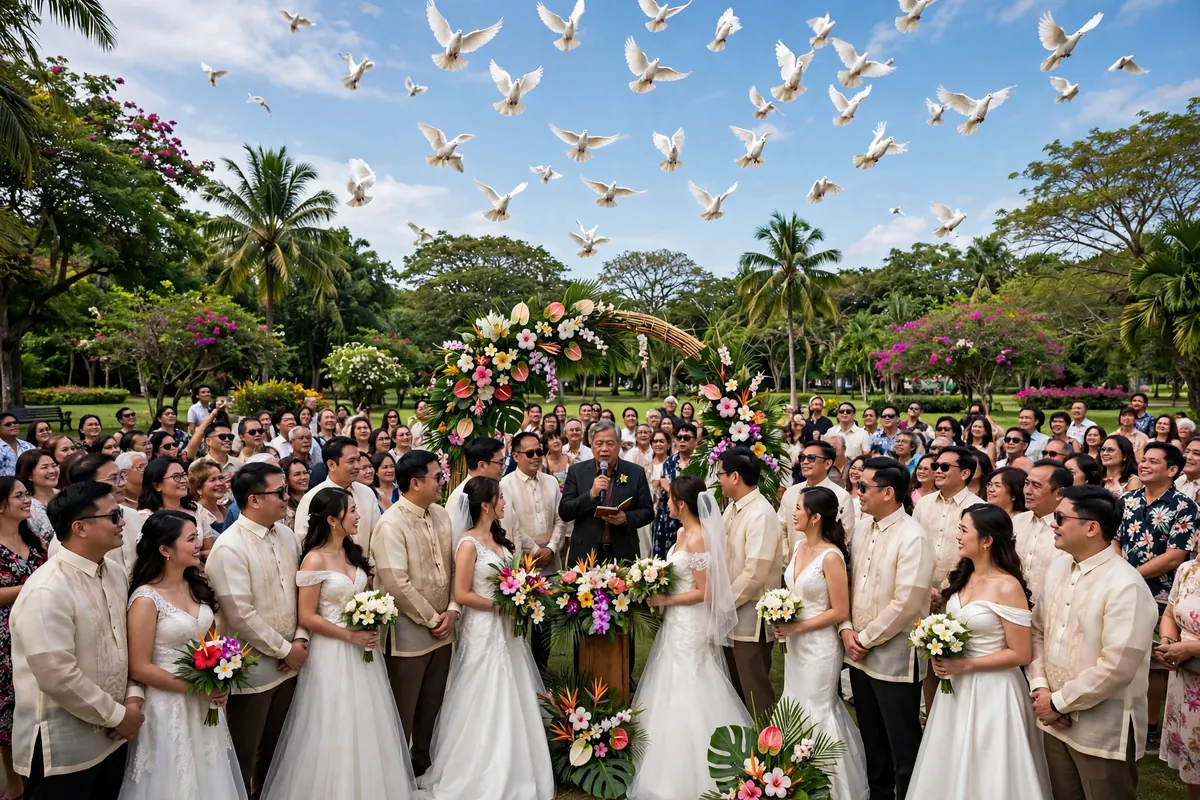
In most countries, Valentine’s Day is about dating. In the Philippines, it’s about marrying — hundreds of couples at a time, in public parks and gymnasiums and plazas, dressed in white and barong tagalog, exchanging vows before mayors, priests, and cheering crowds. The Filipino Valentine’s doesn’t ask will you be mine? It asks, in front of everyone: will you marry me — right now, with all these witnesses?
The Kasalang Bayan — the “town wedding,” the mass wedding — is the Philippines’ signature Valentine’s tradition: free, government-sponsored ceremonies that turn February 14 into the country’s biggest wedding day. This guide goes inside the phenomenon, from the couples who wait decades for their chance to the mayors who officiate, the doves that get released, and the grand gestures that make Filipino Valentine’s unlike any other.
Why Valentine’s Day Is Wedding Day in the Philippines
The logic is beautifully practical. Getting married in the Philippines — as anywhere — costs money: licenses, venues, clothes, food, paperwork. For many Filipino couples, especially those who have lived together for years or even decades, the wedding keeps getting postponed behind life’s other expenses. The Kasalang Bayan removes every barrier at once: local government units organize the ceremony, cover the costs (often including rings, attire, flowers, and the reception), and provide the officiant — usually the mayor, sometimes a priest.
February is the natural home for it. Not only is the 14th Valentine’s Day, but February is also Civil Registration Month in the Philippines — the Philippine Statistics Authority’s annual campaign promoting the importance of civil registration, including marriage registration. The Kasalang Bayan is explicitly framed as both a romantic celebration and a civic good: formalizing unions gives couples — and especially their children — legal security, inheritance rights, and peace of mind.
The result is a Valentine’s Day with real social weight. This isn’t a Hallmark holiday; it’s a government program that marries people. Mayors speak about it in terms of public service, not romance — legitimizing unions, strengthening families, promoting responsible parenthood. The romance is the vehicle; the destination is legal, familial, and communal.
Inside a Kasalang Bayan
Picture the scene, repeated in hundreds of venues across the archipelago every February 14. At Paco Park in Manila, 271 couples gathered for one recent Valentine’s Kasalang Bayan — the women in white dresses, the men in barong tagalog, polo shirts, or tuxedos. Each couple gets their own entrance, walking down the aisle in turn. A priest officiates; district councilors stand as principal sponsors. The couples exchange rings, share wedding cake, seal the ceremony with a kiss — and then, in a touch of pure Filipino pageantry, doves are released on behalf of all the newlyweds.
In Gapan City, Nueva Ecija, the scale is staggering: 234 couples married in a single gymnasium ceremony, with the local government providing free gold wedding rings, gowns and barongs, bouquets, flower arrangements, and a full reception for all the guests. In the SOCCSKSARGEN region, 225 couples were married across multiple municipalities in a single Valentine’s Day, with Philippine Statistics Authority officials attending to underscore the civil-registration mission. In Iligan City, 97 couples; in Mambajao, Camiguin, 61 more — each ceremony a full wedding, with all the trimmings, for people who could never have afforded one alone.
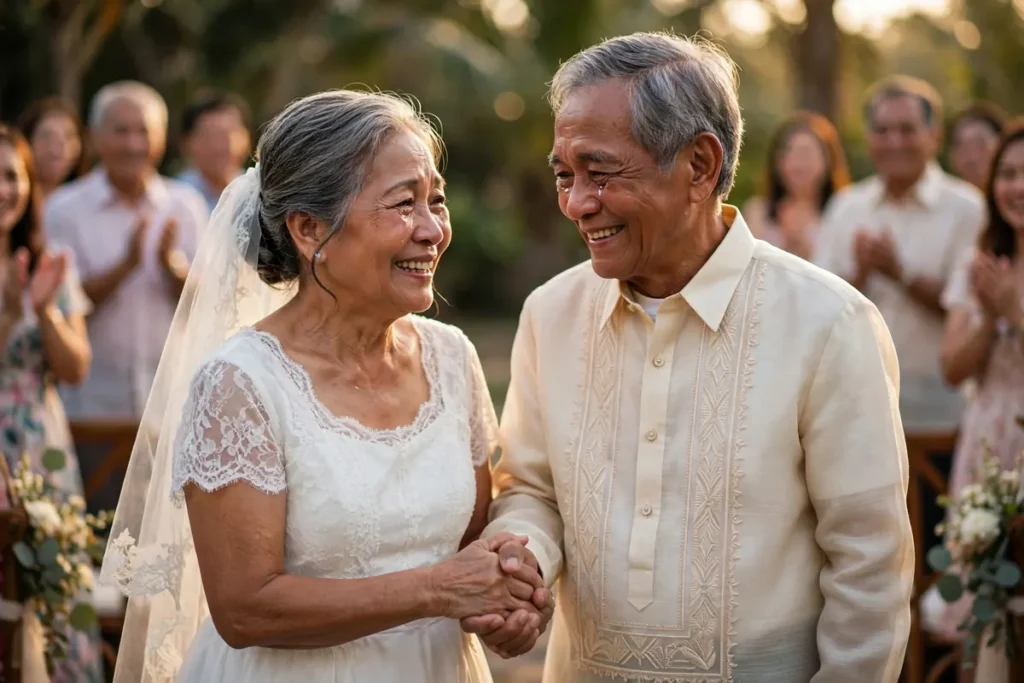
The couples themselves are the story. Ronald and Remedios, married at the Manila ceremony, had been together for 40 years and had four grown children — but had never formalized their union until the Kasalang Bayan gave them the chance. “Now the opportunity has finally come in our lives,” Remedios said. In Surigao City’s annual Kasalan sa Valentine’s Day, the youngest couple were both 18; the oldest were a 64-year-old groom and his 63-year-old bride. In General Tinio, a Philippine Army soldier and his partner — together for years, parents of a 7-month-old — chose the mass wedding to legalize their family.
These are not shotgun weddings or publicity stunts. They are the formalization of real, long-standing love — given, finally, the ceremony it deserved. The mayors who officiate speak about it with visible emotion; the crowds of family members cheer like it’s a festival. Because it is one.
The Philippines’ Valentine’s at a Glance
| Detail | What to Know |
|---|---|
| Date | February 14 — Valentine’s Day doubles as mass-wedding day |
| The tradition | Kasalang Bayan (“town wedding”) — free, government-sponsored mass weddings |
| Organizers | Local government units (mayors officiate); often tied to Civil Registration Month |
| Scale | Hundreds of couples per ceremony; recent examples: 271 in Manila, 234 in Gapan City, 225 across SOCCSKSARGEN |
| What’s provided | Often rings, attire (barong tagalog/gowns), bouquets, cake, reception |
| Who it’s for | Especially long-term unmarried couples and financially strapped pairs |
| The point | Legalize unions, strengthen families, celebrate love — all at once |
Watch: A Kasalang Bayan Mass Wedding
Real footage from a Kasalang Bayan mass wedding in Las Piñas — hundreds of couples, one ceremony, and the pageantry of the Philippines’ most meaningful Valentine’s tradition.
Grand Gestures: The Rest of the Filipino Valentine’s
The mass weddings are the headline, but Filipino Valentine’s culture runs deeper — a blend of Catholic devotion, American influence, and native romantic traditions that makes February 14 one of the year’s great social occasions.
Harana — the serenade — still lives. The traditional Filipino courtship serenade, in which a suitor sings beneath his beloved’s window (often with friends providing guitar accompaniment), is rarely practiced in its old form — but its spirit survives in Valentine’s concerts, surprise performances, and the extraordinary Filipino love of the grand musical gesture. The 2026 Pasig City Kasalang Bayan featured a surprise serenade by the beloved band Ben&Ben, performing for 30 newlywed couples — a very modern harana, and reportedly an unforgettable one.
Flowers, malls, and the Valentine’s economy. Like elsewhere, florists do enormous business — roses, often imported, command premium prices. But the Filipino Valentine’s has its own commercial geography: the shopping mall. Malls across the country run Valentine’s programs — couple contests (including, in some towns, “longest kiss” competitions), concerts, and decorations — turning the air-conditioned mall into the default Valentine’s venue for millions. It’s practical (February is hot in much of the country) and social: the Filipino Valentine’s is celebrated together, in crowds, not just in couples.
Church and devotion. The Philippines is Asia’s most Catholic nation, and Valentine’s Day carries a devotional undertone many countries have lost. Couples attend Mass together; some make pilgrimages; Tagaytay City holds its Pista ng Pag-ibig (Feast of Love) in honor of its patroness. The sacred and the romantic aren’t separated here — they’re the same impulse, expressed two ways.
Family is the unit, not the couple. Perhaps the most distinctive feature: the Filipino Valentine’s is a family occasion as much as a couples’ one. The Kasalang Bayan crowds are full of children, parents, grandparents — whole extended families celebrating the couple’s formalization. Gifts flow between family members; balikbayan relatives time visits for February. Love, in the Filipino understanding, was never just about two people. For gift ideas that honor that expansive spirit, our Valentine’s Day gifts for her guide works — but consider buying for the whole family.
Timeline: How February 14 Became Wedding Day
Spanish colonial era: Catholic marriage culture
Three centuries of Spanish rule embed Catholic marriage as the social and legal norm — and embed the church wedding as an expensive, aspirational event many poor couples postpone indefinitely.
20th century: The Kasalang Bayan emerges
Local governments begin organizing sponsored mass weddings as a social service — free ceremonies for couples who can’t afford private ones. The practice spreads across the archipelago’s thousands of municipalities.
Valentine’s Day convergence
The Kasalang Bayan tradition merges with February 14, the most romantic date on the calendar. Mayors discover that Valentine’s mass weddings draw the biggest crowds and the most goodwill — the tradition becomes annual and expected.
February as Civil Registration Month
The Philippine Statistics Authority’s annual Civil Registration Month campaign gives the Valentine’s Kasalang Bayan an official civic frame: every February, the state actively promotes marriage registration alongside the romance.
2010s–2020s: The spectacle grows
Ceremonies get bigger and more elaborate — hundreds of couples, full receptions, celebrity serenades, dove releases, media coverage. The Kasalang Bayan becomes one of the Philippines’ signature cultural exports: proof that a government program can be genuinely moving.
Myth vs. Fact: The Filipino Valentine’s
Myth: Mass weddings are just for show.
Fact: They’re a serious social service with legal consequences. Formalizing a union affects inheritance, children’s legitimacy and rights, and access to spousal benefits. The pageantry is real, but so is the paperwork — and the paperwork is the point.
Myth: Only young couples get married at Kasalang Bayan.
Fact: The ceremonies famously include couples together for decades — 40 years in one documented case — plus very young couples and elderly newlyweds alike. The common thread isn’t age; it’s that the wedding was previously out of reach.
Myth: The ceremonies are purely civil/secular.
Fact: They vary: some are officiated by mayors (civil), others by priests (religious), and many blend both. The Philippines’ Catholic culture means faith is often woven into even the government-run events.
Myth: Filipino Valentine’s is just like American Valentine’s.
Fact: The American influence is real (malls, flowers, cards), but the Kasalang Bayan, the family-centered celebration, and the devotional dimension make the Filipino February 14 structurally different — more communal, more consequential, and more public.
Myth: The couples don’t get a “real” wedding experience.
Fact: By every account, they do — the aisle walk, the rings, the kiss, the cake, the reception, the doves. Many participants describe it as the wedding they’d always dreamed of. Shared with 200 other couples, but no less real for that.
How to Celebrate Like a Filipino
1. Make it communal
The Filipino Valentine’s rejects the couples-in-a-bubble model. Invite the family. Bring the kids. Celebrate in a crowd. Love, in this tradition, is something you witness together — and the witnessing is part of the joy.
2. Formalize something
You don’t need a mayor and 200 witnesses, but borrow the Kasalang Bayan spirit: use Valentine’s Day to make something official. Renew vows. Sign the paperwork you’ve been postponing. Write the will. Put the relationship’s legal house in order — the least romantic-sounding, most loving thing you can do.
3. Go big on the gesture, not the budget
The harana tradition — the serenade — is about effort and courage, not money. Sing (badly, if necessary). Perform. Gather friends for a surprise. The Filipino grand gesture is measured in embarrassment risked, not pesos spent. Our Valentine’s Day date ideas can supply the framework; you supply the nerve.
4. Include the devotion
Whatever your faith or none, borrow the Filipino instinct to mark the day as significant — not just fun. A moment of gratitude, a shared intention, a visit to somewhere meaningful. The sacred and the romantic reinforce each other.
5. Feed everyone
No Filipino celebration is complete without a feast — and the Kasalang Bayan receptions, serving hundreds, are the ultimate expression. Your version: cook for the extended circle, not just the couple. Abundance is the love language. If a getaway is more your style, our romantic getaways guide applies the same principle — togetherness at scale.
The Couples’ Stories: Why They Waited
Statistics make the Kasalang Bayan impressive; the couples make it unforgettable. Behind every mass wedding are hundreds of individual answers to the same question: why did you wait?
Money, almost always. A private Filipino wedding — even a modest one — can cost several months’ wages for a working-class family. Venue, food for dozens of expected guests (Filipino weddings are rarely small), attire, documentation fees, the church stipend: it adds up faster than savings do. For couples raising children on daily wages, the wedding fund keeps losing to school fees, medical bills, and rice. The Kasalang Bayan doesn’t just offer a free wedding; it offers permission to stop waiting — a date, a venue, and a community that says now.
Life kept happening. Ronald and Remedios — together 40 years, four grown children — are the extreme case, but their story is the common one in miniature: the years filled up with everything except the ceremony. Couples describe the same arc again and again: we meant to, then the children came, then work, then it felt too late, then it felt unnecessary — until the Kasalang Bayan made it feel possible again. The mass wedding works because it removes not just cost but inertia.
What changes after. Ask the newlyweds what the ceremony gave them and the answers go beyond romance. Legal marriage in the Philippines affects children’s birth registration and legitimacy status, inheritance rights, hospital decision-making, and access to spousal government benefits. A 64-year-old groom marrying his 63-year-old partner isn’t performing romance for an audience — he’s securing her future. Mayors and social workers frame the program exactly this way: marriage as social protection, delivered with flowers and doves.
The children watch. Perhaps the most moving detail in the reporting: the grown children of long-unmarried couples, standing in the crowd, watching their parents finally marry. For them, the Kasalang Bayan isn’t about their parents’ romance — it’s about legitimacy, pride, and the strange, late-arriving completeness of seeing your family made official. Several couples have described their adult children’s tears as the day’s real ceremony.
Valentine’s Day Across the Archipelago: Regional Variations
The Philippines is 7,641 islands, and February 14 wears different clothes in different places.
Manila: the grand stage. The capital’s ceremonies are the biggest and most covered — Paco Park’s 271-couple wedding, Pasig City’s Ben&Ben-serenaded ceremony for 30 couples officiated by Mayor Vico Sotto. Manila does the Kasalang Bayan as civic spectacle, with full media presence and maximum pageantry.
Cavite: the love province. Cavite leans into February as “Love Month” — Tagaytay City’s Pista ng Pag-ibig (Feast of Love), Bacoor’s hundred-couple ceremonies with the mayor as both officiant and godmother (ninang), best-dressed-couple cash prizes. The province treats Valentine’s as a tourism asset, drawing Manila couples to the cool highland air.
Mindanao: community scale. In SOCCSKSARGEN, Iligan, Surigao, and Camiguin, the ceremonies run at community scale — dozens of couples per town, organized by city social-welfare offices, often with practical gifts (in Mambajao, each couple received a sack of rice and a wedding cake alongside their vows). The Mindanao Kasalang Bayan is the least showy and the most directly useful: rice, cake, and legal marriage in one package.
The Hundred Islands: the scenic extreme. Alaminos City has held its Kasalang Bayan at the Hundred Islands National Park — 169 couples married on Quezon Island, surrounded by the famous limestone karsts, with the mayor advising the newlyweds to put God at the center of their marriage. It’s arguably the most beautiful mass-wedding venue on earth, and proof that “free” doesn’t mean “plain.”
Dumaguete: the boulevard wedding. In Dumaguete City, the ceremony unfolds along Rizal Boulevard by the sea — couples registering for numbers and wedding bands, parading the aisle one by one, then celebrating with free cakes and souvenirs as the sun sets over the water. The seaside setting makes it the most romantic of the regional variants, and a local Valentine’s institution.
Frequently Asked Questions
What is Kasalang Bayan?
Kasalang Bayan (“town wedding”) is the Filipino tradition of free, government-sponsored mass weddings — often held on Valentine’s Day, February 14. Local government units organize and fund the ceremonies, which can marry hundreds of couples at once, providing rings, attire, flowers, and receptions.
Why are mass weddings held on Valentine’s Day in the Philippines?
February 14 is the natural focal point for romance, and February is also Civil Registration Month in the Philippines — the state’s annual campaign promoting marriage registration. The combination makes Valentine’s Day the country’s biggest wedding day, blending celebration with civic purpose.
Who can join a Kasalang Bayan?
Generally any couple — the ceremonies especially serve long-term unmarried couples and financially strapped pairs who couldn’t otherwise afford a wedding. Participants have ranged from 18-year-old newlyweds to couples together for 40 years.
Who officiates the mass weddings?
Usually the local mayor (civil ceremony), sometimes a priest (religious ceremony), with local councilors as sponsors. Philippine Statistics Authority officials often attend to support the civil-registration mission.
What is harana?
Harana is the traditional Filipino courtship serenade — a suitor singing beneath his beloved’s window, often with friends accompanying on guitar. Rarely practiced in its original form today, its spirit survives in Valentine’s concerts and surprise musical gestures, like the Ben&Ben serenade at Pasig City’s 2026 Kasalang Bayan. The harana reminds us that in Filipino culture, love has always been something you perform for someone, at some personal risk — the embarrassment of singing badly in public being part of the devotion.
Is Valentine’s Day a public holiday in the Philippines?
No — it’s a working day, but a major social occasion. The Kasalang Bayan ceremonies, mall events, and family celebrations make it one of the most visibly celebrated days of the Filipino year. Many employers grant leave flexibility for couples joining the mass weddings, and the ceremonies themselves are often scheduled to accommodate working families.
The Wedding Day That Happens to Be Valentine’s Day
Every country gets the Valentine’s Day it deserves, and the Philippines deserves this one: a day when love isn’t just felt but formalized — when the state itself shows up to marry its people, when 40-year couples finally get their aisle walk, when doves rise over Manila and a mayor pronounces two hundred couples married at once.
The Kasalang Bayan is the loveliest rebuke to the idea that Valentine’s Day is frivolous. Here, February 14 changes legal statuses, secures children’s futures, and gives the poorest couples the grandest day of their lives — free of charge, in front of everyone they love. Roses wilt. Rings from a mass wedding, given before a cheering crowd on Valentine’s Day — with the mayor officiating, the doves rising, and forty years of waiting finally over — last forever.