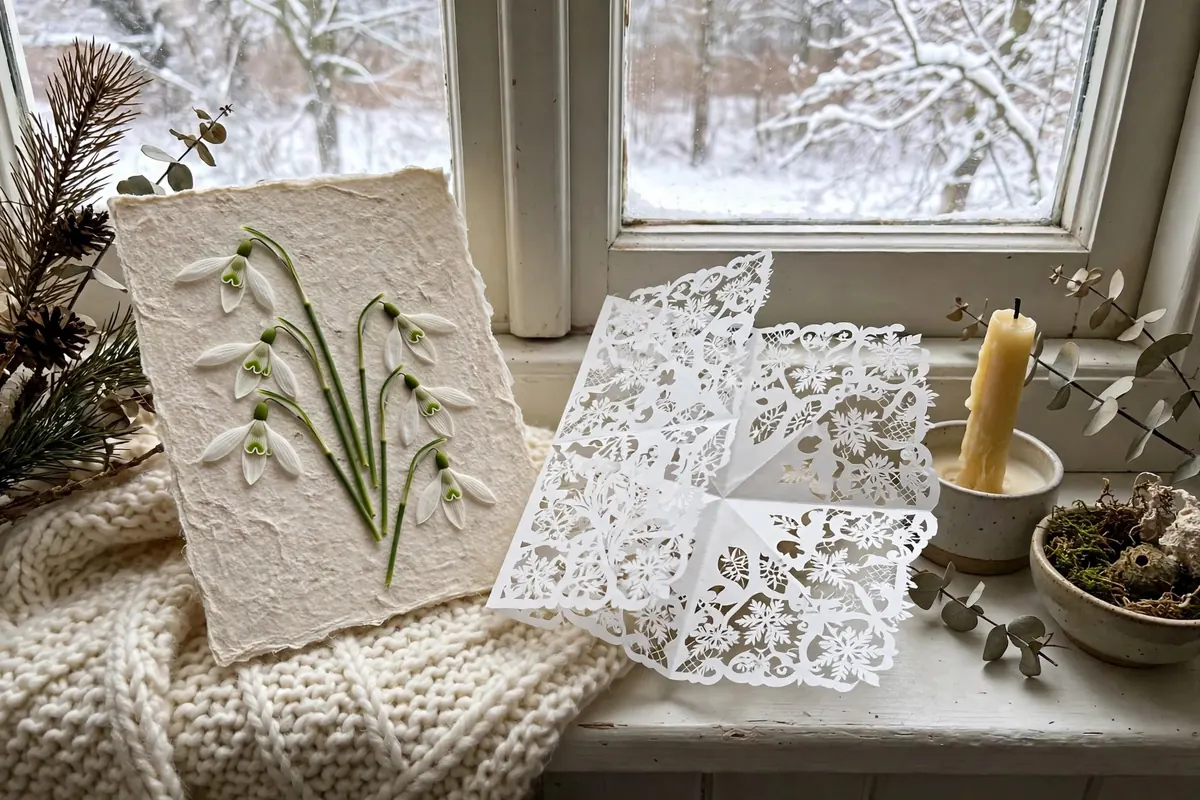
Denmark does Valentine’s Day the way Denmark does most things: quietly, cleverly, and with a twist nobody else thought of. Forget the dozen red roses — in Denmark, the romantic flower of February is a small white snowdrop, pressed flat onto a card. And forget the signed love letter — the Danish version arrives anonymously, in rhyme, on intricately cut paper, with a chocolate egg hanging on whether you can guess who sent it.
The gaekkebrev — the “joking letter” — is one of the most charming Valentine’s traditions on earth, and it’s barely known outside Scandinavia. This guide explains how it works, why snowdrops beat roses, and how Denmark took an imported holiday and made it unmistakably Danish.
Valentine’s Day, Danish Style: An Import With a Twist
Here’s the first thing to understand: Valentine’s Day is relatively new in Denmark. Unlike in France or Italy, where the holiday has centuries of local history, Denmark only really adopted February 14 in recent decades — within living memory, and largely through the usual channels of globalization and commerce. An American expat in Copenhagen once observed that Danes “usurped the holiday in the past 20 years or so,” and the timeline is about right.
But Denmark didn’t just copy the holiday — it Danified it. Rather than importing the full apparatus of roses, teddy bears, and greeting-card sentiment, Danes grafted Valentine’s Day onto older native traditions: the paper-cutting craft, the rhyming gaekkebrev, and the snowdrop, a flower with deep roots in Danish winter culture. The result is a Valentine’s Day that feels less like an American import and more like something Denmark invented for itself.
The Danish celebration also skews young. The traditions are most enthusiastically observed by people roughly 16 to 30 — students, young couples, new romances — for whom the anonymity game and the paper-craft carry the most thrill. Older Danes may mark the day with flowers and dinner, but the gaekkebrev belongs to the young. It’s a holiday of beginnings: new love, secret admiration, the delicious uncertainty of not knowing.
Gaekkebrev: The Joking Letter
The gaekkebrev (plural gaekkebreve) is the heart of the Danish Valentine’s. The name translates roughly as “joking letter” or “teasing letter,” and the concept is a delightful piece of romantic game design:
A sender — traditionally a man, though the custom has broadened — writes a short funny poem or rhyming verse on a piece of paper that has been intricately cut into a lacy, decorative pattern (the paper-cutting itself is part of the art; Danish papirklip is a serious folk craft). The poem is playful, teasing, often a little cheeky — a gaek, a joke — rather than a grand declaration. Then comes the signature: instead of a name, the sender signs with dots — one dot for each letter of their name.
The recipient’s task is to guess the sender by counting the dots and matching them to a name. Five dots? That could be Mette… or Jonas… The guessing is the game, and the stakes are deliciously Danish: if the recipient guesses correctly, the sender owes them a chocolate Easter egg later in the spring. (Yes — a Valentine’s tradition whose payoff arrives at Easter. Only Denmark.) If the recipient fails to guess, tradition holds that they owe the sender an egg — though in practice, the eggs flow in whichever direction keeps the romance alive.
What makes the gaekkebrev brilliant is what it solves. A signed love letter to a crush is high-risk: rejection is explicit, embarrassment total. The anonymous joking letter lowers the stakes to nearly zero — it’s framed as a game, a joke, a bit of fun. If the recipient guesses and is delighted, the romance advances. If they’re unmoved, the sender was “only joking.” The dots provide just enough information to make guessing possible and just enough cover to make sending safe. It’s romantic cryptography, and it works.
The tradition’s roots are older than Valentine’s Day in Denmark — the gaekkebrev is originally an Easter custom, in which children send the cut-paper rhyming letters to family and friends with the same guessing game and the same chocolate-egg stakes. Denmark simply ported its favorite anonymous-letter game onto the newly adopted lovers’ holiday. The snowdrop connection runs through both: the letters are traditionally sent with a pressed snowdrop, the first flower of the Danish spring.
Denmark’s Valentine’s at a Glance
| Detail | What to Know |
|---|---|
| Date | February 14 — a relatively recent import in Denmark |
| The letter | Gaekkebrev (“joking letter”) — anonymous rhyming poem on cut paper |
| The signature | Dots — one per letter of the sender’s name; the recipient must guess |
| The stakes | Correct guess earns the recipient a chocolate Easter egg in spring |
| The flower | Pressed white snowdrops (vintergæk) instead of red roses |
| Origins | The gaekkebrev began as an Easter tradition; adapted for Valentine’s Day |
| Who celebrates most | Young people (roughly 16–30); the day skews toward new romance |
Snowdrops Instead of Roses
The snowdrop — vintergæk in Danish, literally “winter joke” or “winter tease” — is Denmark’s Valentine’s flower, and the choice is pure poetry. Where the rose is loud, expensive, and imported in February, the snowdrop is quiet, local, and brave: one of the first flowers to push through the Danish winter, blooming while snow still lies on the ground.
Danes don’t typically give fresh snowdrop bouquets (the flowers are small and wild). Instead, the tradition is to press the white blossoms and mount them on cards — a craft in itself, requiring the flowers to be picked, pressed flat for days, and arranged with care. A snowdrop card is handmade almost by definition, which makes it the opposite of the last-minute petrol-station roses: it proves forethought. You can’t fake a pressed flower.
The symbolism does heavy lifting. The snowdrop means hope, renewal, and the promise that winter ends — a perfect emblem for new love, and a gentler one than the rose’s passion. It also connects the Valentine’s custom to the Danish landscape: this is a flower you can actually find in Denmark in February, not one flown in from Kenya. In a culture that prizes authenticity and understatement (hygge‘s quieter cousins), the snowdrop is the honest choice.
There’s a linguistic wink, too: vintergæk (snowdrop) and gaekkebrev (joking letter) share the gaek root — the joke, the tease. The flower and the letter are a matched set, a little pun in petals and paper. Denmark’s Valentine’s is, at its core, a joke about winter — and like all good Danish humor, it’s warmer than it first appears.
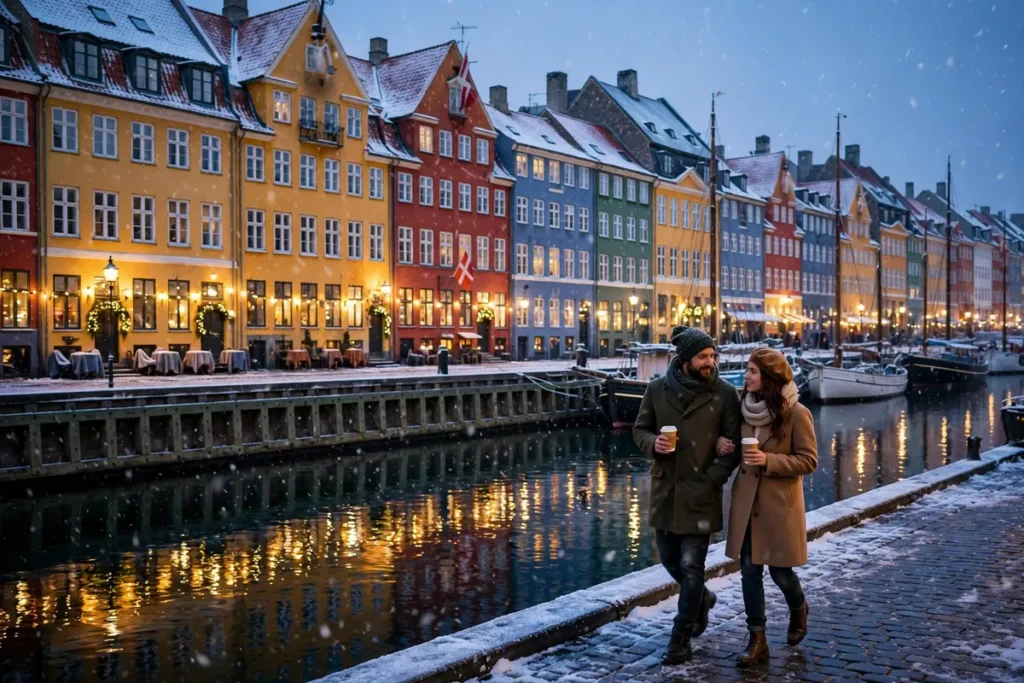
Watch: Valentine’s Day the Danish Way
From gækkebrev to hygge, Nyhavn strolls to Tivoli Gardens — ten ideas for celebrating February 14 like a Dane.
How to Write a Gaekkebrev: The Complete Guide
The gaekkebrev is one of those traditions that’s more fun to do than to read about — so here’s how to make one, Danish-style, wherever you live.
1. Cut the paper
The paper-cutting is half the art. Take a piece of white or light-colored paper, fold it, and cut a lacy pattern of hearts, snowflakes, and scalloped edges — the Danish papirklip tradition. It doesn’t need to be perfect; handmade imperfection is the charm. Unfold it to reveal your doily-like canvas. (If cutting isn’t your skill, a decorative paper or a bought papercut-style card works — but try the scissors first. The effort is the message.)
2. Write the rhyme
The verse should be short, playful, and teasing — a gaek, not a sonnet. Traditional gaekkebreve are often a little cheeky, hinting at the sender’s identity without revealing it. Here’s an example in English, in the spirit of the tradition:
A winter flower, a paper lace,
A riddle wrapped in rhyme —
Five little dots beneath this verse
Will tell you in good time.
Guess my name before the spring,
And win your chocolate prize;
But if you cannot guess it, dear —
Well, that was the surprise.
Adjust the dot-count line to your own name’s length. Keep it light: the tone is flirtation, not declaration.
3. Sign with dots
Count the letters in your first name and draw that many dots beneath the poem — no name, no initials. (Traditional senders use just the first name’s count.) This is the cryptographic heart of the game: enough information to be guessable, not enough to be obvious.
4. Add the snowdrop
Press a snowdrop (or another small white winter flower) and attach it to the letter. If snowdrops don’t grow near you in February, a pressed white flower of any kind — or even a drawn one, done carefully — carries the symbolism. The flower says hope; the dots say guess.
5. Deliver anonymously — and honor the egg
Slip it into a bag, a mailbox, a locker, a coat pocket. The delivery should be as anonymous as the signature. And if your recipient guesses correctly, you owe them a chocolate Easter egg come spring — a debt of honor. (Pro tip: hoping they’ll guess is the whole point. Choose a recipient who knows your name’s length.)
Myth vs. Fact: The Danish Valentine’s
Myth: The gaekkebrev is an ancient Viking tradition.
Fact: It’s old, but not that old — and it began as an Easter custom, not a Valentine’s one. Its use for February 14 is recent, part of Denmark’s late-20th-century adoption of Valentine’s Day. The paper-cutting craft (papirklip) has deeper roots, popularized in the 19th century — Hans Christian Andersen himself was a noted paper-cutter.
Myth: Danes don’t celebrate Valentine’s Day at all.
Fact: They do — just differently, and more quietly than the greeting-card industry would like. The celebration is real but low-key, concentrated among the young, and built around native customs rather than imported ones.
Myth: The Easter egg prize is a joke.
Fact: It’s a genuine, honored part of the game — in both the Easter and Valentine’s versions. The egg debt is real social currency. A Dane who owes you a gaekkebrev egg will pay it.
Myth: Snowdrops are just a cheaper substitute for roses.
Fact: The snowdrop is a deliberate aesthetic and symbolic choice — hope, renewal, Danish winter — not a budget option. Pressed-flower cards require more forethought than bought roses, not less.
Myth: Only men send gaekkebreve.
Fact: Traditionally the sender was male and the recipient female, but the modern custom has broadened — anyone can send a joking letter to anyone. The game works in every direction.
Celebrating the Danish Way: Hygge, Honesty, and Understatement
Beyond the letter and the flower, the Danish Valentine’s has a philosophy worth stealing: understatement as romance. Denmark is the home of hygge — the celebrated art of coziness — and February 14 in Denmark often looks like hygge with someone you love: candles lit against the early dark, good coffee or gløgg, a home-cooked meal, no performance.
The Danish date tends toward the simple and the sensory: a walk along Nyhavn’s colored houses, hot chocolate at Tivoli Gardens in its winter illuminations, a castle day trip (Denmark has no shortage), pastries from a real bakery — the wienerbrød that the rest of the world calls “Danish.” Grand gestures are viewed with gentle skepticism; thoughtfulness is the currency. A hand-cut letter beats a diamond; a pressed flower beats a dozen roses; an evening in beats a night out.
There’s also a refreshing honesty to the Danish approach. The gaekkebrev‘s framing — it’s just a joke, just a game — gives both parties an exit, which paradoxically makes the romance braver. Denmark understood before the dating-app era what the apps are still learning: the best romantic gestures are the ones that don’t trap anyone. For more on keeping the day genuine, our Valentine’s Day traditions around the world roundup shows how other cultures solve the same problem — and our Galentine’s Day ideas suit the Danish spirit of including friends in the warmth.
If you’re planning the evening itself, keep it Danish: cook together rather than booking out, walk rather than drive, and end the night with the letter. Our Valentine’s Day date ideas can fill in the details — just subtract the extravagance and add candles. And remember the deeper lesson of the gaekkebrev: the best romantic gesture is one that gives the other person room — room to guess, room to laugh, room to say yes without pressure. Denmark’s whole Valentine’s philosophy fits in that space between the dots.
The Paper-Cutting Craft: Papirklip and Hans Christian Andersen
The gaekkebrev‘s lacy paper isn’t just decoration — it’s part of one of Denmark’s most beloved folk arts. Papirklip (paper-cutting) has deep roots in Danish culture, and its most famous practitioner was none other than Hans Christian Andersen, who was renowned for cutting intricate paper designs to entertain children (and adults) at gatherings. The fairy-tale author’s delicate cuttings — swans, dancers, fantastical scenes — are museum pieces today, and they established paper-cutting as a distinctively Danish art form.
The connection to the gaekkebrev is direct: the same folding-and-cutting technique that produces a snowflake-like doily produces the letter’s decorative ground. Traditional gaekkebreve are cut with small, sharp scissors from folded paper, the pattern revealed only when unfolded — a little moment of magic before the poem is even read. Danish schoolchildren still learn basic papirklip, and the craft’s presence in the Valentine’s tradition means every gaekkebrev is, in a small way, a folk-art object.
This is why a bought card can’t substitute. The cut paper carries the sender’s hand in a literal sense — the slightly uneven edges, the personal pattern choices, the time visible in the work. In an age of perfect digital design, the gaekkebrev‘s handmade imperfection is its authenticity certificate. Andersen would have approved: he understood that the most magical things are often made of paper.
Denmark vs. the Nordics: A Scandinavian Valentine’s Map
Denmark’s approach stands out even among its neighbors. Norway shares the gaekkebrev tradition to some extent (the custom crosses the Scandinavian borders), but Valentine’s Day remains even more low-key there — many Norwegians barely mark it. Sweden calls it Alla hjärtans dag (All Hearts’ Day) and celebrates with a slightly more commercial but still restrained style; the Swedish Valentine’s is notably egalitarian, with no strong gendered gift expectations.
Finland and Estonia take the most radical departure: February 14 is Ystävänpäivä / Sõbrapäev — Friendship Day, a celebration of friends rather than lovers, with cards and gifts exchanged platonically. It’s the mirror image of Denmark’s romantic-anonymous game: where Danes use Valentine’s for secret courtship, Finns use it to affirm friendship.
Seen against this map, Denmark’s version is the most playful — the only one built around a game, a riddle, and a chocolate egg three months later. It suits the Danish national character as the Danes themselves describe it: ironic, understated, and quietly romantic underneath the jokes. The gaekkebrev lets a famously reserved culture flirt without embarrassment — which may be why, of all the Nordic Valentine’s variants, it’s the one travelers remember.
Frequently Asked Questions
What is a gaekkebrev?
A gaekkebrev (“joking letter”) is a Danish Valentine’s tradition: an anonymous funny poem or rhyme written on intricately cut paper, signed only with dots — one dot per letter of the sender’s name. The recipient tries to guess the sender; a correct guess traditionally earns a chocolate Easter egg in spring.
Why do Danes give snowdrops instead of roses?
The pressed white snowdrop (vintergæk) is Denmark’s Valentine’s flower — a symbol of hope and renewal, one of the first flowers of the Danish spring. Pressed onto handmade cards, it represents forethought and authenticity versus imported roses, and it shares a linguistic root (gaek, “joke/tease”) with the gaekkebrev.
How long has Denmark celebrated Valentine’s Day?
It’s a relatively recent adoption — largely within the last few decades. Denmark grafted the holiday onto older native customs (the Easter gaekkebrev game, paper-cutting, snowdrop pressing) rather than importing it wholesale.
What happens if you guess the gaekkebrev sender correctly?
Tradition holds that the sender owes you a chocolate Easter egg later in the spring. If you guess wrong, you may owe them one — though in practice, the eggs tend to flow toward keeping the romance alive.
Can anyone send a gaekkebrev?
Yes. While the traditional pattern was a male sender and female recipient, the modern custom is open to everyone — the game works in every direction, and the anonymity makes it ideal for shy admirers of any kind.
What is hygge, and what does it have to do with Valentine’s Day?
Hygge is the Danish art of coziness — candles, warmth, good company, simple pleasures. A Danish Valentine’s often is hygge with someone you love: an evening in, well-lit and unhurried, rather than a grand night out. It’s the philosophical opposite of the commercial Valentine’s — and, Danes would argue, the more romantic for it.
The Joke That Was Serious All Along
The gaekkebrev pretends to be a joke — that’s the gaek, the tease. But underneath the dots and the rhymes and the chocolate-egg stakes is one of the most psychologically astute romantic inventions in any culture: a love letter that can’t be rejected, because it was never quite a love letter at all.
Denmark took a holiday it didn’t need, refused to celebrate it the way everyone else does, and built something better from spare parts — an Easter game, a winter flower, a paper-cutting craft, and a national talent for understatement. The snowdrop pushes through the snow; the dots wait to be counted; the egg waits for spring. Somewhere in Copenhagen tonight, someone is folding paper, counting letters, and hoping — just hoping — that she guesses. And if she does, they’ll both know the game was never really a joke. Glædelig Valentinsdag — happy Valentine’s Day, the Danish way: quietly, cleverly, and with a joke that was serious all along.