Every February, one Italian city leans into Valentine’s Day harder than anywhere else on earth — and it has been preparing for about four hundred years. Verona, the setting of Shakespeare’s most famous love story, doesn’t just celebrate February 14: it hosts a multi-day festival, answers thousands of love letters, and temporarily rebrands its piazzas in red. Whether or not Romeo and Juliet ever existed, Verona has decided that love is its business, and business is excellent.
This guide covers the real Verona Valentine’s: the Juliet Club and its army of volunteer letter-answerers, the “Verona in Love” festival, the sites that matter (and the ones that are pure theater), and how to experience the city of love without falling for its traps.
Why Verona Owns Valentine’s Day
Verona’s claim rests on a play written by an Englishman who probably never set foot in Italy. Shakespeare’s Romeo and Juliet (c. 1595–96) fixed Verona in the global imagination as the home of the world’s most famous lovers — and the city, over the centuries, simply agreed with the premise. The Verona of the play is a fantasy, but the Verona of today has built a very real romantic infrastructure on top of it: a house, a balcony, a tomb, a club, a festival, and an entire civic identity.
The genius of Verona’s approach is that it never apologizes for the artifice. The city knows the balcony is a twentieth-century addition, knows Shakespeare invented the lovers, and celebrates anyway — because the emotions the story describes are real, and a city that gives those emotions an address is providing a genuine service. Hundreds of thousands of visitors a year, many arriving in February, suggest the service is appreciated.
What makes Verona different from other “romantic cities” is institutional commitment. Paris is romantic by atmosphere; Venice by beauty. Verona is romantic by program — a deliberate, city-organized, multi-day celebration of love with concerts, markets, awards ceremonies, and guided tours. No other city on earth does Valentine’s Day quite like this.
Verona in Love: The City’s Own Valentine’s Festival
The centerpiece is Verona in Love, the city’s official Valentine’s festival, organized by the City of Verona with local partners. Recent editions have run across the Valentine’s weekend (for example, February 14–16), transforming the historic center into a stage set for romance.
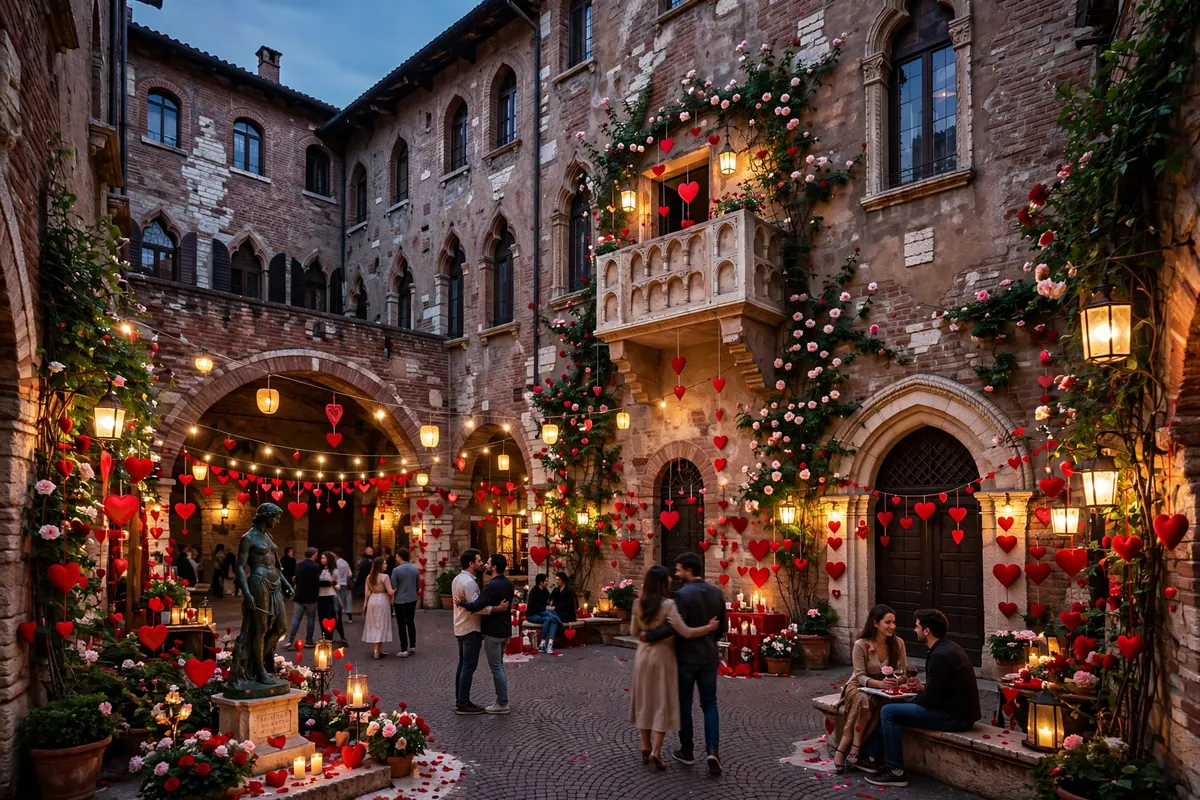
The festival’s geography is the city’s most beautiful public spaces. Piazza dei Signori hosts the famous heart-shaped street market, where vendors sell Baci di Giulietta (“Juliet’s kisses,” sweet treats), crafts, and Valentine’s goods, often around a giant red heart painted on the pavement. Piazza Bra, in the shadow of the Roman Arena, fills with installations and lights. The Torre dei Lamberti — the city’s medieval tower — pours light over the old town, and visitors can book special experiences like an aperitif at the top with panoramic views.
The program is packed: “Live in Love” concerts, theatrical performances of Shakespeare, tastings of local products (including Amarone, the region’s iconic red wine, born in the nearby hills), poetry readings, and the beloved “Heart of Kisses,” where couples step inside a giant heart installation to seal their love with a kiss amid confetti. Guided experiences include the “Verona Walking Tour in Love” through the historic center and “Love Hunting,” a treasure hunt designed for couples. On Valentine’s Day itself, entrance to Juliet’s House is traditionally free — the city’s gift to lovers.
For food lovers, the festival is also a showcase of Veronese cuisine: Risotto all’Amarone (risotto made with the local red wine and Vialone Nano rice), wine tours through the Valpolicella hills, and tastings at the Loggiato in Love. A Verona Valentine’s is never just about the story — it’s about the table, too. If you’re planning a romantic trip around the festival, our guide to romantic getaways covers the planning principles, though fair warning: nothing in the US quite matches Verona in February.
The Juliet Club: Answering the World’s Love Letters
The most extraordinary Valentine’s institution in Verona isn’t the festival — it’s the mail. Since the 1930s, people from around the world have been writing letters addressed simply to “Juliet, Verona,” pouring out their hearts about love found, love lost, and love hoped for. And for decades, a team of volunteers has been writing back.
The Juliet Club (Club di Giulietta) is the organization behind the replies. Its volunteers — known as Juliet’s secretaries — answer thousands of letters every year, each response personal, each in the spirit of Juliet herself: wise, compassionate, and on love’s side. The club also runs the annual Premio Internazionale Cara Giulietta (Dear Juliet International Award), honoring the most beautiful love letters addressed to Juliet from around the world — a ceremony that forms part of the Valentine’s festivities.
Visitors can participate directly: leave a letter in Juliet’s courtyard, or volunteer as one of Juliet’s secretaries for a day, helping read and respond to the incoming mail. The 2010 film Letters to Juliet, starring Amanda Seyfried, dramatized the tradition for a global audience and sent a new wave of letters to Verona — but the club predates the film by decades and will outlast its fame. The letters are real; the secretaries are real; only the balcony scenes needed Hollywood.
If you want to write: letters can be sent to the Juliet Club in Verona (the club’s address is publicly listed as Corso Santa Anastasia, Verona), and tradition holds that every letter gets an answer. In an age of instant messaging, there is something profoundly moving about a volunteer in Verona sitting down with pen and paper to answer a stranger’s heartbreak.
Watch: Inside Verona’s Juliet Club
DW Euromaxx visits the Club di Giulietta to show how hundreds of love letters arrive every day — and meet the volunteers who answer them all.
Verona’s Valentine’s at a Glance
| Detail | What to Know |
|---|---|
| The festival | Verona in Love — city-organized Valentine’s festival, typically across the Feb 14 weekend |
| Heart market | Heart-shaped street market in Piazza dei Signori; Baci di Giulietta treats |
| Juliet’s House | Casa di Giulietta, Via Cappello — free entry traditionally on Valentine’s Day |
| The letters | Written to “Juliet, Verona” since the 1930s; answered by the Juliet Club’s volunteer secretaries |
| Letter award | Premio Internazionale Cara Giulietta — annual prize for the most beautiful love letter |
| The balcony | A 20th-century addition to a 13th-century building; the house belonged to the Cappello family |
| Local wine | Amarone, from the nearby Valpolicella hills; try Risotto all’Amarone |
A Walk Through the Legend: The Sites That Matter
Verona’s romantic geography is a mix of genuine medieval history and enthusiastic stagecraft. Here’s how to read it — site by site, with the honest version of each story.
Casa di Giulietta (Juliet’s House), Via Cappello
The courtyard house on Via Cappello is the gravitational center of Verona’s romance. The building itself is a genuine 13th-century palazzo, and historical documents suggest it belonged to the Cappello family — close enough to “Capulet” to keep the dream alive. (Records also place families named Montecchi and Cappelletti in medieval Verona, though nothing connects them to Shakespeare’s lovers.) The famous balcony is a 20th-century reconstruction, assembled from medieval marble fragments during 1930s–40s restorations designed to give literary tourists the Renaissance atmosphere they expected.
None of that diminishes the experience. The courtyard walls are covered in love notes, the bronze statue of Juliet in the courtyard is rubbed bright by millions of touches (legend says touching it brings luck in love), and the museum inside displays period frescoes and the bed used in Franco Zeffirelli’s famous film. Go early on Valentine’s weekend — or accept the crowds as part of the theater.
Tomba di Giulietta (Juliet’s Tomb)
In the former Capuchin monastery of San Francesco al Corso stands an open stone sarcophagus venerated as Juliet’s tomb. It’s a solemn, slightly eerie spot — a red-marble trough in a quiet cloister — and it draws a particular kind of pilgrim: the ones who take the tragedy more seriously than the romance. The monastery also houses a museum of frescoes. It’s worth the walk for the atmosphere alone.

Casa di Romeo
Romeo’s supposed house, a crenellated medieval building not far from Juliet’s, is privately owned and can only be admired from the outside — which is fitting, since Romeo spends most of the play outside Juliet’s window anyway. It’s a quick stop on the walking tour, atmospheric and unrestored.
The Arena and Piazza Bra
The Arena di Verona — the remarkably preserved Roman amphitheater — isn’t part of the Romeo and Juliet story, but it’s essential to a Valentine’s visit. Lit up at night, with Piazza Bra’s cafés spilling onto the pavement, it’s the city’s great romantic backdrop. In summer it hosts opera; in February, it hosts your evening stroll.
Torre dei Lamberti
Climb the 84-meter medieval tower for the definitive view of Verona’s red rooftops, the Adige river bending around the old town, and on Valentine’s weekend, the festival lights below. The special aperitif experiences at the top, offered during the festival, are worth booking ahead.
Timeline: How Verona Became the City of Love
Late 1500s: Shakespeare writes the play
Romeo and Juliet (c. 1595–96) fixes Verona as the setting of the world’s most famous love story. Shakespeare likely never visited Italy; he worked from Italian novellas by Luigi da Porto and Matteo Bandello, who had set their own tragic romances in Verona decades earlier.
1800s: Literary tourism begins
Romantic-era travelers on the Grand Tour start seeking out “Juliet’s tomb” in Verona. The city begins, informally, to accommodate the legend.
1930s–40s: The myth gets architecture
Major restorations reshape the Casa di Giulietta into the Renaissance fantasy tourists expect: the balcony is reconstructed, interiors are dressed with period frescoes and furniture. Around the same time, the tradition of writing letters to Juliet takes root.
1972: The Juliet Club formalizes
The volunteer organization answering Juliet’s mail takes its modern form as the Club di Giulietta, systematizing what had been an informal tradition of replies.
2010: Hollywood arrives
Letters to Juliet introduces the letter-answering tradition to a global audience, triggering a surge in visitors and correspondence.
2010s–today: Verona in Love grows
The city’s official Valentine’s festival expands into a multi-day event with concerts, markets, awards, and record attendance — cementing Verona’s status as the city that does Valentine’s Day as civic policy.
Myth vs. Fact: Verona’s Valentine’s
Myth: Romeo and Juliet were real people.
Fact: They were fictional — Shakespeare’s invention, built on earlier Italian novellas that were also fiction. No evidence connects any real Veronese couple to the story. The city’s romance is real; its lovers are not.
Myth: The balcony is where it all happened.
Fact: The balcony is a 20th-century addition to a medieval building, assembled from old marble to satisfy tourist expectations. The “it” that happened there happened only in a play.
Myth: Shakespeare visited Verona.
Fact: There is no evidence Shakespeare ever left England. His Italy was assembled from books, travelers’ tales, and imagination — which makes Verona’s achievement in building a real romantic culture on an imagined foundation all the more impressive.
Myth: The Juliet Club is a tourist gimmick.
Fact: The letter-answering tradition predates modern tourism marketing by decades, stretching back to the 1930s. The volunteers are genuine, the letters are genuine, and the replies are personal. It’s one of the least cynical institutions in European tourism.
Myth: Verona is only worth visiting on Valentine’s Day.
Fact: The festival is the peak, but the Juliet Club answers letters year-round, the sites are open year-round, and Verona is a UNESCO-listed city with Roman, medieval, and Renaissance layers worth days of exploration. February is the theme park; the rest of the year is the city.
How to Do Verona on Valentine’s: A Practical Guide
1. Time it for the festival — and book early
Verona in Love typically spans the Valentine’s weekend. Hotels in the historic center sell out; book months ahead. The festival program is usually published in January — check the city’s official channels for concert and tour schedules.
2. Write the letter before you go
Bring a real letter for Juliet — handwritten, honest, in any language. Leave it in the courtyard or mail it to the Juliet Club. It’s the single most authentic thing you can do in Verona, and it costs nothing.
3. Do the sites in story order
Start at Juliet’s House (morning, to beat crowds), walk to Romeo’s house, then out to Juliet’s Tomb in the afternoon quiet. End at the Arena at dusk. The narrative arc — house, separation, tomb, then the living city — gives the day a shape the play itself would recognize.
4. Eat and drink like a Veronese
Amarone is non-negotiable — whether in the glass or in the risotto. The festival’s tastings and the Loggiato in Love food events are built for this. A Valentine’s dinner in Verona should be long, local, and unhurried; our Valentine’s Day date ideas can help you plan the evening’s arc.
5. Pair Verona with the Bacio pilgrimage
The definitive Italian romance itinerary combines Verona with Perugia: the city of the story and the city of the chocolate. Read our guide to Valentine’s Day in Italy: Baci Perugina and lovers’ traditions for the second half of the trip — and bring Baci to leave with your letter to Juliet. She’d approve.
A Valentine’s Evening in Verona: Hour by Hour
If you only get one Valentine’s evening in Verona, spend it like this. 5 PM: aperitivo at the top of the Torre dei Lamberti as the festival lights come on across the old town — book the special Valentine’s slot ahead. 6:30 PM: descend into the golden-hour crowds and walk to Piazza dei Signori, working the heart-shaped market for Baci di Giulietta and a small, ridiculous souvenir you’ll keep forever. 8 PM: dinner — long, candlelit, Amarone-heavy — at a restaurant in the historic center; the menù di San Valentino is the move, and reservations are essential. 10:30 PM: the night walk: across Piazza Bra with the Arena lit up, down to the Adige riverbank, and back through the quiet side streets with the day’s letter to Juliet in your pocket. Midnight: read each other the Bacio notes from dessert. That’s the whole itinerary, and it’s perfect.
The Premio Cara Giulietta: The World’s Most Romantic Awards Ceremony
Among all of Valentine’s season’s ceremonies worldwide, one stands apart for pure emotional voltage: the Premio Internazionale Cara Giulietta — the “Dear Juliet” International Award. Each year, the Juliet Club selects the most beautiful love letter addressed to Juliet from the thousands received from around the globe, and its author is honored in Verona during the Valentine’s festivities.
Think about what that means: out of all the love letters in the world — the desperate, the joyful, the grieving, the hopeful — a panel of Juliet’s secretaries reads them and chooses the one that most deserves to be celebrated. The winning letters are extraordinary documents: some written by teenagers, some by the elderly, some by people who have loved and lost and loved again. The award ceremony itself, held amid the festival’s concerts and events, treats these private declarations with the gravity of a literary prize — because, the club insists, they are literature.
The Premio captures what makes Verona’s Valentine’s different from every other city’s. Elsewhere, February 14 is about what you buy. In Verona, at least for one ceremony, it’s about what you write — and the belief that a love letter, honestly composed, is among the highest forms of human expression. Winners have described the experience as life-changing; audiences describe the readings as unforgettable. If you attend one festival event beyond the markets and concerts, make it this one.
Frequently Asked Questions
What is Verona in Love?
Verona in Love is the City of Verona’s official Valentine’s festival, typically held across the February 14 weekend. It features a heart-shaped market in Piazza dei Signori, concerts, Shakespeare performances, tastings (including Amarone wine), guided love-themed tours, the “Heart of Kisses” installation, and the Premio Cara Giulietta awards for the most beautiful letters to Juliet.
Can you really write letters to Juliet?
Yes. People have written to “Juliet, Verona” since the 1930s, and the Juliet Club’s volunteer secretaries answer thousands of letters every year. You can leave a letter in the courtyard of Juliet’s House or mail one to the club; tradition holds that every letter receives a personal reply.
Is Juliet’s balcony real?
The building is a genuine 13th-century palazzo once belonging to the Cappello family, but the famous balcony is a 20th-century reconstruction added during 1930s–40s restorations. Shakespeare’s lovers were fictional, and there is no evidence the playwright ever visited Verona.
Is entry to Juliet’s House free on Valentine’s Day?
Traditionally, yes — the city has offered free entrance to the Casa di Giulietta on February 14 during the festival. Confirm the current year’s arrangement before visiting, as details can change.
What is the Premio Cara Giulietta?
The Premio Internazionale Cara Giulietta (Dear Juliet International Award) is an annual prize honoring the most beautiful love letters addressed to Juliet from around the world. The awards ceremony is part of the Valentine’s festivities.
What should you eat and drink in Verona on Valentine’s Day?
Amarone wine from the nearby Valpolicella hills is the signature — try it in the glass and in Risotto all’Amarone. The festival features tastings, wine tours, and the Loggiato in Love food events, plus sweet Baci di Giulietta treats from the heart-shaped market.
The City That Chose Love as Its Business
Verona’s Valentine’s is the most gloriously artificial — and the most sincerely felt — romantic celebration in the world. The lovers are fictional, the balcony is a reconstruction, and the festival is municipal policy. And yet: the letters are real, the volunteers are real, the crowds in the courtyard are feeling something real, and the city has spent decades getting better at hosting it all.
There is a lesson in that for every Valentine’s Day, wherever you spend it: romance isn’t about historical accuracy. It’s about the willingness to take love seriously enough to build something for it — a festival, a letter, a dinner, a walk. Verona built a whole civic identity. You only need an evening. Start with the letter.