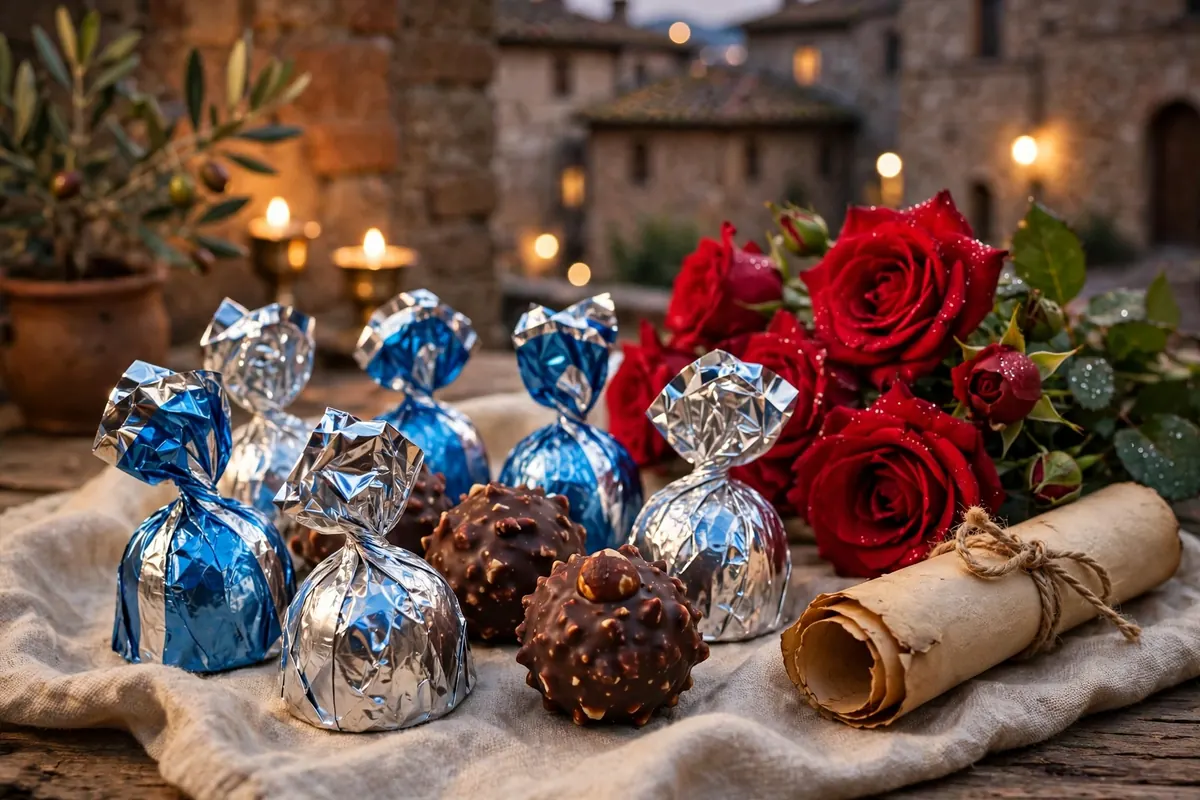
In Italy, the most romantic thing you can hand someone on February 14 isn’t a rose or a ring — it’s a small, fist-shaped chocolate wrapped in blue and silver foil, hiding a secret. The Bacio Perugina — the Perugina “kiss” — has been Italy’s edible love letter for more than a century, and its story involves a brilliant businesswoman, a clandestine romance, leftover hazelnuts, and a graphic designer who understood that chocolate tastes better with poetry.
This is the story of how a thrifty factory improvisation became a global symbol of Italian romance — and how Italians actually celebrate Valentine’s Day today, from the Festa degli Innamorati to the city of Terni’s claim on the saint himself.
The 1922 Birth of the Bacio
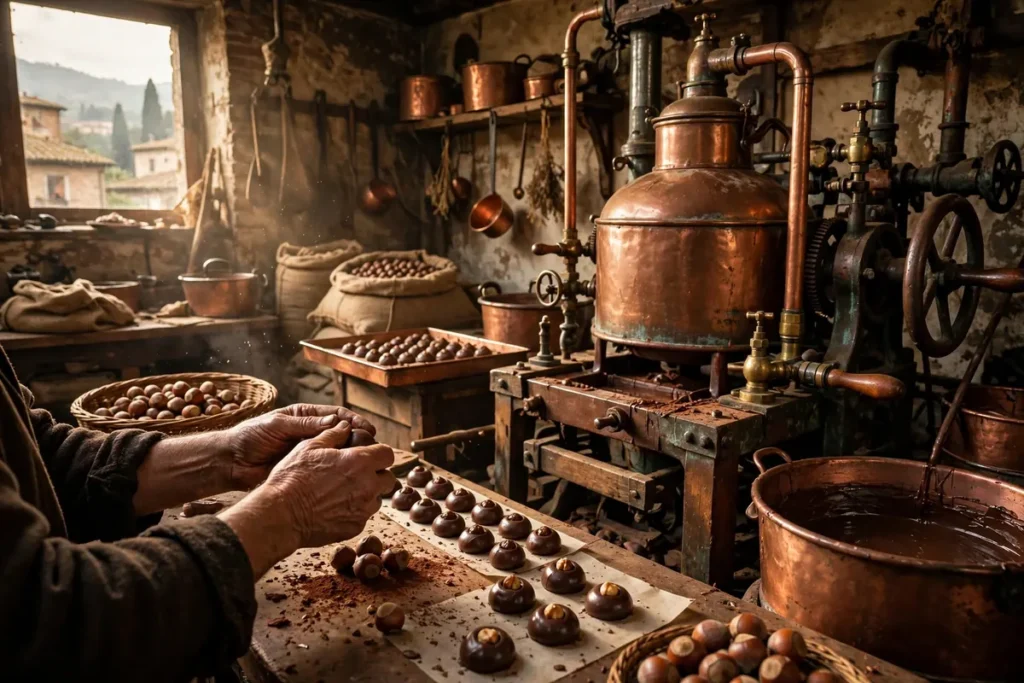
The Bacio was born from thrift, not romance. In 1922, Luisa Spagnoli — one of the driving forces behind the Perugina chocolate company, founded in Perugia in 1907 — faced a familiar factory problem: at the end of each day, chopped hazelnuts and chocolate were left over from the company’s other production lines, destined for the bin. Spagnoli, who had taken charge of the business during the First World War and would later become famous for inventing angora-wool knitwear, hated waste. Her solution was to bind the leftover hazelnut pieces with chocolate cream into a rough, fist-shaped confection, crown it with a whole hazelnut, and coat the whole thing in dark chocolate.
She called the result a cazzotto — a “punch.” The name was honest but, as her colleagues quickly realized, not exactly romantic. It was Giovanni Buitoni, son of one of Perugina’s founders, who supplied the rebrand: wrap the little fist in a love note and call it a Bacio — a kiss. Graphic designer Federico Seneca created the now-iconic blue-and-silver foil wrapper, printed with a starry night sky, and designed the little scroll of paper carrying a romantic message that would tuck inside every wrapper.
The intuition paid off spectacularly. Just five years later, in 1927, the Perugina factory claimed to have sold 100 million Baci — a figure that, even allowing for corporate enthusiasm, signals how quickly the chocolate captured Italy’s imagination. The recipe — gianduia (hazelnut-chocolate cream) studded with chopped hazelnuts, crowned with a whole hazelnut, enrobed in dark chocolate — remains essentially unchanged a century later, still produced in Perugia, in the region of Umbria that Italians fondly call “the heart of Italy.”
Baci Perugina at a Glance
| Detail | What to Know |
|---|---|
| Created | 1922, by Luisa Spagnoli at the Perugina factory in Perugia, Umbria |
| Original name | Cazzotto (“punch”) — renamed Bacio (“kiss”) by Giovanni Buitoni |
| What it is | Gianduia center with chopped hazelnuts, crowned with a whole hazelnut, coated in dark chocolate |
| The wrapper | Blue-and-silver foil with a starry-sky design by Federico Seneca |
| The love notes | A romantic message scroll inside every wrapper; today printed in six languages |
| Milestone | Perugina claimed 100 million Baci sold by 1927 |
| Ownership | Perugina acquired by Nestlé in 1988; Baci still made in Perugia |
The Love Notes: From Secret Romance to Global Ritual
The most famous thing about a Bacio isn’t the chocolate — it’s the paper. Every Bacio Perugina contains a cartiglio: a small scroll bearing a message of love, affection, or friendship, drawn from poets, philosophers, and writers across the centuries. Unwrapping a Bacio is a two-act experience: first the chocolate, then the words. For generations of Italians, the note has been the point.
Where did the notes come from? Tradition — and the company’s own storytelling — traces them to a real romance. Luisa Spagnoli and Giovanni Buitoni, the younger man who renamed her “punch” a “kiss,” are said to have carried on a clandestine love affair, and legend holds that Luisa slipped handwritten secret messages into the chocolates as a way of communicating with her lover. Historians treat the details as company lore rather than documented fact, but the story has become inseparable from the product: the chocolate that carries secret messages was born, supposedly, from secret messages.
What is documented is the notes’ evolution. In the 1960s, English and French translations were added to the original Italian; German followed in 1990, and two more languages in the 2000s brought the total to six. The messages themselves expanded from simple romantic lines to quotations from classical authors and contemporary artists. The note turned the Bacio from a confection into a communication medium — a way to say what words alone, spoken aloud, sometimes can’t.
That communicative power is why the Bacio became Italy’s default Valentine’s gesture. Giving Baci says something specific: it says I thought about what to say, and I let the chocolate say it. For a culture that takes both food and eloquence seriously, no other gift compresses so much meaning into so small a package. If you’re choosing between romantic gifts this year, our guides to Valentine’s Day gifts for her and Valentine’s Day gifts for him can help — but in Italy, the answer is usually already decided.
Watch: The Italian Story of Baci Perugina
Perugina’s own immersive telling of the Bacio story — from the 1922 laboratory to the modern factory — walks through the cobbled streets of Perugia and the legend of Luisa and Giovanni’s romance.
Timeline: A Century of Baci
1907: Perugina is founded
Four partners — including Annibale Spagnoli and his wife Luisa — found the Perugina chocolate company in Perugia, Umbria, initially producing sugared almonds (confetti) and expanding into chocolate.
1914–1918: Luisa takes charge
With Italy’s entry into the First World War, Luisa Spagnoli becomes the driving force of the company, steering it through wartime disruption and laying the groundwork for its interwar boom.
1922: The Bacio is born
To use up leftover chopped hazelnuts, Spagnoli creates the fist-shaped chocolate she calls a cazzotto. Giovanni Buitoni renames it Bacio, adds the love note, and Federico Seneca designs the blue-and-silver starry wrapper.
1927: 100 million sold
Perugina claims 100 million Baci sold within five years of the product’s creation — the chocolate is now a national phenomenon.
1930s: The notes become legend
The love-note tradition cements itself in Italian popular culture; the story of Luisa’s secret messages to Giovanni enters company lore.
1939: Baci crosses the Atlantic
Perugina introduces its chocolates at the New York World’s Fair and opens a Fifth Avenue store the same year, planting the brand in America.
1960s–2000s: The notes go multilingual
English and French translations in the 1960s, German in 1990, and two more languages in the 2000s — the love notes become readable in six languages.
1988: Nestlé acquires Perugina
The Swiss giant buys the Buitoni-Perugina group. Production stays in Perugia; the recipe stays unchanged.
Today: A century of kisses
Baci remain Italy’s signature Valentine’s chocolate — still made in Perugia, still wrapped in blue and silver, still carrying a message. Each Bacio is still individually checked before wrapping, a detail the company proudly maintains.
How Italy Celebrates Valentine’s Day Today
Italians call February 14 the Festa degli Innamorati — the Feast of Lovers — and they celebrate it with a characteristic blend of passion and practicality. The day is unmistakably romantic, but it lacks the greeting-card machinery of some countries; the emphasis falls on the couple’s private experience rather than public performance.
Baci lead the gift economy. No other Valentine’s gift in Italy carries the Bacio’s cultural weight. Boxes of Baci Perugina — the classic dark, the milk-chocolate Baci Latte, limited Valentine’s editions — move in enormous volumes every February. But the Bacio is rarely given alone; it accompanies flowers (red roses dominate, as elsewhere), jewelry, perfume, and the increasingly popular cena di San Valentino, the Valentine’s dinner. Many Italian couples treat the Bacio as the card and the flowers as the gift: the chocolate says it, the roses show it.
Terni claims the saint. One of Italy’s most distinctive Valentine’s traditions belongs to Terni, the Umbrian city that claims Saint Valentine as its own — he is said to have been its bishop in the third century. Every February, Terni hosts celebrations honoring its patron, including the Festa della Promessa (Festival of the Promise), in which engaged couples receive a blessing. Lovers make pilgrimages to the Basilica of Saint Valentine, and the city leans into its identity as the saint’s hometown with concerts, markets, and religious ceremonies. Whether Valentine was truly Terni’s bishop is a matter of ancient tradition rather than firm documentation — but the city has believed it for a very long time.
Old customs linger in memory. Italy’s folk Valentine’s traditions are mostly historical now, but they were once vivid. In some regions, the day was treated as a spring festival: young people gathered outdoors for poetry and music before strolling with their beloved. One charming old belief held that an unmarried girl who woke before dawn on Valentine’s Day would marry — within the year — the first man she saw, or at least someone who strongly resembled him. These customs have faded, but their spirit survives in the Italian instinct to take the day outside: a walk, a piazza, the evening passeggiata with someone you love.
Dinner is sacred. As in France, the restaurant dinner is the day’s anchor. Italian restaurants offer menù di San Valentino — multi-course fixed menus, heavy on the romance signifiers: candlelight, a good Barolo or Prosecco, chocolate dessert. Booking ahead is essential in any Italian city. For couples cooking at home, the Italian approach favors the achievable-but-beautiful: fresh pasta, a simple secondo, and Baci for dessert — because in Italy, ending a Valentine’s meal with anything else would feel like a missed opportunity. Our Valentine’s Day dinner ideas include plenty of Italian-inspired options.
Myth vs. Fact: Baci and the Italian Valentine’s
Myth: Luisa Spagnoli definitely sent secret love notes to Giovanni Buitoni in the chocolates.
Fact: This is company lore, not documented history. The clandestine romance between Spagnoli and Buitoni is part of Perugina’s cherished origin story, and the notes’ exact origin is uncertain — one account credits designer Federico Seneca with inventing the scroll. Treat the love-note origin as legend: beautiful, plausible, and unverified.
Myth: Baci were always called “kisses.”
Fact: The original name was cazzotto — “punch” — because the rough little chocolate looked like a fist. “Bacio” was a marketing rebrand, and a brilliant one.
Myth: The love notes were always multilingual.
Fact: The notes began in Italian only. English and French translations arrived in the 1960s, German in 1990, and the sixth language only in the 2000s. For most of the Bacio’s first half-century, the poetry was for Italians alone.
Myth: Saint Valentine was certainly Italian.
Fact: The historical Valentine (or Valentines — several saints share the name) is genuinely obscure. Terni’s claim that he was its third-century bishop rests on ancient tradition rather than solid evidence. Italy’s connection to the saint is a matter of faith and civic pride, not archaeology.
Myth: Italians only give Baci on Valentine’s Day.
Fact: Baci are a year-round love token — given at anniversaries, weddings, and ordinary romantic moments. Valentine’s Day is their peak season, not their only season.
How to Do an Italian Valentine’s: The Bacio Ritual
Borrowing the Italian approach is less about buying the right box than about adopting the right sequence. Here’s the ritual, as Italians practice it:
1. Choose your Baci deliberately
Don’t grab the nearest box. Italians have opinions: the classic dark (Classico) for traditionalists, the milk version for the sweet-toothed, limited editions for the impressionable. The choice itself is part of the message.
2. Give them with words, not instead of words
The Bacio’s note is a prompt, not a substitute. Read it together, laugh or sigh at it, then say what you actually mean. The chocolate opens the conversation; you have to finish it.
3. Pair chocolate with an experience
In Italy, Baci accompany the evening — the walk, the dinner, the piazza — rather than constituting it. Plan the experience first (our Valentine’s Day date ideas can help), then let the Baci punctuate it.
4. Save one note
Ask any Italian couple of a certain age and they’ll admit it: somewhere in a drawer is a faded Bacio note from years ago, kept for reasons they can’t quite articulate. Start your own archive. Future you will be grateful.
5. Visit the source, at least once
The Casa del Cioccolato Perugina — the Chocolate House at the Perugia factory — offers tours and tastings, and the city hosts Eurochocolate, one of Europe’s biggest chocolate festivals, every October. A pilgrimage to Perugia is the ultimate Bacio gesture. For the fullest expression of Italy’s romantic geography, pair it with Valentine’s Day in Verona, in Romeo and Juliet’s city — the two trips together are the definitive Italian romance itinerary.
Beyond February: Baci at Italian Weddings, Anniversaries, and Ordinary Days
To understand the Bacio’s true place in Italian life, you have to look past Valentine’s Day. The chocolate’s genius was never really about a single date — it’s about making the everyday romantic gesture effortless, and Italians have woven it into the fabric of their celebrations year-round.
At weddings, Baci are practically infrastructure. The Italian wedding favor — the bomboniera — traditionally pairs sugared almonds (confetti) with something chocolate, and Baci are among the most popular choices. Guests at Italian weddings expect to leave with a small bag containing an odd number of confetti (for good luck) and very often a Bacio or two. The symbolism is neat: the wedding celebrates a union, and the favor is itself a little kiss. Couples who want to personalize the gesture sometimes pair the Bacio’s printed note with a handwritten one of their own, turning the factory’s romance into their own.
Anniversaries run on Baci. Ask Italians of a certain generation about their parents’ anniversaries and the Bacio comes up with remarkable consistency — a box of them on the breakfast table, a single one tucked into a card, a handful scattered across a restaurant table at the end of a celebratory dinner. The chocolate functions as a kind of emotional punctuation: it marks the moment as special without requiring a speech. In a culture where grand romantic declarations can feel theatrical, the Bacio offers a middle path — meaningful but light, sincere but not heavy.
The notes have their own afterlife. The cartigli — those little scrolls — have become collectibles in their own right. Italians trade stories about the best notes they’ve received; some keep them in wallets, taped inside diaries, or pinned to corkboards. The notes’ quotations, drawn from Dante to contemporary songwriters, function as a kind of pocket anthology of love poetry, and the multilingual versions mean a Bacio bought in Rome can speak to a lover in six languages. It’s a small thing, but it explains the product’s century-long grip: every Bacio is two gifts, and the second one costs nothing to keep.
The factory itself is a destination. The Casa del Cioccolato Perugina, at the Perugia factory, draws visitors year-round with its museum, tastings, and chocolate-making courses. The Guinness-record Bacio — a 13,000-pound giant unveiled years ago — remains part of local legend. And every October, Perugia hosts Eurochocolate, one of Europe’s largest chocolate festivals, when the hill town’s streets fill with stalls and the smell of chocolate drifts for blocks. For the Bacio-obsessed, October in Perugia is the real holiday; Valentine’s Day is just the excuse.
Frequently Asked Questions
What are Baci Perugina?
Baci Perugina (“Perugina kisses”) are Italian chocolates created in 1922: a gianduia (hazelnut-chocolate cream) center with chopped hazelnuts, crowned with a whole hazelnut and coated in dark chocolate. Each is wrapped in blue-and-silver foil containing a cartiglio — a scroll with a romantic message, now printed in six languages.
Who invented Baci?
Luisa Spagnoli, one of the driving forces of the Perugina company, created the chocolate in 1922 from leftover hazelnuts and chocolate. Giovanni Buitoni renamed her cazzotto (“punch”) as Bacio (“kiss”) and added the love note; Federico Seneca designed the wrapper.
Why are Baci associated with Valentine’s Day?
The combination of the “kiss” name, the romantic messages hidden in every wrapper, and a century of marketing made Baci Italy’s default romantic chocolate. They are exchanged year-round but peak at Valentine’s Day, anniversaries, and weddings.
What is the Festa degli Innamorati?
Italy’s name for Valentine’s Day — the “Feast of Lovers.” It’s celebrated much like elsewhere in southern Europe: flowers, chocolates (especially Baci), jewelry, and the cena di San Valentino, a special Valentine’s dinner.
What happens in Terni on Valentine’s Day?
Terni, which claims Saint Valentine as its third-century bishop, holds celebrations including the Festa della Promessa, where engaged couples receive a blessing, plus pilgrimages to the Basilica of Saint Valentine, concerts, and markets.
Are Baci still made in Italy?
Yes. Despite Nestlé’s 1988 acquisition of Perugina, Baci are still produced in Perugia, Umbria, according to the original 1922 recipe — and each chocolate is still individually checked before wrapping.
A Kiss That Lasts a Century
The Bacio Perugina shouldn’t have worked. It was factory leftovers with an unromantic name, created by a businesswoman better known for knitwear, in a hill town in Umbria. But a renamed kiss, a starry wrapper, and a scroll of poetry turned thrift into myth — and a chocolate into a language. Every February, millions of Italians still pause at the same small ritual: crack the foil, eat the kiss, read the words. Some messages get kept for decades; all of them get felt for a moment.
That is the Italian Valentine’s in miniature: take something ordinary, make it beautiful, and hide a message inside. Whether you celebrate in Perugia or at your own table, the lesson travels well. Say it with chocolate — but make sure the chocolate says something worth hearing. A century after Luisa Spagnoli swept up her leftover hazelnuts, her little kiss is still doing what she never planned: teaching the world that the smallest package can carry the biggest feeling. And if you need a last-minute gift to complete the ritual, our last-minute Valentine’s Day gifts guide has you covered.