Paris did not become the “City of Love” by accident — and it did not become it on Valentine’s Day alone. The French capital’s romantic reputation was built over centuries of art, literature, cinema, and very deliberate mythmaking. But on February 14, that reputation gets its annual stress test, as hundreds of thousands of visitors arrive expecting the most romantic day of their lives and Parisians themselves celebrate in a markedly different, quieter register.
This guide separates the Paris of postcards from the Paris of practice: the true story of the love locks, what couples really do on February 14, the spots that earn their romantic reputation, and how to plan a Paris Valentine’s — or a Paris-style one at home — without falling for the tourist traps.
Why Paris Became the City of Love
The “City of Love” title is, historically speaking, a relatively recent invention — a twentieth-century branding triumph built on much older foundations. The foundations are real enough: Paris was the capital of courtly love culture, the city of Edith Piaf’s La Vie en Rose, of An American in Paris and Amélie, of existentialist couples arguing beautifully in Left Bank cafés. French cinema spent decades teaching the world that love looks best with Parisian light on it, and the tourism industry happily completed the lesson.
But there is substance beneath the marketing. Paris is genuinely, physically romantic in ways that have nothing to do with slogans: the quality of evening light on the Seine, the human scale of the streets, the café culture that treats lingering as a civic virtue, the sheer density of beauty per square kilometer. Few cities reward a slow walk with a loved one the way Paris does. The city’s romantic reputation persists because, for the most part, the city delivers — just rarely in the ways visitors expect.
The key insight for Valentine’s Day is this: Paris’s romance is ambient, not event-driven. The city doesn’t need February 14 to be romantic; it is romantic on an ordinary Tuesday in October. Which means the smartest way to do Valentine’s in Paris is to let the city do what it always does, and simply show up with someone you love.
The Love Locks: Rise and Fall of a Global Ritual
No single image defined Parisian romance in the 2010s like the Pont des Arts smothered in padlocks. Yet the whole phenomenon — from arrival to removal — unfolded in barely seven years, and it was never a French tradition at all.
How the locks arrived
The love-lock ritual did not originate in Paris. Its modern form is widely traced to Italy: the 2006 novel Ho Voglia di Te (I Want You) by Federico Moccia, and its 2007 film adaptation, included a scene in which young lovers attach a padlock to a lamppost on Rome’s Ponte Milvio and throw the key into the Tiber. Young couples across Europe began imitating the gesture. The first padlocks appeared on Paris’s Pont des Arts — the elegant pedestrian bridge linking the Louvre to the Institut de France — around late 2008. The bridge’s steel railings, central location, and cinematic views made it the perfect host, and within a few years it had become the most famous love-lock site on earth.
The ritual was simple and photogenic: engrave a padlock with your initials, clamp it to the bridge, throw the key into the Seine. At its peak, the bridge carried an estimated 700,000 to over a million locks. Travelers who never would have visited a hardware store at home bought padlocks from street vendors at inflated prices and performed the rite with total sincerity. For a few years, it genuinely felt like a folk tradition — spontaneous, global, and deeply felt.
How the locks nearly broke the bridge
Romance, it turns out, is heavy. By 2014 the locks weighed an estimated 45 tons — roughly the weight of 20 elephants, as contemporary coverage liked to note — and the bridge was suffering. In June 2014, a section of the parapet actually collapsed under the weight of the padlocks. The newly elected mayor, Anne Hidalgo, tasked her deputy with finding alternatives, and in August 2014 the city launched its “Love Without Locks” campaign, urging visitors to take selfies instead. Wooden panels went up over the worst sections. It didn’t work.
In June 2015, the city began the great removal: workers cut away the lock-laden railings and replaced them with glass panels that offer the view without the anchor points. It was the end of the Pont des Arts love-lock era — and, effectively, the end of the city’s tolerance for the practice on its historic bridges generally.
What happened to a million locks
The aftermath was handled with surprising grace. Most of the removed locks were recycled, but the city auctioned off a selection of the padlocks and the grille panels they hung from, donating the proceeds to charities supporting refugees. Prices ranged from around €150 to €10,000 — meaning pieces of the world’s most famous romantic gesture now fund humanitarian work. There is something poetically French about that transaction.
Today, attaching a lock to the Pont des Arts is forbidden, and the glass panels make it impractical anyway. Occasional locks still appear on other bridges and are removed by city workers. The city would rather you declare your love with a photograph, a walk, or a kiss — #lovewithoutlocks, as the campaign put it. Our broader look at Valentine’s Day traditions around the world puts the lock phenomenon in global context, but Paris remains its most famous chapter.
What Parisian Couples Actually Do on February 14
Here is where the postcard and the reality diverge most sharply. Ask Parisians about their Valentine’s plans and you’ll hear a familiar national refrain: dinner, a card, a small gift — quelque chose de simple. The grand romantic set pieces are overwhelmingly performed by visitors.
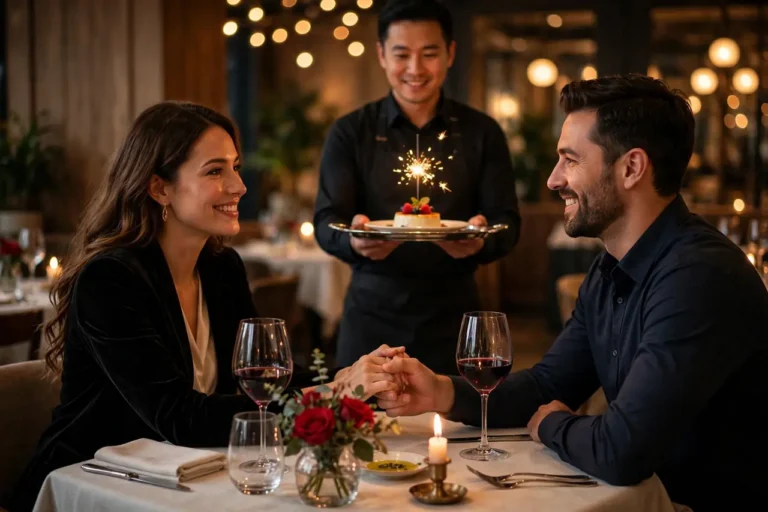
The restaurant is the ritual. As across France, the menu Saint-Valentin dominates. Parisian restaurants — from storied institutions to tiny neighborhood bistros — offer special fixed menus for the night, and the best tables book out weeks ahead. Many Parisian couples deliberately avoid the most famous romantic restaurants (too crowded, too marked-up) in favor of their own beloved local spot. The insider move is not the Eiffel Tower restaurant; it’s the corner bistro where the owner knows your name.
Flowers move through the city like a second rush hour. Parisian florists do some of their biggest business of the year on February 13 and 14, and the sight of commuters carrying single roses or small bouquets home on the Métro is one of the day’s genuine traditions. Red roses dominate, but Parisian taste also runs to peonies (when available), ranunculus, and simple, elegant arrangements.
The evening stroll is non-negotiable. If dinner is the ritual, the walk is the sacrament. Couples stroll the Seine quays, the Tuileries, the narrow streets of the Marais or Saint-Germain — not as tourists ticking boxes, but as residents savoring their city at its most beautiful. February evenings in Paris are cold and often clear, and the city’s lights do the rest.
What they don’t do: attach locks to bridges (forbidden), propose at the top of the Eiffel Tower at sunset on February 14 (the queue alone would end the romance), or attend Valentine’s parties (they barely exist). Parisian Valentine’s Day is intimate by design. For planning the logistics of a special night out — in Paris or anywhere — our guide to planning a Valentine’s date without a dinner reservation has tactics that travel well.
Watch: Why Paris Removed the Love Locks
For a visual account of how the Pont des Arts went from bare steel to a million padlocks and back again, this report captures the whole arc — the romance, the weight, and the city’s decision.
Paris Valentine’s at a Glance
| Detail | What to Know |
|---|---|
| Date celebrated | February 14 — La Saint-Valentin |
| City nickname | “City of Love” (Ville de l’Amour) |
| Love-lock era | First locks c. 2008; removed June 2015; railings replaced with glass panels |
| Peak of the phenomenon | An estimated 700,000–1,000,000 locks weighing roughly 45 tons |
| The bridge | Pont des Arts — pedestrian bridge over the Seine between the Louvre and the Institut de France |
| Typical Parisian celebration | Menu Saint-Valentin dinner, flowers, handwritten card, evening stroll |
| What not to do | Attach locks to bridges (forbidden); expect empty landmarks on February 14 |
A Romantic Tour of Paris: Seven Spots That Earn the Hype
Not every “romantic Paris” spot deserves its reputation. These seven do — each for a different reason, and each best experienced on foot, in the evening, with no particular agenda.
1. Pont des Arts at dusk
The locks are gone, but the bridge remains one of the great vantage points in Europe: the Louvre on one bank, the Institut de France’s dome on the other, the Seine sliding underneath. Come at blue hour, when the streetlamps come on and the houseboats light up. Street musicians often play here; tip them and keep walking.
2. The Eiffel Tower — from a distance
The tower itself on Valentine’s night is a crush of crowds and overpriced champagne. The romantic move is to admire it from afar: the Champ de Mars at night, the Trocadéro esplanade, or a bridge like Pont de Bir-Hakeim. On the hour after dark, the tower sparkles for five minutes — time your stroll to catch it.
3. Montmartre and the Sacré-Cœur steps
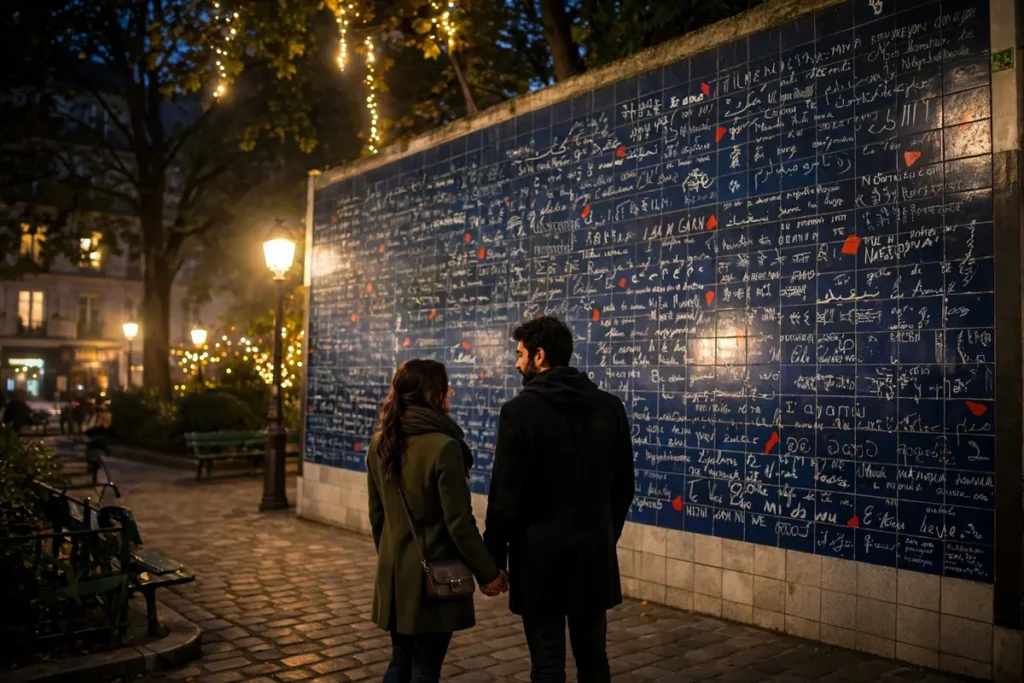
Climb to the basilica terrace for the city’s great panoramic view, then lose yourselves in the tangle of streets below — Place du Tertre, the vineyard of Montmartre, the Le Mur des Je t’aime (the “I Love You” wall) in Square Jehan Rictus, where “I love you” is written in hundreds of languages. It is touristy and utterly charming at the same time.
4. The Louvre courtyard at night
The pyramid lit against the dark palace façades is one of Paris’s great free spectacles. You don’t need to go inside (it’s closed in the evening anyway, except late openings); the courtyard itself, nearly empty after dark, is the experience.
5. The Luxembourg Gardens
In February the gardens are bare and formal — which is precisely their winter beauty. The Medici fountain, half-frozen some years, with the ironwork and the bare plane trees, feels like a film set. Bring coffee from a nearby café and walk the long allées.
6. The Seine quays of the Left Bank
From the Quai de la Tournelle to the Quai des Grands Augustins, the Left Bank quays are the classic Parisian lovers’ walk: Notre-Dame across the water, the bouquinistes (booksellers) shuttered for the night, the city reflected in the river. This is where Parisian couples actually walk on Valentine’s night.
7. A covered passage
The passages couverts — Galerie Vivienne, Passage des Panoramas — are glass-roofed 19th-century arcades full of wine bars, old bookshops, and tea rooms. Sheltered from February weather and nearly empty in the evening, they are one of Paris’s best-kept romantic secrets.
Myth vs. Fact: Valentine’s Day in Paris
Myth: You can still attach a love lock in Paris.
Fact: No. The Pont des Arts railings were replaced with lock-proof glass panels in 2015, and the city actively removes locks elsewhere. Don’t bring one; you’ll be carrying it home.
Myth: Valentine’s Day is a huge public celebration in Paris.
Fact: It’s a big commercial night for restaurants and florists, but there are no parades, festivals, or public events. The celebration is private — dinner, flowers, a walk.
Myth: The love-lock tradition was French.
Fact: It arrived in Paris around 2008, popularized by an Italian novel and film, and was never a French folk custom. Parisians largely regarded it as a tourist phenomenon — charming at first, then a nuisance, then a structural hazard.
Myth: The most romantic restaurant is the one with the best view of the Eiffel Tower.
Fact: The most romantic restaurant is the one where you can hear each other talk. Parisian couples favor intimate neighborhood bistros over panoramic tourist traps — atmosphere beats altitude.
How to Do Valentine’s Day the Parisian Way — Anywhere
You don’t need a plane ticket to borrow the Parisian playbook. The method is a philosophy, not a location.
1. Book the dinner, then stop planning
Parisians invest their planning energy in exactly one decision: where to eat. Make the reservation (or plan the home-cooked menu), and let the rest of the evening unfold. Over-scheduling kills romance; the Parisian evening breathes. If dinner out isn’t in the cards, our Valentine’s Day dinner ideas will help you build a bistro-worthy meal at home.
2. Walk after dinner — always
The post-dinner stroll is the most portable Parisian tradition there is. Whatever your city offers — a river, a park, a pretty street — walk it after the meal, slowly, with no destination. In Paris this is the promenade digestive; everywhere else it’s just the best part of the night. For more on crafting the perfect evening arc, see our Valentine’s Day date ideas.
3. One perfect flower, well chosen
Skip the gas-station dozen. Buy a single excellent rose, or a small bunch of something seasonal, from a real florist. Presentation matters: have it wrapped properly, carry it with confidence. The Parisian Métro commuter with one perfect rose understands something the bouquet-buyer doesn’t.
4. Write the card like you mean it
French cards are sincere, specific, and private. A few true sentences beat a page of borrowed poetry. If words don’t come easily, write about a single memory from the past year — specificity is the soul of romance.
5. Declare love without hardware
The love locks taught Paris a lesson the whole world can use: the grandest gestures are sometimes the most fragile. A photograph, a letter, a promise kept — these outlast padlocks. #lovewithoutlocks works as a life philosophy, not just a municipal campaign. For the bigger picture of how France celebrates beyond the capital, read our deep dive on how the French really celebrate Valentine’s Day: La Fête des Amoureux.
The Valentine’s Economy: What February 14 Means for Paris Businesses
Valentine’s Day is one of the most commercially significant single days of the year for several Parisian trades — and the numbers explain why the city leans into the romance even as its residents keep things low-key. Florists routinely report Valentine’s week as their biggest sales period of the winter, with the average French Valentine’s bouquet running around €45 and premium Parisian arrangements climbing far higher. Restaurants, meanwhile, treat February 14 as a second New Year’s Eve: fixed menus at premium prices, two seatings a night, and weeks of advance bookings.
The economics extend well beyond dinner and roses. Parisian chocolatiers release limited-edition Valentine’s collections; jewelers on the Place Vendôme and in the Marais run targeted campaigns; hotels package nuits Saint-Valentin with champagne and late checkout; and the city’s pastry shops compete for the most photogenic Saint-Valentin dessert. Perfumeries — an industry Paris essentially invented — consider the day a natural showcase, with gift sets and engraving services doing brisk business.
There is a tension here that Parisians navigate with characteristic irony: a culture that publicly shrugs at commercialized romance while privately sustaining an enormous Valentine’s economy. The resolution, as always, is taste. Spending is fine; showing off about spending is not. The ideal Parisian Valentine’s purchase is expensive enough to signal seriousness and discreet enough that no one else needs to know the price. It is, in the end, the same philosophy as the celebration itself: the value is in the intention, not the invoice.
Frequently Asked Questions
Can you still put a love lock on the Pont des Arts?
No. The locks were removed in June 2015 after their weight (an estimated 45 tons) caused a section of the parapet to collapse. The railings were replaced with glass panels specifically designed to prevent new locks, and the city removes locks that appear on other bridges.
What do Parisians actually do on Valentine’s Day?
Most celebrate much like the rest of France: a special restaurant dinner (menu Saint-Valentin), flowers, a handwritten card, and an evening stroll. Grand public gestures are rare; the day is intimate by design, with the big romantic performances largely left to tourists.
Why is Paris called the City of Love?
The nickname grew from centuries of art, literature, and cinema that framed Paris as the natural setting for romance — from courtly love culture to films like Amélie — amplified by twentieth-century tourism marketing. The city itself, with its light, scale, and café culture, largely lives up to the branding.
Is the Pont des Arts worth visiting without the locks?
Absolutely. The bridge’s appeal was never really the locks; it’s the location — spanning the Seine between the Louvre and the Institut de France with superb views in both directions. At dusk, with street musicians playing, it remains one of Europe’s great romantic spots.
What happened to all the removed love locks?
Most were recycled, but the city auctioned off a selection of padlocks and grille panels, donating the proceeds to charities supporting refugees. Individual pieces fetched from around €150 to €10,000 at auction.
When should I book a Paris restaurant for Valentine’s Day?
Weeks in advance, at minimum. The best tables for February 14 in Paris are typically reserved well ahead, and many restaurants offer only their special menu Saint-Valentin that night — no à la carte. If you’re planning a romantic trip, our guide to romantic getaways in the US covers closer-to-home alternatives with the same spirit.
Paris Keeps Its Promises — Just Not the Obvious Ones
Paris on Valentine’s Day will not give you the movie montage — no locks on the bridge, no empty Eiffel Tower at sunset, no accordion player appearing on cue. What it gives you instead is better: a city that is genuinely, effortlessly romantic on any evening of the year, and a local culture that understands love as something private, specific, and best expressed slowly.
The love locks came and went in seven years. The Seine, the light, the long dinners, and the walks home will outlast all of us. That is the real Parisian Valentine’s tradition — and it was never for sale in a souvenir shop.