As the countdown hits zero, across millions of living rooms and crowded plazas, strangers and sweethearts alike turn to the nearest person and kiss. It’s one of New Year’s Eve’s most electric rituals — and one of its most mysterious. Unlike the song we can date to 1788 or the calendar reform we can date to 45 BC, the midnight kiss has no founding document, no inventor, no first broadcast. Its origins dissolve into folklore, masked balls, and centuries of humans deciding that the year’s first moments should begin with affection. Here’s what historians actually know, what tradition holds, and why — whatever its source — the kiss at midnight endures.
The Honest Answer: Nobody Knows for Sure
Let’s start with scholarly humility: there is no verified “first midnight kiss,” no decree that established it, and no single culture that can claim to have invented it. What we have instead is a convergence of traditions — folk beliefs about first encounters, the rowdy intimacy of centuries of New Year’s revelry, and the amplifying power of 20th-century mass media — that fused into the ritual we know. Historians believe the custom emerged gradually from European folk traditions around first-footing and first encounters: the widespread belief that the first person you meet, or the first thing you do, in the new year sets the tone for everything that follows.
This “first things” superstition is ancient and global. In Scotland and northern England, first-footing held that the first person to cross your threshold after midnight determined your year’s luck (a dark-haired man bearing coal, salt, or whisky was ideal). In the same spirit, English and German folklore held that whom you were with — and what you were doing — at the stroke of twelve shaped the year ahead. Kissing the person you loved at midnight was, by this logic, a way of locking in love and affection for the twelve months to come. Tradition holds that failing to kiss someone at midnight meant a year of loneliness — a superstition that did wonders for the custom’s survival.
Roman Roots? The Saturnalia Question
You’ll often read that the midnight kiss descends from Saturnalia, the raucous Roman midwinter festival (December 17–23). It’s a tempting story: Saturnalia featured role reversals, feasting, gift-giving, and a general loosening of social norms. But historians urge caution here — there’s no solid evidence that Saturnalia involved a ritual New Year kiss, and Saturnalia wasn’t even a new year festival (it fell in December, weeks before the Kalends of January). What Saturnalia did contribute was the template for midwinter revelry itself: the idea that the darkest, coldest nights are for gathering close, drinking deep, and suspending ordinary restraint. The kiss belongs to that emotional lineage, even if no Roman ever planted one at midnight.
A more plausible ancient thread is the mistletoe tradition. Kissing under mistletoe at Christmas descends from Norse and Celtic associations of the plant with fertility and love (the Norse myth of Baldr, though the “kiss under mistletoe” custom itself is a much later, likely 18th-century English development). Mistletoe’s Christmas-season presence kept ritual kissing in the midwinter air, culturally speaking, right up against New Year’s Eve — the customs are cousins, if not siblings.
Masked Balls and the Kiss of the Unmasking
One of the strongest candidate origins lies in the masquerade balls of 18th- and 19th-century Europe. At these lavish affairs — which often ran past midnight on New Year’s Eve — masks came off at twelve, and the unmasking was traditionally sealed with a kiss. The anonymity of the mask licensed a boldness that propriety otherwise forbade; the midnight unmasking-kiss was thrilling precisely because you might not know whose lips you’d find. As masquerade culture filtered down from aristocratic ballrooms to public dance halls and eventually to house parties, the kiss survived the mask. By the early 20th century, the association of midnight, celebration, and kissing was firmly embedded in popular culture — no mask required.
The American Amplification: 1907 and All That
Whatever its folk roots, the midnight kiss became a mass ritual in 20th-century America, and two forces drove it: Times Square and Hollywood. When the first ball drop lit up Times Square on December 31, 1907, it created a new kind of public New Year’s Eve — hundreds of thousands of strangers packed together at midnight, cameras rolling. Newsreel and later television cameras loved the kiss: it was visual, emotional, and wordless — perfect for broadcast. Year after year, images of couples kissing at midnight in Times Square taught the rest of the country (and eventually the world) what one does at midnight.
Hollywood did the rest. Generations of films ended — or featured — the New Year’s Eve kiss as shorthand for romance fulfilled, from classic screwball comedies to modern rom-coms built entirely around the night (the genre even has a name: the New Year’s Eve movie). Each on-screen kiss at midnight reinforced the real-world script. By the late 20th century, the question wasn’t why kiss at midnight — it was the anxious who will I kiss at midnight?, a social pressure the custom’s folk origins never anticipated.
Midnight Kisses Around the World
The kiss-at-midnight isn’t universal — different cultures fill the midnight moment with their own rituals — but affection at the turning of the year is a near-global instinct:
- Scotland: First-footing remains the dominant tradition — the emphasis is on who crosses the threshold rather than kissing, though plenty of kisses happen too. The luck of the year rides on the first-footer’s gifts of coal, shortbread, salt, and whisky.
- Italy: The traditional New Year’s kiss is the bacio di mezzanotte — but Italian folklore also holds that what you’re wearing at midnight matters: red underwear for luck and love in the new year, a custom now exported worldwide.
- Spain & Latin America: Midnight belongs to the twelve grapes — one per bell chime — with kisses and hugs exchanged in the joyful chaos afterward. In Spain’s Puerta del Sol, thousands kiss between grape-swallows.
- Brazil: At Copacabana’s giant Réveillon party, the midnight moment is a wave of embraces — hugs and kisses exchanged with strangers as fireworks explode overhead. Affection as crowd behavior.
- Germany: Bleigießen (lead pouring for fortune-telling) and fireworks dominate, but the midnight toast — “Prosit Neujahr” — is sealed with embraces and kisses among friends and family.
- Philippines: Round shapes for prosperity (coins, polka dots, round fruit) share the midnight table with the beso-beso cheek-kiss greeting exchanged as the year turns.
The pattern: whatever the local ritual, midnight is for physical closeness — kisses, hugs, linked arms during Auld Lang Syne. Humans greet the unknown future the way we’ve always faced frightening thresholds: holding onto each other.
The Folklore: Why a Kiss (and Not, Say, a Handshake)
Folk traditions converge on the kiss for a reason. A handshake is a contract; a kiss is a blessing. Across European folklore, the kiss carried protective and prophetic power: kissing under mistletoe warded off evil, a mother’s kiss healed, a kiss sealed an oath more binding than words. Applied to midnight, the kiss becomes a benediction on the year — you are literally breathing affection into the first moments of the future, in the hope that the year breathes it back.
There’s also the matter of courage. Midnight on New Year’s Eve is a liminal moment — the old year dying, the new one unborn — and liminal moments in folklore are when magic works and when ordinary rules suspend. The masked ball’s unmasking-kiss, the stranger’s kiss in Times Square, the kiss you finally dare at the countdown: all of them borrow the night’s permission. The tradition persists because it gives structure to bravery — a socially approved moment to do the thing you wanted to do all evening.
The Modern Midnight Kiss: Notes on Doing It Well
Traditions evolve, and the midnight kiss is evolving too — mostly for the better. A few thoughts for the contemporary party:
- Consent is the modern mistletoe. The old custom assumed the kiss; the new custom asks. A smile, an open gesture, a raised eyebrow at 11:59 — read the room, and let “no” be as easy as “yes.” The best midnight kisses are the wanted ones.
- It’s not only romantic. Some of the finest midnight kisses are platonic: the cheek-kiss with your best friend, the forehead kiss for your kid, the hug-and-kiss for your grandmother. The tradition’s heart is affection, not romance — widen it.
- Solo at midnight is fine. The folklore about a kissless year bringing loneliness is just folklore — charming, but folklore. Plenty of people welcome the year with a toast to themselves, and there’s something quietly powerful about raising your midnight glass to your own company. The year doesn’t check your relationship status.
- Make it deliberate. The kiss lands harder when the moment around it is intentional: the champagne poured, the song sung, then the kiss. Ritual needs a frame.
Myth vs. Fact
- Myth: The midnight kiss comes from ancient Rome. Fact: There’s no solid evidence of a Roman New Year kissing ritual. The custom’s traceable roots are in European folk beliefs about first encounters and the masked-ball tradition — centuries later than Rome.
- Myth: Not kissing at midnight dooms you to a lonely year. Fact: Folklore, not fact — though historians believe this very superstition helped the custom spread, since nobody wanted to risk it.
- Myth: Everyone everywhere kisses at midnight. Fact: It’s strongest in Western cultures; many cultures center grapes, embraces, toasts, or threshold rituals instead. The universal is closeness, not the kiss specifically.
- Fact: The Times Square ball drop (first held December 31, 1907) and 20th-century broadcasting turned a folk custom into a global mass ritual — the cameras needed something to film at midnight, and the kiss was perfect television.
In Pictures: Why We Kiss at Midnight on New Year's Eve
The clock strikes twelve and the room erupts — but why a kiss? The answer stretches back to ancient Rome. Here's the tradition, mid-celebration.
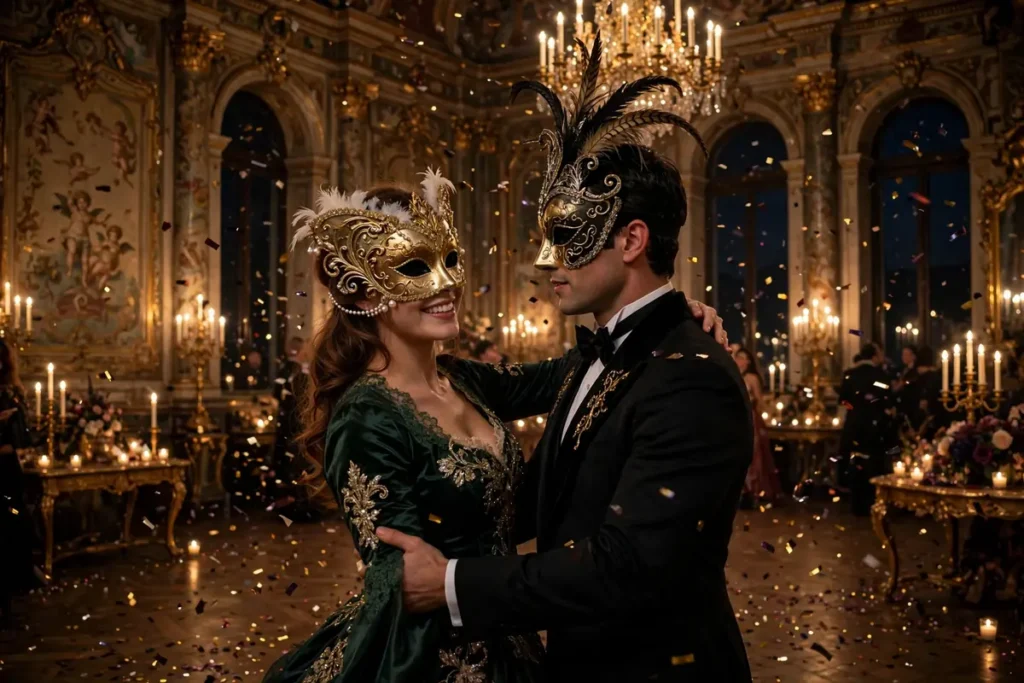
A joyful New Year's Eve crowd sharing midnight kisses and embraces as confetti rains down in a grand ballroom.
Watch: Why We Kiss at Midnight on New Year's Eve
The midnight kiss tradition and its origins — where this New Year's Eve custom really comes from.
At a Glance: Why We Kiss at Midnight on New Year's Eve
The traced roots of the midnight kiss.
| Era / Source | Detail | Note |
|---|---|---|
| Saturnalia | Ancient Rome, mid-December | The raucous winter festival is often cited as the custom's earliest ancestor |
| Hogmanay | Scotland | Kissing friends and strangers at New Year remains part of Scottish Hogmanay hospitality |
| Masquerade balls | Renaissance Europe | At midnight masks came off; a kiss symbolized purification for the new year |
| English and German folklore | Later centuries | Folklore holds that who you're with at midnight foretells your year's luck in love |
| Sir Gawain and the Green Knight | Medieval literature | Contains one of the earliest literary nods to a New Year's kiss |
| Today | A global ritual | The midnight kiss is now one of NYE's most universal moments |
Frequently Asked Questions
Where did the New Year’s Eve kiss originate?
There’s no single documented origin. Historians trace it to a convergence of European folk beliefs — particularly the idea that the first person you encounter in the new year shapes your fortunes — and the 18th/19th-century masquerade tradition of the midnight unmasking kiss. It became a mass ritual through 20th-century American media, especially Times Square broadcasts beginning with the first ball drop on December 31, 1907.
Is it bad luck not to kiss anyone at midnight?
According to old folklore, yes — tradition held that going kissless at midnight meant a lonely year. In reality, it’s just a superstition, and a charming one. Many people happily welcome the year with friends, family, a toast, or their own company. The year ahead is shaped by what you do in it, not by twelve seconds of lip contact.
Why do people kiss strangers at midnight in Times Square?
Crowd euphoria plus tradition: hundreds of thousands of people share an intense communal moment, the custom says “kiss someone,” and the nearest someone is a stranger. It’s the masquerade-ball logic updated — anonymity plus a liminal moment equals boldness. (Modern note: enthusiasm is great; consent still applies, even at midnight, even in Times Square.)
Do other cultures kiss at midnight on New Year’s Eve?
Some do — Italy’s bacio di mezzanotte, Brazil’s wave of embraces at Copacabana, Germany’s midnight hugs — but many cultures fill the moment differently: Spain’s twelve grapes, Scotland’s first-footing, the Philippines’ round-fruit traditions. Physical closeness at midnight is near-universal; the kiss specifically is strongest in Western tradition.
What’s the connection between the midnight kiss and mistletoe?
They’re cousins, not siblings. Kissing under mistletoe is a Christmas-season custom (likely 18th-century English in its modern form, with older Norse/Celtic associations of the plant with love and protection). Its presence kept ritual midwinter kissing culturally current right up against New Year’s Eve, and the two customs share emotional DNA — but one didn’t directly create the other.
How can I make the midnight moment special without a romantic kiss?
Expand the definition: kiss your kid’s forehead, cheek-kiss your best friend, embrace your family, or simply raise your glass in a deliberate toast to the people around you. Pair it with the full ceremonial sequence — the song, the toast, then affection — and the moment will feel complete. Our at-home celebration plan maps out the whole midnight ritual.
In the end, the midnight kiss is folk wisdom wearing evening clothes: begin as you mean to go on. Begin the year held, kissed, or at least surrounded — and carry that warmth forward into whatever the next twelve months bring. It’s not bad advice for a superstition. Happy New Year.
The Science of the Kiss: Why It Feels Like Magic
Folklore aside, there’s real biology behind why a midnight kiss feels transformative. Researchers in the field of philematology (the scientific study of kissing) have found that a passionate kiss triggers a cascade of neurochemistry:
- Dopamine surges — the same reward chemical behind new love and, well, champagne. The brain literally rewards kissing.
- Oxytocin — the “bonding hormone” — rises, promoting feelings of attachment and trust. A midnight kiss chemically bonds you to the person and the moment.
- Cortisol (the stress hormone) drops. Kissing is, measurably, calming — which is why the anxious countdown dissolves the instant lips meet.
- Adrenaline spikes first — the racing heart isn’t just romance; it’s your nervous system registering novelty and excitement.
- Testosterone transfers in saliva (in all genders’ saliva, to all genders’ receptors), subtly increasing arousal — one reason kisses escalate.
Add the context — the countdown’s built-up tension, the crowd’s collective euphoria, the fireworks overhead, the symbolic weight of the threshold — and you have a neurochemical perfect storm. The folk belief that a midnight kiss “sets” the year isn’t literally true, but the feeling it describes is: the kiss genuinely alters your brain state as the year turns, and memory encodes emotionally intense moments more deeply. You’ll remember this midnight. That’s the real magic — chemistry, not superstition.
Famous Midnight Kisses: The Canon
Some kisses at midnight have escaped the private moment and entered culture:
- Times Square, every year: The collective kiss — hundreds of thousands of people turning to each other at the ball drop — is the world’s most-photographed simultaneous kiss, broadcast to over a billion viewers. The 1907 first ball drop started it; television made it ritual.
- When Harry Met Sally (1989): The New Year’s Eve party kiss — after the whole film’s “can men and women be friends” debate — remains cinema’s definitive midnight kiss, the one every rom-com since has tried to replicate.
- Bridget Jones’s Diary (2001): Opens and closes on New Year’s Eve, with the midnight kiss as the narrative’s resolution — the film that taught a generation to associate the holiday with romantic do-overs.
- The Apartment (1960): Billy Wilder’s New Year’s Eve climax — “Shut up and deal” — proved the midnight moment could carry an entire film’s emotional weight.
- Royal kisses: Public New Year’s kisses by public figures — from presidential couples on the White House balcony to the Duke and Duchess of Cambridge at midnight events — turn the private ritual into national theater, watched and mimicked by millions.
Each famous kiss reinforced the script for the rest of us: this is what midnight is for. Culture taught us the choreography; our neurochemistry does the rest.
Hosting the Midnight Moment: A Practical Script
If you’re hosting, you can shape the midnight kiss from awkward scramble into genuine ritual:
- 11:55 — Gather. Call everyone together. Dim the music. The physical gathering is the cue that something is about to happen.
- 11:57 — Pour. The toast drinks (or champagne) go into hands now, not at midnight — fumbling with bottles during the countdown kills the moment.
- 11:59 — Count. Put the broadcast on the biggest screen, or lead the count yourself. The shared counting synchronizes the room — it’s the drumbeat before the downbeat.
- Midnight — Song, then kiss, then toast. The traditional order: sing (or at least the chorus), then the kisses and embraces, then raise glasses. The sequence gives the kiss a frame instead of a scramble.
- 12:05 — The word. Go around the circle: one word for the year ahead, or one thing you’re carrying forward. It takes five minutes and people remember it for years. (Our New Year wishes collection can seed the toasts.)
The kiss itself needs no scripting — but the moment around it does. That’s the host’s real job at midnight: not to manufacture romance, but to build the frame in which it can happen naturally.
The Midnight Kiss in Literature and Song
Long before Hollywood, writers and songwriters were already scripting the midnight kiss. In F. Scott Fitzgerald’s Jazz Age stories, New Year’s Eve parties shimmer with the era’s particular blend of longing and champagne — the kiss at midnight as the decade’s emotional currency. John Cheever and Dorothy Parker used the New Year’s party as a stage for everything unsaid all year finally being said (or kissed) at twelve.
Popular music made it explicit. Countless songs use the midnight kiss as their climax or their ache: the lonely narrator watching couples kiss at midnight is a pop-song archetype, from jazz standards to modern ballads. The midnight song provides the soundtrack; the kiss provides the plot. Together they form the two-act structure of the holiday’s emotional narrative — first the communal remembrance (the song, arm in arm), then the intimate sealing (the kiss). It’s no accident that the order is fixed: the collective moment licenses the personal one. The circle gives you courage; the kiss spends it.
And there’s a quieter literary tradition worth noting: the un-kissed midnight — the protagonist alone at the window, watching fireworks, choosing solitude. Writers from Virginia Woolf to contemporary novelists have found the year’s turning to be the perfect setting for the character who doesn’t kiss anyone: the widow, the traveler, the newly single, the contentedly alone. These scenes argue, gently, that the midnight moment belongs to everyone — including those who greet it with a book, a walk, or simply a deep breath. The kiss is the tradition; the choice is yours.