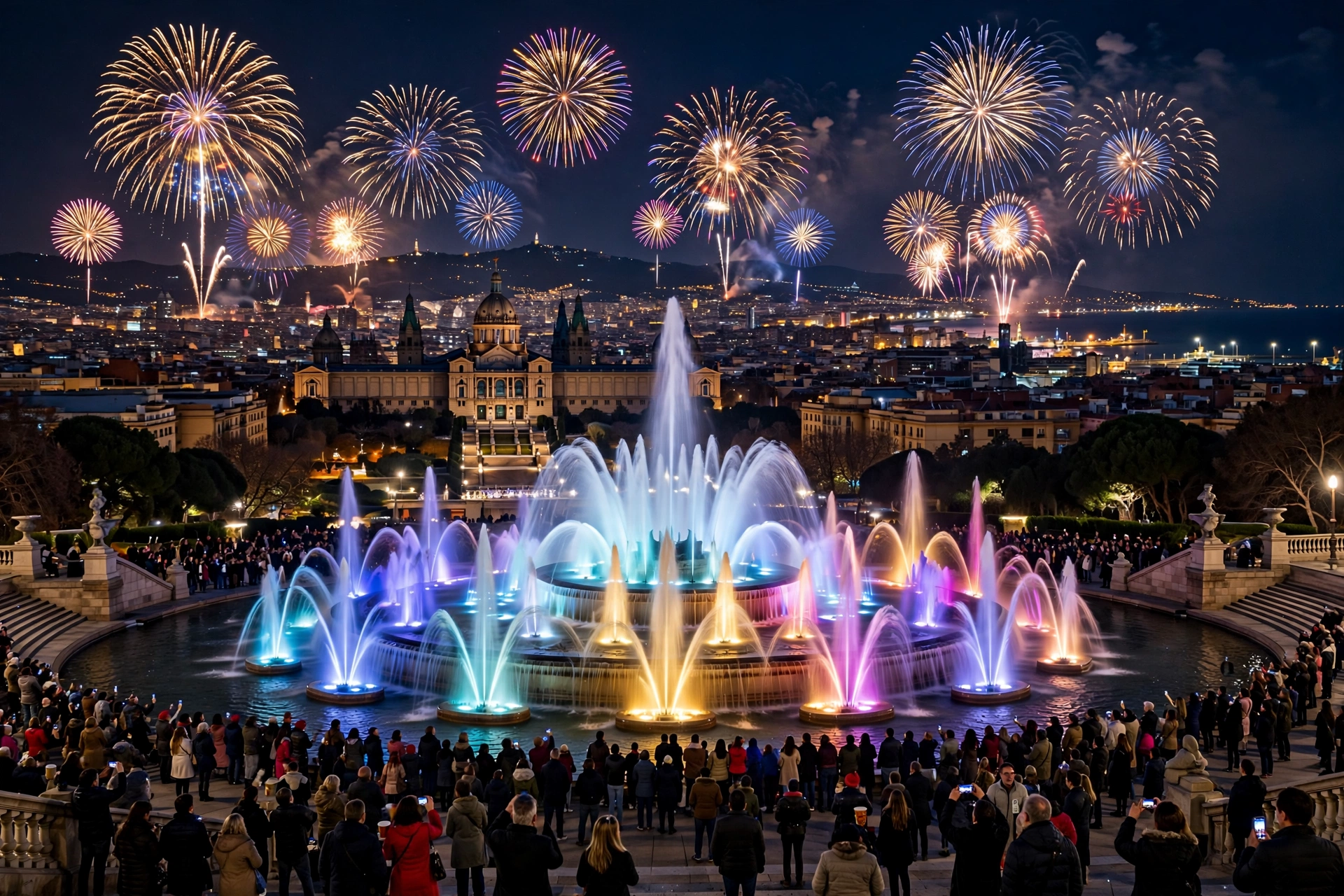
Barcelona does New Year’s Eve with Mediterranean flair: a spectacular light-and-music show at the Magic Fountain of Montjuïc, fireworks over the city, beach parties on Barceloneta, and the Spanish tradition of eating twelve grapes at midnight. It is warmer than most European countdowns, gloriously outdoorsy, and fuelled by cava, vermouth, and a city that loves a late night.
This guide covers the Magic Fountain show, the midnight grapes tradition, the best viewing spots, beach parties and nightlife, Catalan food traditions, where to stay, and the practical details for the night.
Why Barcelona on New Year’s Eve
Barcelona’s December weather is one of its biggest draws: daytime temperatures around 14°C (57°F) and evenings around 8–10°C (46–50°F) — chilly by local standards, but positively mild compared to northern Europe. The city celebrates outdoors well into the night, and the combination of the Magic Fountain show, the beach, and the grapes tradition gives the night a character all its own.
The centrepiece is the New Year’s Eve show at the Magic Fountain of Montjuïc — a special edition of the fountain’s famous light, water, and music spectacle, staged in the final minutes of the year with fireworks to mark midnight. In recent years the show has typically drawn huge crowds to Avinguda de la Reina Maria Cristina, the grand avenue leading up to the Palau Nacional. Check the city council’s announcements for each year’s timing.
The Magic Fountain Show: What to Expect
The Magic Fountain (Font Màgica de Montjuïc) is Barcelona’s beloved choreographed fountain — water, light, and music dancing together. On New Year’s Eve it hosts a special extended show that builds to the midnight moment, when fireworks crown the performance and the crowd counts down together.
A typical evening:
- Evening: The avenue fills from the early evening. Expect a festive, family-friendly atmosphere with music and anticipation building.
- Before midnight: The special fountain show begins — an extended performance leading into the countdown.
- Midnight: Fireworks over Montjuïc as the crowd eats its twelve grapes (more on that below) and the new year begins.
- After midnight: The party moves to the beach clubs, the clubs of Port Olímpic, and the bars of El Born, Gràcia, and Eixample.
The Twelve Grapes: Spain’s Midnight Tradition
The most important Spanish New Year’s tradition happens at midnight: eating twelve grapes (las doce uvas de la suerte), one for each chime of the clock, for twelve months of luck. The tradition dates to the early 20th century and is observed across Spain — in Barcelona, thousands gather with their bags of grapes to eat them in time with the bells.
How to do it right:
- Buy your grapes in advance — supermarkets sell special New Year’s Eve packs of twelve seedless grapes, often in tins or small bags. They sell out, so do not leave it to December 31.
- One grape per chime. The chimes come fast — it is harder than it sounds, and that is part of the fun.
- Finish all twelve before the chimes end for the full twelve months of luck.
- Wash them down with cava. Obviously.
Best Places to Watch the Midnight Moment
Avinguda de la Reina Maria Cristina (Magic Fountain)
The main event. The avenue between Plaça d’Espanya and the Palau Nacional fills with tens of thousands for the fountain show and midnight fireworks. Arrive early — the best positions near the fountain go hours ahead. Bring your grapes, your cava, and warm layers.
Plaça de Catalunya and the Ramblas
The city centre’s grand square is a traditional gathering point, with a festive crowd and easy access to the bars of the Gothic Quarter and El Born for after midnight. You will not see the fountain show from here, but the atmosphere is electric.
Tibidabo
For the panorama, head up to Tibidabo — the hilltop amusement park and church overlook the entire city. On a clear night you get Barcelona spread below with fireworks in multiple locations. It is further from the action but spectacular and less crowded.
Barceloneta Beach
The beach parties start early and run late. Watching midnight from the sand — grapes in hand, sea air, fireworks visible along the coast — is the most Barcelona way to do it. The beach clubs (xiringuitos in their winter incarnation and the clubs of Port Olímpic) host ticketed parties.
Montjuïc Castle
The castle hill above the fountain offers an elevated view of the show and the city. A strong pick if you want the panorama without the avenue crowds.
Beach Parties and Nightlife
Barcelona’s New Year’s Eve nightlife is famous. The clubs of Port Olímpic and the beachfront host the biggest ticketed parties, with international DJs and dawn finishes. Razzmatazz in Poblenou runs one of the city’s legendary New Year’s events across its multiple rooms. The bars of El Born, Gràcia, and Eixample offer more local, less megaclub alternatives.
Tickets for the big clubs sell out — buy in advance, and check what the ticket includes (some include drinks, cloakroom, and even the grapes). After-parties run well into New Year’s Day.
Catalan Food and Drink Traditions
The New Year’s Eve dinner
Dinner on December 31 is a family affair in Catalonia — and a late one. Restaurants offer special menús de Nochevieja (New Year’s Eve menus), typically served in seatings from 8 PM onward. Expect seafood, roast meats, and turrón (nougat) for dessert. Book well ahead.
Cava, not champagne
Catalonia is the home of cava, Spain’s sparkling wine, and it flows freely on New Year’s Eve. A good brut nature cava is the authentic (and affordable) midnight toast.
Vermouth hour
Barcelona’s beloved vermut tradition — a pre-lunch or pre-dinner vermouth with olives and conservas — is the perfect way to start December 31. The vermouth bars of Gràcia and Eixample are at their most festive.
New Year’s Day: escudella
January 1 calls for escudella i carn d’olla, the hearty Catalan stew — the traditional recovery meal. Many restaurants serve it on New Year’s Day.
Where to Stay
- Plaça d’Espanya / Montjuïc: Walk to the Magic Fountain show. The obvious choice for the main event.
- Eixample: Central, elegant, well-connected — a great base for the whole night.
- El Born / Gothic Quarter: Atmospheric old-town streets, near the centre’s nightlife.
- Barceloneta / Port Olímpic: For the beach-party route — stay near the sand.
- Gràcia: Local, lively, excellent bars and restaurants; a short metro ride from the action.
New Year’s Eve is a busy night in Barcelona — book accommodation early, especially near Plaça d’Espanya or the beach.
Practical Tips
Weather
Mild by European winter standards: evenings around 8–10°C (46–50°F). You will want a warm jacket for hours outdoors at the fountain or beach, but nothing like northern-European winter gear. Rain is possible but not typical.
Transport
Barcelona’s metro typically runs all night on New Year’s Eve — one of the great advantages of the city’s celebration. Buses run holiday schedules. The metro is the best way to reach Plaça d’Espanya and to get home; expect crowds at the Espanya station after midnight.
Crowds and safety
The fountain avenue and the beach get very crowded. Pickpockets operate in the crush — keep valuables secure and be alert on the metro. The atmosphere is festive, but the density around Plaça d’Espanya at midnight demands awareness.
Budget
The fountain show and street celebrations are free. A menú de Nochevieja is the main expense; club tickets are the other splurge. Cava and vermouth are delightfully affordable — a very good bottle of brut nature cava costs less than a mediocre champagne anywhere else, and the city’s tapas bars keep a full night of eating and drinking remarkably reasonable. The metro’s all-night New Year’s Eve service keeps transport costs near zero. Splurge where it counts (the dinner, the club ticket) and let the city’s free spectacles — the fountain, the beach, the Gothic Quarter at dawn — carry the rest.
Language
Barcelona is bilingual (Catalan and Spanish). A few words of either go a long way; English is widely spoken in the centre.
New Year’s Day in Barcelona
January 1 is a public holiday — the city wakes slowly. The traditional Primer Bany de l’Any (first swim of the year) sees brave souls plunge into the sea at Barceloneta and other beaches at midday — spectators welcome. Otherwise, recover with escudella, stroll the empty morning streets of the Gothic Quarter, and ease into the year the Barcelona way.
If the new year has you thinking about fresh starts, our New Year reset guide offers a structured 30-day plan.
The Perfect New Year’s Eve Day in Barcelona
Morning: the Gothic Quarter
Start in the Gothic Quarter — the cathedral, the Roman walls, the sun-dappled Plaça Reial — before the crowds build. It is at its most atmospheric in the morning light. Stop for a café con leche and a croissant in a traditional granxa.
Midday: vermouth hour
The sacred Barcelona ritual: vermut — a vermouth on tap with olives, potato chips, and conservas — in Gràcia or Eixample. On December 31 the vermouth bars are at their most festive. This is lunch, Barcelona-style.
Afternoon: Park Güell or the beach
Two options: Park Güell for Gaudí’s mosaic wonderland (book tickets ahead), or a walk along Barceloneta Beach to scout your evening territory. Then back to the hotel to rest and dress for the night — the evening is long.
Evening: dinner, then the fountain
Your menú de Nochevieja — or tapas-hopping through El Born — then make your way to Plaça d’Espanya by early evening. Buy any last-minute supplies (grapes if you forgot — though you should not have), find your position on the avenue, and soak in the build-up.
Midnight: grapes and fireworks
Twelve grapes, twelve chimes, fireworks over Montjuïc. The crowd roars. The year turns.
After midnight: the beach clubs
Port Olímpic and the beach clubs for the big party, Razzmatazz for the legendary multi-room night, or the bars of El Born for something more local. Dawn ends with chocolate con churros.
Day Trips from Barcelona
Montserrat
The serrated mountain with its Benedictine monastery, an hour from the city — the boys’ choir, the Black Madonna, and hiking with vast views. A spiritual counterpoint to the night’s revelry; best done on December 30 or January 2.
Sitges
Forty minutes down the coast: the charming seaside town with beaches, Modernista streets, and a famously lively LGBTQ+ scene. Its own New Year’s celebrations are smaller and more intimate than Barcelona’s.
Girona and the Costa Brava
With an extra day, Girona’s medieval old town and the coves of the Costa Brava make a beautiful winter excursion — quieter, slower, and stunning.
Catalan Christmas Traditions
Barcelona’s New Year’s Eve sits inside a Catalan festive season with traditions found nowhere else in Spain.
Caga Tió
The beloved Caga Tió (“pooping log”) — a hollow log with a painted face, fed treats by children through December and then beaten with sticks on Christmas Eve to “poop out” presents. It is absurd, cherished, and very Catalan. You will see Tió logs for sale in markets throughout December.
The caganer
Even better: the caganer — the figurine of a peasant defecating, traditionally hidden in the nativity scene (pessebre). Modern caganers depict celebrities, politicians, and footballers. Finding the caganer in Barcelona’s grand Plaça Sant Jaume nativity scene is a beloved annual game.
The pessebre
Catalans take their nativity scenes seriously — the pessebre is an art form, with elaborate scenes in churches, civic buildings, and the great public nativity in Plaça Sant Jaume. Visit it in the days around New Year’s Eve.
Sant Esteve (December 26)
Catalonia celebrates St. Stephen’s Day on December 26 with family gatherings and canelons (cannelloni made from Christmas leftovers) — a second Christmas Day that extends the festive season.
Gaudí and Beyond: More Barcelona
The Sagrada Família
No Barcelona trip is complete without Gaudí’s basilica — still under construction after 140+ years, and astonishing. Book tickets well ahead; the festive season is busy.
Casa Batlló and La Pedrera
Gaudí’s fantastical apartment buildings on Passeig de Gràcia — the dragon-back roof of Casa Batlló, the wave facade of La Pedrera. The evening light shows at Casa Batlló are magical in winter.
The Palau de la Música Catalana
The Modernista concert hall — a jewel box of stained glass and mosaics. If a concert coincides with your visit, it is one of the world’s most beautiful venues.
Money, Transport & Practical Essentials
- Currency: Euro (EUR). Cards are widely accepted; carry some cash for market stalls and small bars.
- Tipping: Service is included in Spain; leaving small change or rounding up is appreciated but not obligatory.
- SIM cards: Prepaid Spanish SIMs with generous data are available at the airport and phone shops — useful for maps on the night.
- Metro: Barcelona’s metro is the backbone of New Year’s Eve transport and typically runs all night on December 31. Buy a T-casual or T-dia ticket depending on your stay length.
- Emergency number: 112.
- Language: Barcelona is bilingual — Catalan and Spanish. Signs are often in Catalan first. English is widely spoken in tourist areas.
- Water: Tap water is safe, though many locals prefer bottled.
- Siesta hours: Smaller shops may close in the afternoon — plan shopping accordingly, especially for last-minute grapes.
When to Book: A Timeline
- 3–5 months ahead: Flights and accommodation near Plaça d’Espanya or the beach.
- 2 months ahead: Menú de Nochevieja dinner reservations and club tickets (Razzmatazz sells out).
- 1 month ahead: Rooftop packages and any guided tours for surrounding days.
- Mid-December: Buy your twelve grapes — the special packs sell out.
- 1 week ahead: Check the city council’s announcements for the Magic Fountain show timing and metro hours.
Barcelona’s Markets: La Boqueria and Beyond
New Year’s Eve cooking — or just eating — starts at Barcelona’s markets.
La Boqueria
The famous market off the Ramblas: a riot of fruit, jamón, seafood, and juice stalls. It is touristy and wonderful — go in the morning of December 30 or 31 for the full sensory overload, and eat at one of the market’s counter bars.
Mercat de Sant Antoni
The locals’ market: recently renovated, beautiful, and far less crowded than La Boqueria. The Sunday book market in the surrounding streets is a bonus if your dates align.
Mercat de la Concepció
The Eixample’s elegant market — excellent for jamón ibérico, cheeses, and the ingredients for a New Year’s Eve feast if you are self-catering.
Grapes and cava shopping
Buy your twelve grapes at any supermarket or market fruit stall in the days before — the special New Year’s packs appear everywhere. For cava, a good bodega or supermarket will have excellent brut nature bottles at very fair prices. Stock up before December 31; shops close early on the day.
Cava 101: Barcelona’s Sparkling Soul
Midnight in Barcelona is toasted with cava — and understanding it elevates the night.
What it is
Cava is Spain’s traditional-method sparkling wine, made predominantly in Catalonia’s Penedès region (under an hour from Barcelona). Like champagne, it gets its bubbles from a second fermentation in the bottle — but from local grapes (macabeo, xarel·lo, parellada) that give it a distinctive character: crisp, citrusy, and food-friendly.
What to buy
For New Year’s Eve, look for brut nature (the driest style, no added sugar) from a reputable Penedès producer — excellent bottles cost a fraction of champagne. Reserva and Gran Reserva designations indicate longer ageing and more complexity. Supermarkets and bodegas stock them everywhere; buy before December 31.
How to serve
Chill well (3–4 hours in the fridge or 30 minutes in ice water), open carefully — the pressure is real — and pour into flutes or white wine glasses. The traditional midnight toast: Salut i força al canut! (health and strength) in Catalan, or simply ¡Feliz año nuevo!
Cava country day trip
With an extra day, visit Sant Sadurní d’Anoia in the Penedès — the capital of cava, with historic cellars offering tours and tastings. The perfect January 2 excursion.
In Pictures: New Year’s Eve in Barcelona
Barcelona’s New Year is a symphony of drones, water, and fire — 500 drones over Montjuïc with the Magic Fountain back in lights.

Drones forming shapes above the Magic Fountain of Montjuïc during Barcelona’s New Year show.
Watch: New Year’s Eve in Barcelona
The full 2026 show in 4K — 500 drones, the Magic Fountain, and fireworks at Montjuïc.
At a Glance: New Year’s Eve in Barcelona
Barcelona’s Montjuïc spectacle.
| Element | Detail | What to know |
|---|---|---|
| Montjuïc show | 31 December | The official celebration along Avinguda de Maria Cristina, produced by Groupe F, blending drones, the Magic Fountain, fireworks, and music |
| 500 drones | 2026 edition | The 2026 show featured 500 drones forming 3D shapes, themed around the four elements |
| Magic Fountain | Back in action | The Font Màgica returned to the show after drought restrictions had kept it off |
| Music | Marc Parrot | The 2026 edition’s original music was composed by Barcelona musician Marc Parrot |
| Free event | No tickets | The official show is free; organizers advise arriving well before 9:30pm for a good spot |
| 12 grapes | Midnight | Like the rest of Spain, Barcelonans eat 12 grapes — one per clock chime — for luck |
Frequently Asked Questions
What time is the Magic Fountain New Year’s Eve show?
The special show typically builds through the late evening toward the midnight fireworks. Check the city council’s announcements for each year’s exact timing.
What are the twelve grapes of luck?
A Spanish tradition of eating twelve grapes — one per clock chime at midnight — for twelve months of good luck. Buy seedless grape packs in advance; they sell out. The chimes come faster than you expect, so small grapes and a little practice make all the difference between twelve months of luck and a mouthful of grape at 12:00:30.
Where is the best place to watch midnight in Barcelona?
The Magic Fountain avenue for the main show; Barceloneta Beach for the party atmosphere; Tibidabo for the panorama. All are free.
How cold is Barcelona on New Year’s Eve?
Mild — evenings around 8–10°C (46–50°F). A warm jacket suffices; no arctic gear needed.
Does the Barcelona metro run all night on New Year’s Eve?
In recent years the metro has run all night on New Year’s Eve. Confirm the year’s announcement, and expect crowds at Espanya station after midnight — consider walking one stop to Hostafrancs or Tarragona before boarding to skip the worst of the crush.
Is Barcelona good for families on New Year’s Eve?
Yes — the Magic Fountain show is family-friendly and free, the weather is mild, and the early-evening atmosphere is festive rather than rowdy.
Barcelona’s New Year’s Eve is grapes at midnight, fireworks over Montjuïc, and a beach party to finish — the Mediterranean countdown at its best. Buy your grapes early, arrive at the fountain with time to spare, and pace yourself: the night is long. For more European celebrations, see our guides to Madrid New Year’s Eve and Paris New Year’s Eve, and for the words to share the moment, our New Year wishes and captions for 2027. Prefer a quiet night in? Our New Year’s Eve at home plan is there too.