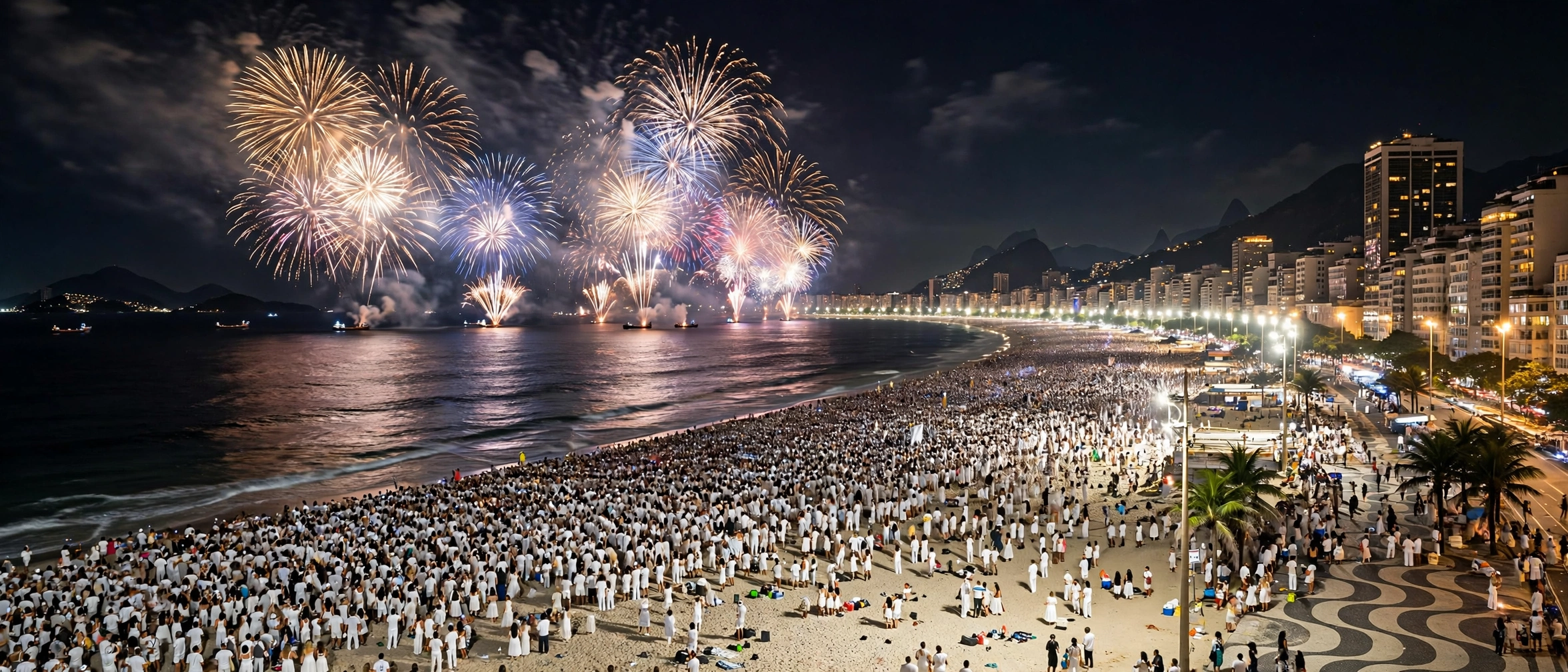
Rio de Janeiro New Year’s Eve is the largest beach party on Earth. Each December 31, the Réveillon — Brazil’s name for the New Year celebration — transforms Copacabana beach into a white-clad sea of humanity: crowds that have topped two million in past years, all dressed in white, standing shoulder to shoulder on four kilometres of sand as fireworks erupt from barges offshore and the whole of Rio’s most famous shoreline glows. It is the Southern Hemisphere’s answer to the great harbour and river shows of the north — but warmer, wilder, and more deeply ritual than any of them.
What makes Copacabana’s Réveillon extraordinary isn’t just the scale — though the scale is staggering. It’s that the party is inseparable from Afro-Brazilian spiritual tradition: the white clothing honouring Oxalá, the orixá of peace; the midnight leap over seven waves for Iemanjá, queen of the sea; the flowers cast onto the water as offerings. Millions of people, sacred and profane at once, welcoming the year together on the sand. Nowhere else on the planet does New Year like this.
This Copacabana Réveillon guide covers the beach party itself, the traditions that give it meaning, the best viewing spots (on the sand and above it), the night’s timeline, Rio’s legendary NYE parties, and the practical realities — safety, transport, heat — of a Brazilian summer midnight.
Réveillon: Understanding Brazil’s New Year
In Brazil, New Year’s Eve is Réveillon (from the French réveillon), and it outranks Christmas as the year’s great celebration. The holiday blends Catholic, African, and Indigenous traditions into something uniquely Brazilian: a night of ritual, music, and collective joy that belongs as much to Candomblé and Umbanda as to the champagne toast.
The sea goddess and the seven waves
At the heart of the Réveillon are the traditions honouring Iemanjá, the orixá (deity) of the sea in the Afro-Brazilian religions. As midnight strikes, celebrants wade into the surf and jump over seven waves — pular sete ondas — making a wish with each leap. Seven is Iemanjá’s number, and the ritual asks her blessing for the year ahead. Flowers — white gladioli and roses especially — are cast onto the water as offerings; small boats of flowers are launched from the sand. Even Brazilians with no religious affiliation perform the seven waves: it’s simply what you do.
Why everyone wears white
The white clothing that turns Copacabana into a glowing expanse isn’t fashion — it’s ritual. White honours Oxalá, the orixá associated with peace, and wearing it expresses the hope for a peaceful year. The tradition is so universal that showing up in colours marks you instantly as a tourist (a charming one, but a tourist). Some add coloured accessories with specific intentions — yellow for money, red for love, green for health — a folk colour-magic that lets you wear your year’s wishes.
Lentils, grapes and champagne
Brazilian New Year food traditions are about prosperity: eating lentils (their coin-like shape symbolising wealth), twelve grapes at midnight (one for each month, a tradition shared with Spain and Portugal), and pomegranate seeds kept in the wallet for money. The midnight toast is champagne — on Copacabana, thousands of bottles pop simultaneously, and the beach bars do a roaring trade. The classic Réveillon supper at home or in restaurants is a lavish affair: roast meats, farofa, tropical fruits, and sweets.
Copacabana: The World’s Biggest Beach Party
The main event unfolds on Copacabana beach — the four-kilometre crescent between the two historic forts, with Sugarloaf Mountain rising at one end and the mosaic promenade designed by Burle Marx running its length. On December 31, the beach becomes the venue: stages with live music through the evening, food and drink vendors, and at midnight, the fireworks.
The fireworks
Copacabana’s fireworks are fired from barges moored offshore, so the display unfolds above the water with the beach as the grandstand — bursts reflecting off the Atlantic, the whole shoreline illuminated. In past years the show has run around fifteen to twenty minutes, making it one of the longest continuous New Year’s displays in the world; the exact duration and design are set fresh each year, so check the city’s announcements in December. The scale matches the crowd: this is a display designed to be seen by two million people at once, with high, wide bursts visible the length of the beach.
The stages and the music
Live music is the Réveillon’s daytime and evening engine. Multiple stages along the beach host samba, pagode, MPB (Brazilian popular music), and pop acts through the afternoon and evening — the line-up announced by the city in December, usually mixing huge Brazilian stars with local favourites. The music builds the crowd through the day: by sunset, the beach is already packed, dancing, and glowing with anticipation. The headliners play into the night, the countdown happens between sets, and the party continues after the fireworks until the small hours.
The crowd
Copacabana on Réveillon holds one of the densest crowds of any annual event on Earth — estimates in past years have run to around two million people on the beach and promenade. The mood is overwhelmingly joyful and communal: strangers share champagne, dance together, and help each other over the waves at midnight. But the density demands respect — this is not a night for wandering alone, for valuables, or for small children in the thick of it. Choose your sector wisely (see below), stay with your group, and embrace the beautiful crush on its terms.
Best Viewing Spots: On the Sand and Above It
On the beach: choosing your sector
Copacabana’s four kilometres offer different experiences by sector. The central beach (around the Copacabana Palace hotel) is the heart of the action — closest to the main stages and the densest crowds. The Leme end (toward the north, by the rock) is slightly calmer with a more local, family feel. The southern end toward Ipanema is younger and livelier. All sectors see the fireworks; the difference is crowd density and atmosphere. Arrive by mid-afternoon for a good position — the beach fills steadily through the day, and by sunset the prime sand is gone.
The promenade
The mosaic boardwalk offers a slightly elevated, less sandy viewpoint with easier movement — good for those who want the atmosphere without the full beach immersion. The kiosks along the promenade serve drinks and snacks all night. It’s also the practical choice for anyone who needs quicker access to streets and transport.
Above it all: rooftops, hotels and the forts
Copacabana Palace. The legendary hotel’s New Year’s Eve gala is Rio’s most storied Réveillon — black-tie dinner, champagne, and a front-row terrace for the fireworks. It’s a splurge of historic proportions; book months ahead.
Rooftop bars and hotel terraces. The beachfront hotels along Atlântica Avenue run NYE packages with rooftop or terrace views — dinner, drinks, and the fireworks spread below. These sell out; book early and confirm the view.
Forte de Copacabana. The historic fort at the beach’s southern tip has hosted ticketed NYE events with panoramic views — check the year’s arrangements.
Sugarloaf Mountain. The cable car has run special New Year’s Eve operations in past years, offering the ultimate aerial view: the whole glowing beach, the fireworks from above, the city spread out. If offered in the current year, it’s unforgettable — and books out fast.
The alternative beaches
Ipanema and Leblon host their own smaller Réveillon scenes — festive, beautiful, and less overwhelming than Copacabana, with partial views of the fireworks. For a calmer night with the same white-clad ritual, they’re excellent choices. Barra da Tijuca’s long beaches offer space and a local crowd.
Your Réveillon Timeline
| Time | What’s happening | Your move |
|---|---|---|
| Morning | Beach setup; stages tested; city prepares | Big breakfast; sunscreen; pack light for the beach |
| Midday–3pm | Beach fills; music starts; vendors open | Claim your sand — the beach fills through the afternoon |
| 3pm–7pm | Peak beach party; concerts build; sunset | Swim, dance, hydrate — the sun is fierce |
| 7pm–11pm | Headliners; crowds at maximum; anticipation builds | Hold position; eat; prepare for midnight rituals |
| Midnight | Fireworks from the barges; seven waves; champagne | Jump the waves, make your wishes, toast the year |
| 12:30am–3am | Party continues; clubs and after-parties peak | Beach on or head to a party — with your group |
The defining feature of the Copacabana timeline: it’s a full-day event, not an evening one. The beach party starts in the heat of the afternoon, and the veterans pace themselves accordingly — shade, water, and rest in the late afternoon are what separate those still dancing at 2am from those who faded by ten.
Rio’s Legendary New Year’s Parties
Hotel galas
Rio’s great hotels compete on Réveillon: the Copacabana Palace’s gala is the most famous, but the Fasano, the Emiliano, and the beachfront towers all run black-tie (or white-tie, fittingly) dinners with fireworks views. These are premium, book-months-ahead affairs — dinner, open bar, live music, and a terrace for midnight. Confirm the dress code (white is encouraged everywhere), the view, and the evening’s schedule.
Club nights and beach parties
Rio’s clubs — from the mega-clubs of Barra to the samba halls of Lapa — throw their biggest nights on December 31, with line-ups of Brazilian stars. Lapa’s street party scene offers a grittier, more local alternative: the arches lit up, samba spilling from the clubs, crowds in the streets. Tickets for the big rooms sell in advance; Lapa is more improvisational but demands street smarts.
The boat option
Schooner and yacht parties depart from the Marina da Glória and sail to positions off Copacabana for the fireworks — dinner, drinks, and the display from the water, with the beach’s two million people as the backdrop. It’s a spectacular vantage and a civilised way to dodge the sand crush. Book through reputable operators well ahead.
Practical Tips: Safety, Heat and Transport
Safety: the honest briefing
Rio is a wonderful city that demands sensible precautions, and Réveillon concentrates both the wonder and the risk. The Copacabana crowd is overwhelmingly joyful, with heavy police presence — but two million people on a beach at night also attract pickpockets and opportunists. The rules that work: bring almost nothing — a little cash, one card, your phone in a waterproof pouch worn under clothing. Leave jewellery, watches, and anything you’d mourn at the hotel. Stay with your group; agree on a meeting point (mobile networks strain at midnight). Avoid empty side streets around the beach zone late at night; stick to the lit, crowded avenues. Use registered taxis or rideshares, never unmarked cars. These aren’t scare tactics — they’re the standard advice of every Rio insider, and they let you relax into the night.
Heat and sun
December 31 in Rio is high summer: daytime highs around 30°C+, intense UV, and a beach day that runs ten hours. Sunscreen (reapplied), a hat, and vastly more water than you think you need are non-negotiable. The sea is warm and wonderful — swim, but respect the surf (Copacabana’s waves are real, and lifeguards are stretched on the night). Pace alcohol against the heat: the sun plus champagne plus midnight is a combination that fells the unprepared.
Getting around
Copacabana’s streets close to traffic on the night, and the whole South Zone becomes a pedestrian maze. The Metro is the answer — it typically runs extended hours on Réveillon (check the current year’s timetable), and the Cardeal Arcoverde, Siqueira Campos, and Cantagalo stations serve the beach. Expect crush-loaded trains after midnight; walking along the beachfront to a less crowded station is often faster than queuing at the nearest one. Don’t drive anywhere near Copacabana on the night.
What to wear and bring
White clothing (light, beach-appropriate — you’ll be in and out of the water), swimwear underneath, flip-flops you don’t mind losing, a waterproof pouch for phone/cash, sunscreen, and a light cover-up for the post-midnight breeze. That’s the whole packing list. The Réveillon is gloriously unpretentious: the fancier your outfit, the more out of place you’ll feel on the sand.
New Year’s Day in Rio
January 1 in Rio is a holiday, and the city spends it exactly as you’d hope: on the beach. The morning-after Copacabana is a sight in itself — the great clean-up, the early swimmers, the flower petals still floating in the surf. By afternoon, the beach is full again with families starting the year as Cariocas (Rio locals) do: sun, sea, mate (the local iced tea) and açaí from the kiosks.
The classic January 1 activities: a slow morning at Ipanema or Leblon (calmer than Copacabana’s post-party scene), a cable-car ride up Sugarloaf for the year’s first panorama, or the botanical garden’s cool green calm. The samba schools begin their serious Carnival preparations in January — some open rehearsals (ensaios) welcome visitors, offering a first taste of the February madness to come. And take the slow day as an invitation to set your intentions for the year — preferably with your feet in the sand.
Rio’s Réveillon is the great summer counterpoint to the Northern Hemisphere’s winter celebrations: compare the white-clad beach with Dubai’s tower spectacle or Bangkok’s riverside fireworks — three warm-weather midnights, three utterly different rituals. And when the waves are jumped and the champagne is gone, have your New Year wishes ready — Feliz Ano Novo! deserves good words. (And if the mega-party wasn’t your tempo, our quiet New Year’s Eve at home plan proves the turn of the year needs no crowd at all.)
The Music of Réveillon: A Soundtrack for the Night
Music isn’t background at the Copacabana Réveillon — it’s the engine. The day’s stages move through Brazil’s great popular genres, and knowing what you’re hearing deepens the night immeasurably. Samba is the root: the surdo drums, the cuíca’s cry, the call-and-response that turns a beach into a parade. Pagode — samba’s romantic, party-ready offspring — dominates the afternoon singalongs. MPB (Música Popular Brasileira) brings the beloved singer-songwriters whose choruses the whole beach knows by heart. As night falls, axé and forró raise the tempo, and the big pop and sertanejo (Brazilian country) stars close the night with singalong anthems.
The practical tip: learn one chorus before you go. When two million people sing together at midnight — and they will — knowing the words to even one great Brazilian anthem turns you from spectator to participant. Ask a Brazilian friend for their Réveillon essential, or find the year’s big hit in December. Music is Brazil’s universal language, and on this night, everyone’s fluent.
Photographing Copacabana at Midnight
Copacabana’s Réveillon is a photographer’s dream and a gear-risk nightmare in equal measure — the white-clad crowds, the fireworks over the water, the mosaic promenade, Sugarloaf silhouetted against the bursts. The dream shots: the fireworks reflected in the wet sand at the waterline (get low, shoot wide), the sea of white with bursts above (elevated position from the promenade), the seven-waves ritual silhouetted against the lit surf. The nightmare: sand, salt spray, crowds, and theft risk. If you bring a real camera, bring it in a discreet bag, use it in bursts rather than wearing it all night, and insure it. For most people, a phone in a waterproof pouch is the right tool — night mode, braced against a railing, exposure pulled down slightly for the bursts. And the non-negotiable rule of the night: shoot the first minutes of the fireworks, then put the device away and jump the seven waves. Some moments are for living, not framing.
Beyond Copacabana: Rio’s Other Réveillons
Copacabana gets the fame, but Rio’s New Year is city-wide. The Lagoa (Rodrigo de Freitas Lagoon) hosts fireworks with the Christ the Redeemer statue illuminated above — a stunning backdrop the beach can’t match. The Marina da Glória throws elegant parties with bay views. Santa Teresa’s colonial streets fill with bohemian house parties. And the favela bailes funk — massive street parties with Rio’s own funk music — are the most authentically Carioca New Year of all, though they demand local guidance to navigate safely. Wherever you land, the rituals are the same: white clothes, seven waves, flowers for Iemanjá. The goddess doesn’t mind which beach you choose.
In Pictures: New Year’s Eve in Rio de Janeiro
Rio’s Réveillon is the world’s biggest beach party — two million people in white, seven waves, and fireworks over Copacabana.

Fireworks bursting over Copacabana Beach as a sea of white-clad revelers welcomes the new year.
Watch: New Year’s Eve in Rio de Janeiro
CNBC TV18 captures the 2026 Copacabana fireworks — Rio’s legendary New Year’s Eve in 4K.
At a Glance: New Year’s Eve in Rio de Janeiro
Rio’s Réveillon, by the numbers and traditions.
| Element | Detail | What to know |
|---|---|---|
| Crowd | ~2 million+ | City officials have reported crowds of around 2–2.9 million on Copacabana Beach for recent celebrations |
| White clothing | 31 December | Revelers dress head-to-toe in white — a symbol of peace, rooted in Afro-Brazilian tradition |
| Seven waves | Midnight | Jumping seven waves while making a wish for each is the signature ritual, honoring the sea goddess Iemanjá |
| Offerings to Iemanjá | Midnight | Flowers and small gifts are cast into the sea for the orixá of the ocean |
| Fireworks | Midnight | A roughly 14-minute display has lit up the bay in recent years, launched from barges offshore |
| Réveillon | All night | The party runs from evening until dawn, with live music stages along the beach |
Frequently Asked Questions
What is Réveillon?
Brazil’s New Year’s Eve celebration — from the French réveillon. In Rio, it centres on Copacabana beach: live music through the day, fireworks from offshore barges at midnight, and the traditions of white clothing, jumping seven waves for Iemanjá, and offerings of flowers to the sea. It’s the biggest annual party in Brazil.
Why does everyone wear white on Copacabana?
White honours Oxalá, the orixá of peace in the Afro-Brazilian religions, expressing hope for a peaceful year. The tradition is near-universal — coloured accessories (yellow for money, red for love) let you add personal intentions. Wearing white is the simplest way to belong on the night.
How big is the Copacabana New Year’s Eve crowd?
Enormous — estimates in past years have run to around two million people on the beach and promenade, making it one of the largest annual gatherings on Earth. Arrive by mid-afternoon for a good position, stay with your group, and bring almost nothing of value.
Are the Copacabana fireworks free to watch?
Yes — the beach, promenade, and surrounding streets are free and open. Premium options (hotel galas, rooftop packages, boat parties, Sugarloaf cable car when offered) are ticketed and sell out. The fireworks are fired from barges offshore, visible the length of the beach.
Is Rio safe on New Year’s Eve?
The Copacabana event has heavy police presence and a joyful atmosphere, but standard Rio precautions apply: bring minimal valuables, stay with your group, avoid empty side streets late at night, and use registered transport. The vast majority of the two million revellers have a wonderful, trouble-free night.
What is the weather like in Rio on New Year’s Eve?
Hot high summer — daytime highs around 30°C+, warm sea, intense sun. Dress for the beach (white clothing over swimwear), use serious sun protection, hydrate constantly, and pace alcohol against the heat.