A traditional German Christmas dinner is one of Europe’s great culinary rituals — a candlelit, multi-course feast that unfolds on the evening of December 24, when most of Germany’s family tables groan under the weight of roast goose, red cabbage, and potato dumplings. For anyone planning to cook this feast abroad, understanding what Germans actually eat on Christmas — and, just as importantly, when and why — is the difference between a generic roast and an authentic German Weihnachtsessen.
This complete guide walks you through every course of a traditional German Christmas dinner: the main roasts, the essential side dishes, regional variations from Bavaria to Hamburg, the desserts and drinks that follow, and a practical timeline so you can pull it off in any kitchen. Along the way, you’ll learn how the German Christmas table connects to centuries of history, regional farming, and the famous German Christmas traditions that surround the meal itself.
What Makes a Traditional German Christmas Dinner
Germany’s Christmas dinner stands apart from its neighbors in several key ways. First is timing: in the vast majority of German households, the main Christmas meal is eaten on Heiligabend — the evening of December 24 — rather than on Christmas Day itself. The Christmas tree is lit for the first time that evening, gifts are opened after dinner (or sometimes just before, in some families), and the meal is the emotional centerpiece of the holiday. December 25 and 26, the first and second Weihnachtsfeiertage, are typically quieter days of leftovers, walks, and extended family visits.
Second is structure. A traditional German Christmas dinner is rarely a single roast with a few sides. It’s a multi-course event: an appetizer or soup, the main roast with two or three starches and two vegetables, a palate of salads and sauces, then dessert, followed by an extended evening of Stollen, Lebkuchen, nuts, marzipan, and coffee. The meal is unhurried — three to four hours is normal — and punctuated by Christmas carols, candlelight, and conversation rather than the rapid course-turnover of restaurant dining.
Third is regional diversity. Germany’s Christmas table is not monolithic. The goose-and-dumplings canon dominates the north and center, but in parts of Bavaria and Austria’s orbit the Christmas Eve fish — carp — reigns supreme, a legacy of Catholic fasting customs. In the Rhineland you might find rabbit or venison; in the south, roast duck or suckling pig; in fishing villages of the north, smoked eel or sole. Understanding these variations lets you choose the Christmas dinner that matches your tastes rather than blindly copying one recipe.
The Centerpiece: Goose, Duck, Carp, and the Regional Rivals
Weihnachtsgans: The Roast Goose of Christmas
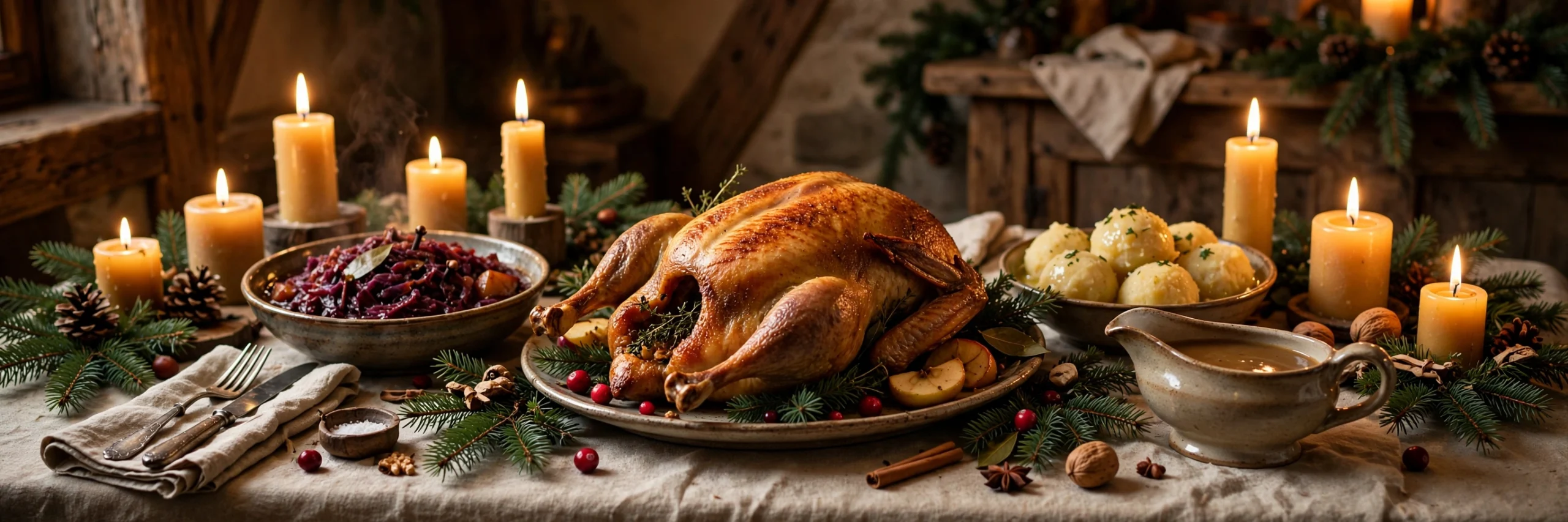
If there is a single dish that defines a traditional German Christmas dinner, it is the Weihnachtsgans — roast goose. A 4-to-5-kilogram goose, rubbed inside and out with salt, pepper, marjoram, and mugwort (Beifuß, the traditional goose herb), stuffed with a mixture of tart apples, prunes, onions, and chestnuts, and slow-roasted for three to four hours until the skin is burnished and crisp. The rendered goose fat is the cook’s treasure: it’s used to baste, to roast the potatoes, and later, in many families, saved in jars for frying throughout the winter.
The goose is traditionally served with Rotkohl (braised red cabbage with apples) and Kartoffelknödel (potato dumplings) — the canonical trinity of the German Christmas plate. A rich brown gravy, made from the roasting juices fortified with a little stock, completes the picture. Ordering a goose is an act of planning: in Germany, Geese are pre-ordered from the butcher or farm weeks ahead, since a fresh holiday goose sells out quickly. If you can’t source a goose where you live, a large duck — which roasts with similar technique in less time — is the accepted substitute, and many German families choose duck precisely because a whole goose is too much bird for a small household.
Karpfen: The Bavarian Christmas Eve Fish
In Catholic regions, particularly Bavaria, parts of Saxony, and neighboring Austria and Czechia, Christmas Eve dinner is historically meatless — a fasting day before the Christmas feast. The answer was carp (Karpfen), served in several classic preparations: Karpfen blau (poached in vinegared court-bouillon, which turns the skin blue-gray), gebackener Karpfen (breaded and fried), or Karpfen polnisch (in a dark gingerbread-thickened sauce with raisins). Carp’s bony flesh is part of its mystique; eating it is slow, deliberate work, and in some families a carp scale is kept in the wallet for luck in the new year.
This tradition has deep roots: medieval fasting calendars forbade meat on December 24, and pond-farmed carp were the affordable festive fish of central Europe. While many younger Bavarian families now serve goose or duck instead, carp remains the Christmas Eve fish of purists — and carp ponds still dot the Upper Palatinate, where the fish is raised for this exact season.
Regional Rivals: Venison, Rabbit, Suckling Pig
Beyond goose and carp, Germany’s Christmas tables reflect local landscapes. In the forested states of Hesse, Thuringia, and Baden-Württemberg, venison — a roast saddle or leg of deer in a red-wine and juniper sauce — is the prestige Christmas roast. The Rhineland has a long tradition of Hasenpfeffer (braised rabbit in pepper sauce). In parts of Saxony, suckling pig appears. And on the North Sea coast, families may serve plaice, sole, or smoked eel alongside or instead of meat. There’s no single “correct” German Christmas dinner — only the dinner your region, and your family, has always cooked.
Essential Side Dishes: Rotkohl, Knödel, and More
The side dishes are what make a German Christmas dinner taste German. Start with Rotkohl: red cabbage shredded fine, braised slowly with onion, tart apple, a splash of red wine or vinegar, a spoonful of goose fat, and cloves. It’s sweet-sour, jammy, and its crimson color is a visual anchor of the plate. Many families cook it a day ahead — it genuinely improves overnight.
Then the dumplings. Kartoffelknödel (potato dumplings, made from a mix of cooked and raw potato in Franconia, or all-cooked in Bavaria) are the classic partner for goose; Semmelknödel (bread dumplings, studded with parsley) appear more often in the south. Both are designed to do one job: soak up gravy. Alongside them come Rosenkohl (Brussels sprouts, often braised with bacon or chestnuts), glazed chestnuts, and in some regions Grünkohl (curly kale, simmered with smoked sausage and potatoes — more a January dish in the north, but it appears on some Christmas tables).
Salads have their place too, particularly on Christmas Eve when the meal is lighter: Kartoffelsalat (warm German potato salad with vinegar and bacon) is the great Christmas Eve fallback across much of Germany — countless families serve potato salad with Würstchen (sausages, often Wiener or Bockwurst) on the evening of the 24th, saving the goose for the 25th. This two-day rhythm — simple on Heiligabend, grand on the first Weihnachtsfeiertag — is common in working households and has its own logic: it keeps the evening of the 24th relaxed and focused on the tree, the songs, and the gifts.
Regional Variations: One Germany, Many Christmas Tables
Northern Germany: Goose, Kale, and the Sea
The north — Hamburg, Schleswig-Holstein, Lower Saxony — is goose country. Here the Weihnachtsgans reigns alongside Grünkohl, the curly kale stewed for hours with smoked Kasseler pork, Pinkel sausage, and mustard. Grünkohl is so culturally significant in the northwest that entire Grünkohltouren (kale hikes) are organized in winter: groups walk through the countryside, play games, and finish with a communal kale dinner. Coastal tables add fish: smoked eel, pickled herring, or a whole baked turbot may open the Christmas Eve meal before the goose arrives on the 25th.
Southern Germany and Bavaria: Carp, Duck, and Knödel
Bavaria holds the strongest carp tradition, but it also loves duck (Ente) — smaller than a goose, crisper-skinned, and easier for a family of four. Bavarian Christmas tables lean heavily on Semmelknödel, Blaukraut (the Bavarian name for red cabbage, typically a little sweeter), and rich dark gravies. In Franconia, the potato dumplings are the half-raw, half-cooked variety with a crouton heart — a source of fierce local pride. Suckling pig (Spanferkel) appears at some southern tables, and in Swabia, Maultaschen (the German ravioli-like pasta pockets) are a beloved Christmas Eve dish — legend says monks invented them to hide meat from God during Lent, earning the nickname “Herrgottsbscheißerle.”
Eastern Germany: Saxon Goose and Stollen Country
Saxony, especially Dresden, is synonymous with two Christmas institutions: the Dresdner Stollen and the Striezelmarkt, Germany’s oldest documented Christmas market (dating to 1434, with a formal charter from 1474). The Saxon Christmas goose is often stuffed with prunes and apples and served with Thüringer Klöße, the region’s famous dumplings. Silesian-influenced tables in the east serve Mohnklöße or poppy-seed-based desserts, and carp in a dark Schlesische sauce with gingerbread crumbs is a surviving tradition in pockets of Saxony and Lusatia.
The Rhineland: Sauerbraten and Festive Flexibility
The Rhineland’s Christmas table is famously flexible. Rheinischer Sauerbraten — beef marinated for days in a sweet-sour wine and vinegar marinade, braised with raisins and gingerbread crumbs in the sauce — is the Rhenish Christmas roast for many families. Duck and rabbit are common too. And the Rhineland keeps the potato-salad-and-sausages Christmas Eve tradition alive with particular devotion: in Cologne and Düsseldorf, Heiligabend is for Kartoffelsalat mit Würstchen, full stop, with the grand roast reserved for the holiday days that follow.
Soups and Starters: The Opening Act
A traditional German Christmas dinner often opens with soup — elegant, warming, and a way to stretch the evening. Classic choices include Kürbiscremesuppe (cream of pumpkin soup, finished with roasted pumpkin seeds), Maronensuppe (chestnut soup), or a clear Rinderkraftbrühe (rich beef consommé) with Markklößchen (marrow dumplings) or Grießnockerl (semolina dumplings). In wine-growing regions, a Weinschaumsuppe (frothy white-wine soup) makes a festive, old-fashioned opener.
Lighter Christmas Eve menus might skip soup for smoked salmon on rye, a herring salad, or Gänseleber (goose liver pâté) — but on the 25th, when the goose is the star, a soup course is the traditional prelude. If you’re cooking the full multi-course version, keep the soup modest: the main event needs appetite room.
Desserts: Stollen, Lebkuchen, and the Christmas Bakery
German Christmas dessert is less a single course than a season-long institution: the Weihnachtsbäckerei (Christmas bakery). But the dinner-table desserts have their stars. Weihnachtsstollen — the dense, buttery fruit loaf dusted in powdered sugar — is the undisputed king; the Dresdner Christstollen carries a protected geographical indication and must be made in the Dresden area to bear the name. Sliced thin, served with coffee, it’s the canonical end to the meal.
Other essentials: Lebkuchen (the spiced honey cakes of Nuremberg, where the Elisenlebkuchen — made with mostly nuts and minimal flour — are the premium tier), Spekulatius (caramelized spiced biscuits), Vanillekipferl (vanilla crescent cookies), Zimtsterne (cinnamon stars), and Dominosteine (layered cubes of gingerbread, marzipan, and jam coated in chocolate). A proper German Christmas table ends with a plate of these — the Plätzchenteller — alongside Bratäpfel (baked apples stuffed with marzipan, raisins, and nuts, sometimes flambéed with rum) and Rote Grütze (red berry compote with vanilla sauce) in the north. Marzipan, especially the Lübecker Marzipan of the Hanseatic north, appears in countless forms.
Drinks: What Germans Pour at Christmas
The German Christmas table drinks Glühwein before and after the meal — mulled red wine with cinnamon, cloves, star anise, and orange — but during dinner, the pairing depends on the main course. Goose and duck call for a Spätburgunder (German Pinot Noir) from the Ahr or Baden, or a dry Dornfelder; white-wine drinkers choose a rich Grauburgunder (Pinot Gris) or an off-dry Riesling Spätlese, whose acidity cuts the fat beautifully. For carp, a crisp dry Riesling or Silvaner is classic.
Beer has its place too — a malty Bock or Doppelbock (the traditional strong winter beer, originally brewed by monks as “liquid bread” for fasting seasons) pairs wonderfully with roast goose. After dessert, the digestif might be a Williamsbirne (pear brandy), Kirschwasser, or a small glass of Eierlikör (German egg liqueur, similar to advocaat) — a favorite holiday tipple, often served in chocolate cups. And Feuerzangenbowle, the spectacular rum-soaked sugarloaf set ablaze over mulled wine, is the dramatic party drink of the season, complete with its own beloved 1944 film.
When Germans Eat: Heiligabend vs. Christmas Day
The single most misunderstood fact about a traditional German Christmas dinner is timing. Roughly speaking, there are two schools:
- The Heiligabend feast (December 24, evening): The full goose-and-dumplings dinner is served on Christmas Eve after the tree is lit and before or after Bescherung (the gift exchange). This is the emotional peak of the holiday for most families.
- The two-day split: Christmas Eve gets the simple meal — Kartoffelsalat mit Würstchen, or a light fish dish — and the grand roast lands on December 25 (the first Weihnachtsfeiertag). This rhythm is especially common in families with young children, since the 24th is already a whirlwind.
December 26 (the second Weihnachtsfeiertag, Stephanstag) is for the extended family: grandparents, aunts, uncles, and the inevitable leftover goose, cold cuts, cheeses, and Stollen. Christmas markets — like those in our guide to Christmas markets — close in Germany on the 24th (most shut by early afternoon), so Heiligabend afternoon is quiet: churches fill for the Christvesper service, streets empty, and families retreat home.
Your Planning Timeline: Cooking a German Christmas Dinner
Two to Three Weeks Before
Order your goose (or duck) from a butcher or farm — fresh holiday birds sell out. If you’re using a frozen bird, buy it now and plan the thaw (a 5-kg goose needs 2–3 days in the refrigerator). Stock up on Stollen ingredients or order an authentic Dresdner Stollen, and buy the Glühwein spices, marzipan, and baking supplies for the Plätzchen. This is also the moment to plan your table: Germans take the festive table setting seriously — beeswax candles, fir sprigs, and good linen.
Two to Three Days Before
Bake the Stollen if homemade (it improves with a few days’ rest). Braise the Rotkohl — it genuinely tastes better reheated. Prepare the stuffing components (chop apples, soak prunes, roast chestnuts). Make the Lebkuchen and cookie plates if you’re baking from scratch.
Christmas Eve Morning
Set the table, prep the dumpling dough, and get the goose (or chosen roast) into the oven by early afternoon — a 5-kg goose needs roughly 3 to 3.5 hours at 160–180°C, with regular basting and the fat drained off. Make the gravy base. Chill the white wine and the beer; prepare the Glühwein for the pre-dinner gathering. Assemble the Plätzchenteller and set out the nuts, mandarins, and chocolates that belong on every German Christmas table.
Vegetarian and Modern Twists on the German Christmas Table
Not every German Christmas table centers on a roast. Vegetarian families increasingly serve a vegetarian “goose” — a roasted whole cauliflower or celeriac with the same apple-prune-chestnut stuffing and red-wine gravy — or a festive nut roast with Rotkohl and Knödel. Filled butternut squash, wild mushroom Wellington-style bakes, and hearty Kürbisgulasch (pumpkin goulash) all slot naturally into the traditional side-dish architecture. The key insight: a German Christmas dinner is defined less by the protein than by the constellation around it — Rotkohl, dumplings, gravy, Stollen, Glühwein. Get those right, and even a vegetarian table tastes unmistakably like Weihnachten.
In Pictures: Traditional German Christmas Dinner
Germany’s Christmas table runs on goose, carp, potato salad with sausages — and a bakery’s worth of stollen and lebkuchen.
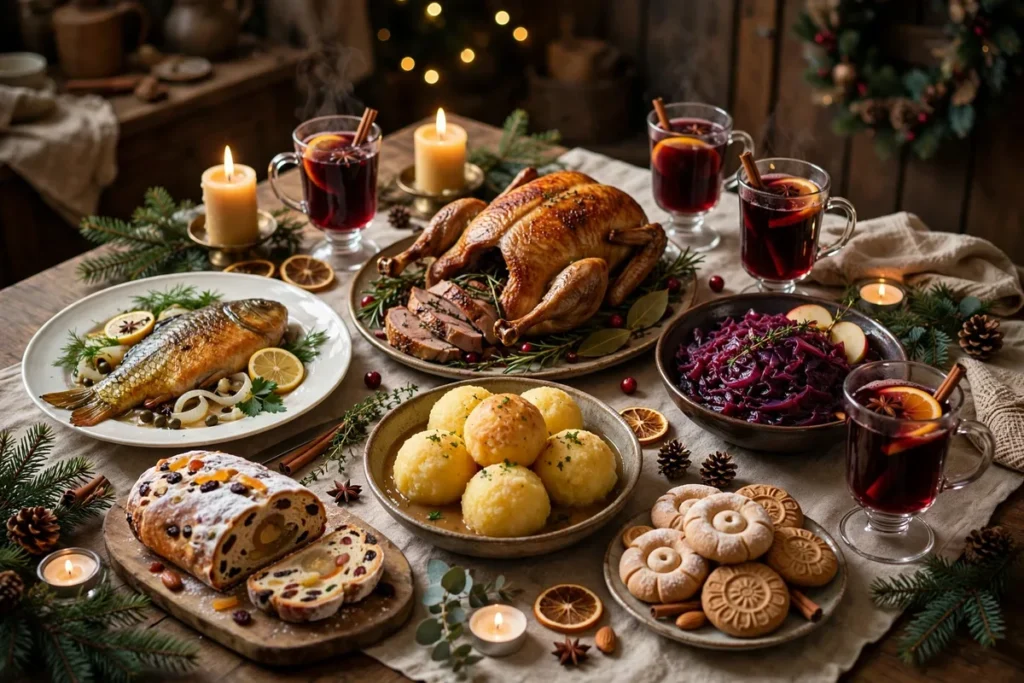
A German Christmas dinner: roast goose with red cabbage and potato dumplings, carp, stollen, lebkuchen and mulled wine.
Watch: Traditional German Christmas Dinner
Slow cooking, Christmas traditions — a traditional stuffed Christmas goose with red cabbage and potato dumplings.
At a Glance: Traditional German Christmas Dinner
What Germany eats at Christmas.
| Dish | When | Key detail |
|---|---|---|
| Heiligabend | 24 December | Christmas Eve is the main celebration — dinner and gifts after church |
| Kartoffelsalat & Würstchen | 24 December | Potato salad with sausages — the most common Eve meal (34% in a 2021 survey) |
| Weihnachtsgans | 25 December | Roast goose with Rotkohl and Knödel — the classic Christmas Day centerpiece |
| Karpfen | 24 December | Carp — the traditional fish, especially in the south and east |
| Stollen | December | The Dresden fruit bread — dusted with powdered sugar, centuries of history |
| Lebkuchen | December | Nuremberg gingerbread — the Christmas market sweet |
| Glühwein & Eierpunsch | December | Mulled wine and egg punch — what Germans pour at Christmas |
Frequently Asked Questions
What is the most traditional German Christmas dinner?
The classic is Weihnachtsgans — roast goose stuffed with apples, prunes, and chestnuts, served with Rotkohl (braised red cabbage), Kartoffelknödel (potato dumplings), and rich gravy. In Catholic regions like Bavaria, the Christmas Eve alternative is Karpfen (carp). Many families serve potato salad with sausages on Christmas Eve and the grand roast on December 25.
Do Germans eat Christmas dinner on the 24th or 25th?
Both — it depends on the family. The majority serve the main feast on the evening of December 24 (Heiligabend), but a large minority keeps the 24th simple (potato salad and sausages) and roasts the goose on December 25. Either way, December 26 is a day of family visits and leftovers.
What is Rotkohl and how is it made?
Rotkohl is Germany’s braised red cabbage: finely shredded cabbage slow-cooked with onion, tart apple, red wine or vinegar, cloves, and a little sugar or currant jelly until sweet-sour and jammy. It’s almost always made a day ahead, since the flavor deepens overnight — making it one of the most cook-friendly parts of the Christmas menu.
Can I substitute duck for goose in a German Christmas dinner?
Absolutely — roast duck is a fully authentic German Christmas roast, especially popular with smaller households. Use the same seasoning (salt, pepper, marjoram, mugwort), stuff with apples and prunes, and roast at 180°C for about 2–2.5 hours for a 2.5-kg duck. All the same sides — Rotkohl, Knödel, gravy — apply.
What desserts are served at a German Christmas dinner?
Stollen (the buttery fruit loaf) is the centerpiece, joined by Lebkuchen, Spekulatius, Vanillekipferl, Zimtsterne, Dominosteine, Bratäpfel (baked stuffed apples), and Lübecker marzipan — usually presented as a shared Plätzchenteller (cookie plate) with coffee after the main courses.
What wine goes with German Christmas goose?
A German Spätburgunder (Pinot Noir) is the classic red pairing; an off-dry Riesling Spätlese is the classic white, its acidity cutting the goose’s richness. A malty Doppelbock beer is an excellent non-wine alternative, and Glühwein belongs before and after the meal, not during it.
Bringing the German Christmas Table Home
A traditional German Christmas dinner is more than a menu — it’s a choreography of light, scent, and patience: the tree lit, the candles lit, the goose basted, the carols sung, and an evening that refuses to be rushed. Whether you roast the full Weihnachtsgans, honor the Bavarian carp, or keep it simple with Kartoffelsalat und Würstchen on Heiligabend, the spirit is the same: Gemütlichkeit — that untranslatable warmth of good food, good company, and a long winter’s night. If this guide has inspired your holiday table, explore our Christmas dinner ideas for more festive menus, and see how Germany’s neighbors celebrate in our French Réveillon dinner guide and traditional British Christmas dinner. Fröhliche Weihnachten — and guten Appetit.