A traditional British Christmas dinner is the most famous holiday meal in the English-speaking world — roast turkey with all the trimmings, Christmas pudding set alight, crackers pulled, and paper crowns worn. But behind the familiar ritual lies a fascinating history: the turkey is a 16th-century American import, the pudding descends from medieval fasting food, and much of what we think of as “traditional” was actually invented by the Victorians.
This guide covers the complete traditional British Christmas dinner: every component from the turkey to the trifle, the history behind each dish, regional variations across the UK, the all-important timing (Christmas Day lunch, not dinner), and practical hosting advice. See also our British Christmas traditions and Christmas dinner ideas for the wider picture.
The Anatomy of a Traditional British Christmas Dinner
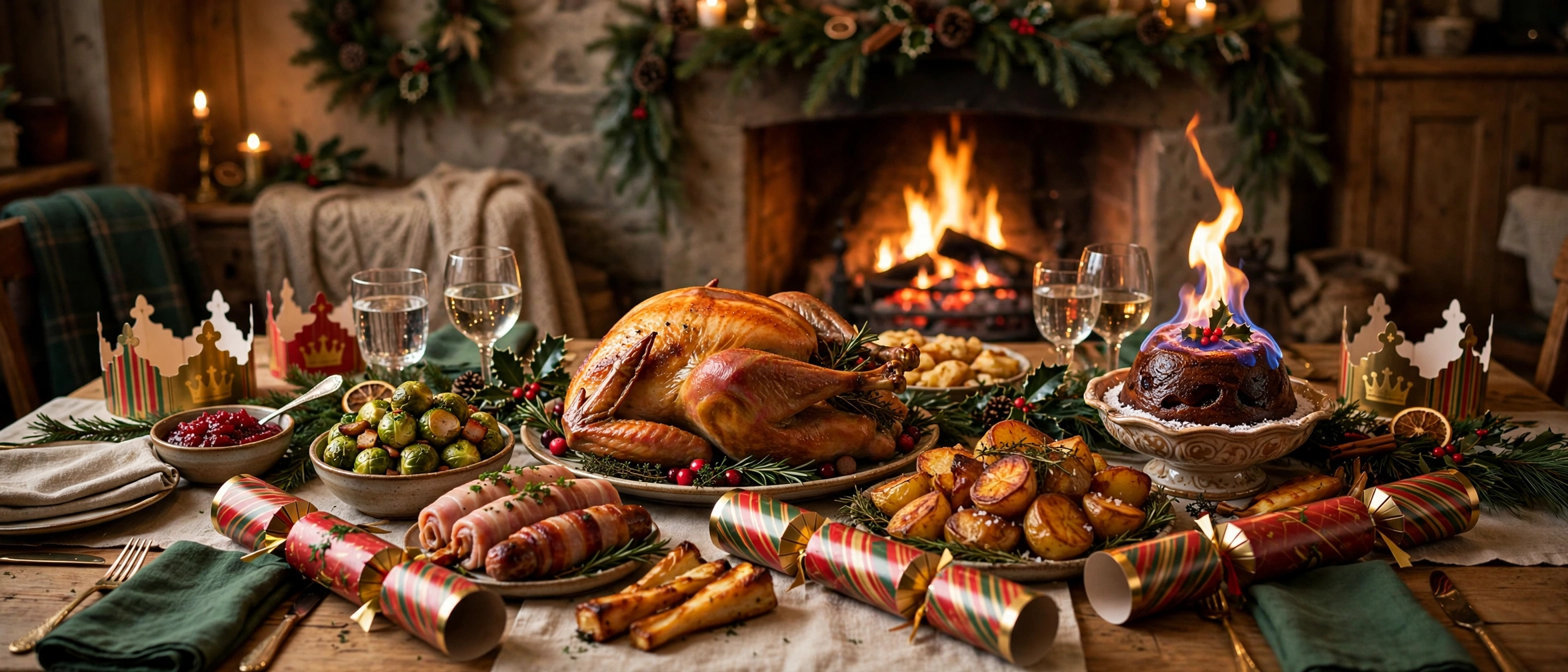
The classic British Christmas dinner follows a fixed architecture. It is served as lunch on Christmas Day — typically between 1 and 3 PM — not as an evening dinner, a timing that surprises many visitors. The meal runs: starter (often prawn cocktail or smoked salmon), the roast (turkey with stuffing, pigs in blankets, roast potatoes, vegetables, and gravy), then Christmas pudding (flamed with brandy), followed by trifle or Christmas cake, cheese, and finally mince pies with tea or coffee. Christmas crackers are pulled before the meal, and the paper crowns are worn throughout — royalty, briefly, all.
Portions are generous and the pace is leisurely; the King’s (or Queen’s) speech at 3 PM traditionally interrupts or follows the meal, and the afternoon dissolves into naps, board games, and chocolate. Boxing Day (December 26) is for leftovers: cold turkey, bubble and squeak, and turkey curry — a second cuisine as beloved as the first.
The Turkey: History of the Christmas Bird
Turkey was not always the British Christmas bird. Medieval Christmas feasts centered on boar’s head, goose, or swan (for the wealthy). The turkey — native to North America — arrived in England in the 1520s, likely via Spanish traders (hence the Turkish misnomer, through confusion with guinea fowl traded via Turkey). Henry VIII is recorded as eating turkey at Christmas, and by the 17th century it was fashionable among the gentry.
What made turkey the Christmas bird was the Victorian era. Charles Dickens’ A Christmas Carol (1843) sealed it: Scrooge’s reformation culminates in sending the Cratchits a prize turkey “as big as him.” Rising middle-class prosperity, railway transport of Norfolk turkeys to London (the famous turkey drives, where flocks were walked to market wearing little leather boots), and the bird’s size — perfect for a large family gathering — did the rest. Goose, immortalized as the Cratchits’ original modest bird, was demoted to second place.
Cooking the bird: A traditional British turkey is roasted with butter under the skin, draped in streaky bacon (which bastes it as it cooks), and stuffed — with sage and onion stuffing as the classic, or chestnut stuffing for luxury. Rest the bird 30–45 minutes before carving — tented loosely in foil, it stays hot while the juices redistribute for cleaner carving and juicier meat; make the gravy from the roasting juices with the giblet stock, thickened with flour and finished with a splash of port. A 5–6 kg turkey serves 8–10 and needs roughly 3–3.5 hours at 180°C, but always cook to temperature (74°C in the thickest part of the thigh), not to the clock.
All the Trimmings: Stuffing, Pigs in Blankets, and Roast Potatoes
Stuffing
British stuffing is a breadcrumb-based affair: sage and onion is the canonical Christmas stuffing, sometimes enriched with sausage meat (making it a “sausage stuffing”) or chestnuts. It’s cooked both inside the bird and separately in a dish (the outside stuffing gets the prized crispy top). Regional variants include oatmeal stuffing in Scotland and thyme and parsley versions in the west country.
Pigs in Blankets
Pigs in blankets — chipolata sausages wrapped in streaky bacon — are non-negotiable. They roast alongside (or under) the turkey, emerging crisp and salty. For Christmas, many cooks make them in bulk; they vanish faster than any other item on the table. A drizzle of honey and mustard before roasting is a modern upgrade.
Roast Potatoes
The roast potato is a British art form: Maris Piper or King Edward potatoes, parboiled, roughed up in the colander, then roasted in goose fat or beef dripping until shatteringly crisp. Delia Smith and Nigella Lawson have both published canonical methods; the non-negotiables are a hot oven (200°C+), plenty of fat, and turning once. Yorkshire pudding — traditional with beef — appears on some Christmas tables too, a northern rebellion against southern orthodoxy.
Vegetables: Sprouts, Parsnips, and Red Cabbage
Brussels sprouts are the great divider: loved or loathed, never optional. The traditional preparation — boiled to submission — is rightly dying; modern Christmas sprouts are roasted with bacon and chestnuts, or shredded and fried with butter. Honey-glazed parsnips, braised red cabbage (a Germanic import, now fully naturalized), glazed carrots, and cauliflower cheese (a baked gratin that doubles as vegetarian centerpiece support) complete the vegetable army. Bread sauce — milk thickened with breadcrumbs, onion, and clove — is the old-fashioned turkey accompaniment that refuses to die, and cranberry sauce provides the sharp-sweet contrast.
Christmas Pudding: The Flaming Finale
Christmas pudding is Britain’s most theatrical dessert: a dense, dark steamed pudding of suet, dried fruit, breadcrumbs, sugar, spices, and brandy — traditionally made on Stir-up Sunday (the last Sunday before Advent), when every family member stirs the mixture and makes a wish. It then matures for weeks, is steamed again on Christmas Day, and brought to the table flaming — brandy poured over and lit, carried in triumphantly in a darkened room.
The pudding’s history is extraordinary: it descends from medieval frumenty, a wheat-and-meat porridge eaten after fasting. By the 17th century it had become a plum porridge; the Victorians solidified the modern steamed form. Traditions cling to it: a silver sixpence (or modern coin, carefully wrapped) hidden inside for luck, a sprig of holly on top, and serving with brandy butter (hard sauce), rum sauce, or custard. Christmas pudding divides Britain — devotees and refusers in roughly equal camps — but its ceremony is undisputed.
Trifle, Christmas Cake, and Mince Pies
Beyond pudding: trifle — layers of sponge, sherry, fruit, custard, and cream (the sherry trifle is the Christmas classic) — is the lighter dessert. Christmas cake, the rich fruit cake covered in marzipan and royal icing, is technically for the season rather than the meal — it’s cut through December and into the new year. Mince pies — small pastry tarts of mincemeat (spiced dried fruit, suet, and brandy; no meat for centuries) — appear from November onward; eating the first mince pie of the season is a small annual ceremony, and leaving one out for Father Christmas on Christmas Eve (with a carrot for the reindeer and a glass of sherry) is the children’s tradition.
Crackers, Crowns, and the King’s Speech
No traditional British Christmas dinner is complete without Christmas crackers — the cardboard tubes that bang when pulled, containing a paper crown, a joke, and a small gift. Invented by London confectioner Tom Smith in the 1840s (inspired by French bon-bons), crackers are pulled before the meal, and the crowns are worn throughout lunch. The jokes are famously terrible; this is the point.
At 3 PM, the King’s Christmas speech airs — a tradition since George V’s first radio broadcast in 1932. Families pause the meal (or the post-meal stupor) to watch. Then comes the cheese course — Stilton (the Christmas cheese, often with a glass of port), Cheddar, and Wensleydale — and the long afternoon of games: charades, board games, and the inevitable argument about the rules.
Regional Variations Across the UK
Scotland
Scotland’s Christmas dinner often features cock-a-leekie soup (chicken and leek) as a starter, and the pudding might be Clootie dumpling — a spiced fruit pudding boiled in a cloth (cloot), the Scottish cousin of Christmas pudding. Scotch whisky replaces brandy in the butter and the toasts. Note: in Scotland, Hogmanay (New Year’s Eve) historically outranked Christmas — Christmas Day only became a public holiday in Scotland in 1958 — so some Scottish families still treat New Year as the bigger feast.
Wales
Welsh tables may start with cawl (the national lamb-and-vegetable soup) and feature Welsh cakes and Bara Brith (speckled fruit bread) among the season’s bakes. Turkey with all the trimmings is standard, but goose holds on more strongly in rural Wales.
Northern Ireland
Ulster’s Christmas dinner leans Irish: spiced beef (a Cork tradition that crossed the border) sometimes joins or replaces turkey, and the dessert table includes sherry trifle and Christmas pudding with equal honor. White pudding and soda bread may appear at the Christmas breakfast.
Drinks: From Bucks Fizz to Port
Christmas morning starts with Buck’s Fizz (champagne and orange juice — the British mimosa) or mulled wine. With lunch: white wine or Champagne with the starter, then red (claret/Bordeaux or Rioja) with the turkey — or white for traditionalists. Port is the essential Christmas wine: vintage or tawny with the Stilton, and in the pudding’s brandy butter. Sherry — the Father Christmas drink — and eggnog (or its British cousin, the posset) round out the season. Boxing Day drinks are whatever survived.
Hosting Timeline: The Christmas Week Plan
Stir-up Sunday (Late November)
Make the Christmas pudding and Christmas cake (the cake needs feeding with brandy weekly). Order the turkey from the butcher. Buy the crackers, mincemeat, and dried fruit.
Christmas Eve
Prep vegetables (peel and parboil potatoes; trim sprouts). Make the stuffing, bread sauce, and trifle (it needs overnight to set). Wrap the pigs in blankets. Set the table with crackers. Leave the mince pie and sherry for Father Christmas.
Christmas Morning
Get the turkey in early (calculate backward from a 1–2 PM serve). Make the gravy stock from the giblets. Assemble the cauliflower cheese. Chill the fizz. Pull crackers, wear crowns, and serve lunch when the bird has rested — never before.
Boxing Day: The Second Feast
Boxing Day (December 26) has its own food traditions: bubble and squeak (fried leftover vegetables — the name mimics the sound they make in the pan), cold turkey with pickles and chutney piled into sandwiches, turkey curry (the great British leftover curry, often made with the carcass stock), and turkey soup from the stripped bones. Many families consider Boxing Day lunch — relaxed, grazing, no ceremony, eaten in front of the football or a film — the better meal. Ham (a glazed baked ham with mustard and brown sugar) often appears on Boxing Day, having been baked on Christmas Eve, and the cheese board makes its second appearance. If Christmas Day is theater, Boxing Day is the comfortable encore.
The Victorian Invention of the British Christmas
Much of the traditional British Christmas dinner was invented — or at least standardized — by the Victorians. Before the 1840s, Christmas in England was a patchwork of regional customs, many suppressed since the Puritan ban on Christmas (1647–1660, when Parliament literally outlawed the holiday). The Victorian revival had three architects: Prince Albert, who popularized the German Christmas tree at Windsor; Charles Dickens, whose A Christmas Carol (1843) gave Christmas its moral narrative and its turkey; and the illustrated press, which spread images of the ideal middle-class Christmas — tree, turkey, pudding, crackers — to every corner of the empire.
The Victorians also gave us the Christmas card (1843, the same year as Dickens’ novella), the modern cracker (Tom Smith’s 1840s invention), and the codified Christmas dinner — cookbooks like Mrs Beeton’s Book of Household Management (1861) laid out the Christmas menu as a fixed ritual: the bill of fare for Christmas Day dinner is one of the book’s most famous passages. What we now call “traditional” is largely 150 years old — which doesn’t make it less traditional, just honestly Victorian. The medieval pudding, the Tudor turkey, and the Victorian ceremony fused into the meal we know.
Christmas Morning: Breakfast Before the Feast
Before the great lunch comes Christmas breakfast — and British families take it seriously. The classic is a full fry-up (bacon, sausages, eggs, mushrooms, tomatoes, black pudding, toast) eaten in pajamas after stockings, or smoked salmon and scrambled eggs with Buck’s Fizz for the more elegant. Panettone (an Italian import, now fully naturalized), croissants, and mince pies appear on many tables. Children eat chocolate from their stockings — selection boxes and chocolate coins are the traditional currency — while parents mainline tea or coffee. Breakfast is fuel: the turkey goes in the oven, the vegetables get prepped, and the day’s cooking begins in earnest.
The Vegetarian (and Vegan) British Christmas Dinner
An increasing number of British tables are meat-free at Christmas, and the tradition has adapted gracefully. The centerpiece options: a nut roast (the classic — nuts, breadcrumbs, herbs, and vegetables, baked in a loaf), a whole roasted cauliflower with festive spices, a mushroom and chestnut Wellington (puff pastry around a duxelles and chestnut filling — the showstopper), or a stuffed butternut squash. All the trimmings — roast potatoes (in vegetable oil), pigs in blankets (vegetarian sausages in vegetarian bacon exist), sprouts, parsnips, bread sauce (made with oat milk), gravy (a rich mushroom and red wine gravy) — translate directly. Christmas pudding is traditionally made with suet, but vegetarian suet (or butter) works perfectly, and most commercial puddings are now vegetarian. The crackers, crowns, and terrible jokes are universal.
The British Christmas Dinner Abroad
Britain’s Christmas dinner travels with its expats — and nowhere is the ritual more fiercely preserved than far from home. In Australia and New Zealand, the traditional hot roast collides with summer: many families serve the full turkey dinner despite 30°C heat, while others pivot to cold turkey, ham, and salads (see our Australian Christmas lunch for the southern-hemisphere answer). In Dubai, Singapore, and Hong Kong, hotels serve full British Christmas lunches to homesick expats. In Spain and France, British retirees roast turkeys in Mediterranean kitchens. The menu is a portable homeland — and the crackers, imported at great expense, are non-negotiable.
Table Etiquette and Unwritten Rules
The British Christmas dinner has its unwritten laws. Crackers are pulled before the meal, not during — and you wear the crown for the duration of lunch, however silly you look. The turkey is carved at the table (or just before, in the kitchen, by whoever has appointed themselves carver — usually the head of the household). Gravy goes on everything; asking for the meal “without gravy” is viewed with suspicion. The Christmas pudding is served flaming — if it doesn’t flame, the brandy wasn’t warm enough, and someone will say so. Seconds are encouraged; leaving food is fine, but leaving before the pudding is a minor scandal. Phones stay away from the Christmas table in traditional households — the King’s speech is the only screen allowed. And the washing up is a communal, post-nap activity, traditionally accompanied by the tin of Quality Street or Roses chocolates and the first mince pie of the afternoon. These rules aren’t written anywhere — which is exactly why everyone knows them, and why breaking one earns you a look that no words need to accompany.
In Pictures: Traditional British Christmas Dinner
The British Christmas dinner is a ritual — turkey, all the trimmings, flaming pudding, crackers and the King’s Speech.

A traditional British Christmas table: roast turkey, pigs in blankets, roast potatoes, Yorkshire puddings, crackers and candles.
Watch: Traditional British Christmas Dinner
BBC Archive goes back to 1976 for a traditional country Christmas dinner — goose by hand, turkey debates, Christmas cake and mince pies.
At a Glance: Traditional British Christmas Dinner
The components of the Christmas feast.
| Tradition | Date | Key detail |
|---|---|---|
| Roast turkey | 25 December | The bird — popularized in Victorian times; Dickens’ Scrooge sends one to the Cratchits |
| Pigs in blankets | 25 December | Sausages wrapped in bacon — among the beloved trimmings |
| Christmas pudding | 25 December | Stirred up on Stir-up Sunday (last Sunday before Advent) and flamed with brandy |
| Mince pies | December | Once filled with meat; now sweet spiced mincemeat |
| Christmas crackers | 25 December | Pulled at the table — invented by London confectioner Tom Smith around 1847 |
| King’s Speech | 25 December | Broadcast at 3pm — a tradition since George V’s 1932 radio address |
| Boxing Day | 26 December | The day after — cold cuts, bubble and squeak, and football |
Frequently Asked Questions
What is in a traditional British Christmas dinner?
Roast turkey with stuffing, pigs in blankets, roast potatoes, Brussels sprouts, parsnips, bread sauce, cranberry sauce, and gravy — preceded by a starter (prawn cocktail or smoked salmon) and followed by Christmas pudding (flamed with brandy), trifle, cheese and port, and mince pies. Crackers are pulled before the meal.
Do the British eat Christmas dinner on Christmas Eve or Christmas Day?
Christmas Day lunch — typically 1–3 PM on December 25. Christmas Eve dinner is usually modest (many families have fish, curry, or a simple supper), saving the grand roast for the 25th. Boxing Day (26th) is for leftovers.
Why do the British eat turkey at Christmas?
Turkey arrived from North America in the 1500s, but it became the Christmas bird in Victorian England — popularized by Dickens’ A Christmas Carol (1843), rising prosperity, and the bird’s ideal size for a family feast. Before turkey, goose was the traditional Christmas roast.
What is Christmas pudding made of?
A steamed pudding of dried fruit (raisins, currants, sultanas), suet, breadcrumbs, brown sugar, spices, eggs, and brandy or stout — matured for weeks, steamed on Christmas Day, and served flaming with brandy, with brandy butter or custard. A coin is traditionally hidden inside for luck.
What are pigs in blankets?
Chipolata sausages wrapped in streaky bacon, roasted until crisp — a mandatory part of the British Christmas plate. They’re also served at other winter celebrations, but Christmas is their spiritual home.
What is the King’s speech tradition?
The monarch’s Christmas broadcast airs at 3 PM on Christmas Day — a tradition since George V in 1932. Families traditionally pause the meal or gather afterward to watch; it’s one of the few shared national moments of the British Christmas.
The Spirit of the British Christmas Table
A traditional British Christmas dinner is controlled chaos: the turkey resting, the gravy whisked, the pudding flamed, the crackers banged, the crowns crooked, the jokes terrible, and everyone — briefly, annually, gloriously — a monarch. It’s a meal built from history (medieval pudding, Tudor turkey, Victorian ritual) and held together by love and roast potatoes. Whether you cook the full canon or borrow its best ideas, the essentials are these: serve it at lunch, pull the crackers, flame the pudding, and wear the crown. For more holiday inspiration, see our Christmas activities for families, our traditional German Christmas dinner for the continental cousin, and French Christmas traditions for the Réveillon alternative.