British Christmas traditions are the ones most of the English-speaking world grew up with — and then forgot were British. The Christmas cracker, the Christmas pudding set alight, the King’s speech at 3 PM, mince pies, pantomimes, and the great ritual of the Christmas Day walk all come from these islands. But the British Christmas is more than its greatest hits: it is a precisely choreographed day, honed over generations, with its own liturgy of timings, television, and turkey.
This guide walks through a traditional British Christmas from first light to the last mince pie — the schedule, the food, the customs, and the regional variations — so you can celebrate it properly, whether you are in London or Louisiana. Think of it as the official program for December 25, British-style.
British Christmas Traditions at a Glance
Before the hour-by-hour schedule, the shape of the day: British Christmas traditions center on Christmas Day itself, December 25 — a full public holiday (bank holiday), along with Boxing Day, December 26. Christmas Eve is for last-minute preparations, carol services, and the pub; Christmas morning is for stockings and presents; Christmas afternoon is for the great dinner; and Christmas evening is for the King’s speech (watched or deliberately ignored), board games, and leftovers. The whole country moves to roughly the same timetable, which is part of the charm — millions of households sitting down to turkey within the same hour.
The Official British Christmas Day Schedule
7:00 AM — Stockings
The day begins with stockings — traditionally hung at the foot of the bed or by the fireplace, filled by Father Christmas overnight. British stockings lean toward the traditional: a satsuma (orange) in the toe, nuts, chocolate coins, and small gifts. The orange-in-the-toe custom is old — it represents the gold coins St. Nicholas gave to the poor — and many families keep it even as the rest of the stocking modernizes. Children open stockings in bed or piled onto parents’ beds, buying the adults time to start the turkey.
8:30 AM — Presents Under the Tree
After stockings comes the main present-opening, around the tree. British families tend to open presents together in the living room, one at a time, with wrapping paper chaos as a competitive sport. Christmas crackers may make an early appearance, but their official moment is dinner (see below).
10:00 AM — The Christmas Morning Walk
A distinctive British Christmas tradition: the morning walk. Families head out — to the park, the beach, the countryside — to work up an appetite and walk off the chocolate. It is brisk, muddy, windswept, and beloved. Dogs get their best walk of the year; children test new bikes and scooters; and the whole country seems to be out at once, greeting neighbors with the day’s official salutation: “Happy Christmas!” (Brits say Happy rather than Merry, a custom dating to Victorian times.)
12:00 PM — Sherry, Nibbles, and the King’s Speech Countdown
Back home, the pre-dinner drinks come out: sherry (the traditional Christmas drink), Bucks Fizz, or champagne, with nibbles — cheese straws, smoked salmon blinis, pigs in blankets as appetizers. The television goes on. For decades, the afternoon’s fixed point has been the monarch’s Christmas broadcast at 3:00 PM — first the King’s (now Charles III’s) speech, previously the Queen’s — watched by millions, discussed by everyone, and meme’d within minutes.
1:30–2:00 PM — Christmas Dinner: The Main Event
The centerpiece of British Christmas traditions is Christmas dinner, served in the early-to-mid afternoon. The canonical spread:
- Roast turkey — the undisputed centerpiece, with bread sauce and cranberry sauce.
- Pigs in blankets — sausages wrapped in bacon, the most fought-over side dish in Britain.
- Roast potatoes — goose-fat roasties, crispy and golden, a point of fierce family pride.
- Brussels sprouts — divisive, traditional, non-negotiable.
- Stuffing, parsnips, carrots, red cabbage — the supporting cast.
- Gravy — in industrial quantities.
- Christmas crackers — pulled before eating: the paper hats worn throughout dinner, the terrible jokes read aloud, the tiny plastic toys treasured or mocked.
The cracker ritual deserves emphasis: everyone pulls a cracker with their neighbor, dons the tissue crown, and reads the joke (“What do you call a boomerang that won’t come back? A stick.”). It is gloriously silly and utterly mandatory. Our deep-dive into the traditional British Christmas dinner covers the full menu, timings, and trimmings in detail.
3:00 PM — The King’s Speech
At 3 PM the country pauses for the King’s Christmas broadcast — a tradition begun by George V in 1932 on BBC radio. Charles III’s messages, like Elizabeth II’s before them, blend reflection on the year’s events with personal notes. Families divide into the devoted (watches in silence, standing for no one but respectful), the backgrounders (it’s on while the washing-up happens), and the refuseniks — but everyone knows it happened. In 2026, expect the broadcast to reflect on the year’s national moments; it remains one of the few genuinely shared national rituals.
4:00 PM — Christmas Pudding, Set Alight
Dessert is Christmas pudding — the dark, rich, suet-based pudding aged for weeks, studded with dried fruit and spices. The traditional presentation: warmed brandy poured over and set alight, carried to the table flaming blue, served with brandy butter or custard. A silver coin (sixpence) baked inside once promised luck to whoever found it — a custom now mostly retired for dental-safety reasons, though some families still do it with a sterilized coin.
The pudding is ideally made on Stir-up Sunday (the last Sunday before Advent), when the whole family takes a turn stirring the mixture and making a wish — a tradition that front-loads the holiday’s togetherness into late November.
5:00 PM — The Christmas Walk (Again) or the Great Slump
Post-dinner options divide the nation: the hardy go for the second walk (the Christmas Day constitutional is a serious tradition in many families), while the sensible collapse in front of the television. Either way, the afternoon’s work is done.
Evening — Television, Games, and Leftovers
British Christmas evening television is an institution: the year’s biggest shows air their Christmas specials — soap operas time their dramatic climaxes for Christmas night, and families argue about what to watch with the seriousness of treaty negotiations. Board games and charades follow (or accompany) the viewing, fueled by the cheese board, mince pies, and turkey sandwiches. Mince pies — small pastry tarts filled with spiced dried fruit (mincemeat, meat-free for centuries despite the name) — are eaten throughout the season; leaving one out for Father Christmas with a glass of sherry (or whisky in Scotland) is standard.
Boxing Day: The Second Day of Christmas
Boxing Day, December 26, is a full bank holiday and a tradition in its own right. The name’s origins are debated — boxes of gifts given to servants and tradesmen, or church alms boxes opened for the poor — but the modern observance is clear: a slow day of leftovers (turkey curry, bubble and squeak from the roast-potato remains), long walks, and visiting extended family.
Boxing Day has its own rituals: the sales begin (Britain’s equivalent of Black Friday, with queues forming at dawn), football fixtures pack the stadiums (the Premier League’s Boxing Day matches are a beloved institution), horse racing (notably Kempton Park’s King George VI Chase), and fox hunting meets (now trail hunting since the 2004 ban, still a countryside spectacle). Cold-water Boxing Day swims — charity dips in the sea in places like Tenby and Brighton — draw hardy crowds. It is Christmas’s relaxed, sporty, bargain-hunting younger sibling.
Advent and Christmas Eve: The Build-Up
The British season starts well before the 25th. Advent calendars (chocolate, increasingly elaborate) open December 1. Towns switch on their Christmas lights in late November — London’s Oxford Street, Regent Street, and Covent Garden displays are major events. Carol services fill churches and cathedrals; the Festival of Nine Lessons and Carols from King’s College, Cambridge, broadcast every Christmas Eve since 1928, is the season’s musical anchor.
Pantomimes (pantos) — the uniquely British theatrical tradition of fairy-tale musical comedies with cross-dressing dames, audience call-and-response (“He’s behind you!”), and slapstick — run from December into January and are a rite of passage for British children. Christmas Eve itself is for the pub (a cherished tradition: the Christmas Eve drink with friends), last-minute wrapping, and hanging stockings — plus, in many families, the one present opened early dispensation.
Regional Variations: Four Nations, One Christmas
- England sets the template described above — turkey, crackers, King’s speech, pantomime.
- Scotland historically downplayed Christmas (it was barely celebrated until the mid-20th century; Hogmanay — New Year’s Eve — was the big event, with first-footing customs). Scottish Christmas now follows the English pattern but keeps distinctive touches: whisky instead of sherry for Father Christmas, and the lingering sense that New Year is the real holiday.
- Wales keeps the Mari Lwyd — a haunting, wonderful tradition in which a horse’s skull decked with ribbons is carried door to door in a wassailing ritual of sung verses, demanding entry and drink. It is one of Britain’s oldest and eeriest Christmas customs, enjoying a major revival.
- Northern Ireland blends traditions with Irish touches — the candle in the window on Christmas Eve (see our Christmas traditions in Ireland guide), and in some areas the Little Christmas (Nollaig na mBan, Women’s Christmas) on January 6.
The Food Beyond Dinner: Mince Pies, Cake, and Cheese
British Christmas food extends well beyond the dinner table. Christmas cake — the dense, iced fruit cake, often topped with marzipan and royal icing — is made weeks ahead and “fed” with brandy. Mince pies appear from late November; the eat one mince pie a day for the twelve days of Christmas for luck superstition is widely cited and widely followed. The cheese board (Stilton, cheddar, Wensleydale with cranberries) with Christmas chutney is the evening’s savory anchor. And mulled wine, eggnog (less central than in America), and sherry trifle round out the season’s eating.
For a broader festive menu that blends British classics with other traditions, our Christmas dinner ideas collection is a useful companion.
How to Do a British Christmas Anywhere
- Buy proper crackers. Not the sad mini ones — full-size crackers with hats, jokes, and mottos. Pull them before dinner, wear the hats throughout.
- Serve dinner mid-afternoon. The 1:30–2 PM dinner is the single most British scheduling decision; it reshapes the whole day.
- Do the walk. Morning, afternoon, or both — the Christmas walk is non-negotiable.
- Flambé the pudding. Warm brandy, a long match, dimmed lights. Practice the pour first.
- Watch something together at 3 PM. The King’s speech, a classic film — the shared viewing is the point. Our best Christmas movies of all time list has the canon.
- Save Boxing Day. Leftovers, football or a long walk, and the sales — the second day is part of the tradition, not an afterthought.
The History: How Britain Invented the Modern Christmas
British Christmas traditions are largely a 19th-century creation — and the architects have names. Prince Albert brought the German Christmas tree to Windsor in the 1840s; the famous 1848 engraving of the royal family around their decorated tree made it fashionable across Britain and America. Charles Dickens‘ A Christmas Carol (1843) essentially invented the moral framework of the modern holiday — charity, family reunion, the reformed miser — and popularized the phrase “Merry Christmas” itself. Tom Smith invented the Christmas cracker in the 1840s after spotting French bon-bons. The first commercial Christmas card was commissioned in London in 1843.
But the Victorians were reviving as much as inventing. The medieval English Christmas was a riotous twelve-day festival of feasting, mumming, and misrule — suppressed by the Puritans in the 1640s (Parliament literally banned Christmas) and only partially restored afterward. The Victorians took the skeleton of the old festival and rebuilt it as a domestic, child-centered, charitable holiday — the version the world then copied. Understanding this helps explain the British Christmas’s particular flavor: it is a designed tradition, self-consciously picturesque, and all the more beloved for it.
The 20th century added the broadcast rituals: the King’s speech (1932), the Nine Lessons and Carols (1928), and eventually the great Christmas television tradition. Each generation adds a layer without removing the old ones — which is why a British Christmas contains, simultaneously, a medieval pudding, a Victorian tree, and a streaming-service premiere.
Christmas Markets, Shopping, and the High Street
Britain embraced the German Christmas market with characteristic enthusiasm: Winter Wonderland in London’s Hyde Park, the Frankfurt Christmas Market in Birmingham (the largest German market outside Germany and Austria), Manchester’s sprawling markets, Edinburgh’s East Princes Street Gardens market, and Bath’s celebrated market among Georgian crescents. The mulled wine is authentic; the Glühwein mugs are collectible; the Bratwurst queues are eternal.
Christmas shopping itself is a national campaign: the great department stores (John Lewis, whose annual Christmas advert is a cultural event dissected like a film release), the Oxford Street lights switch-on, and the peculiarly British tradition of the office Secret Santa with its strict £10–£20 budget and passive-aggressive gift choices. For gift inspiration that avoids the Secret Santa pitfalls, our best Christmas gifts guide is the safer route.
The Twelve Days and Twelfth Night
Traditionally, British Christmas runs twelve days — from Christmas Day to Epiphany (January 6), with Twelfth Night (January 5) as the season’s end, when decorations come down. (Leave the tree up past Twelfth Night and superstition says you court bad luck — a belief still widely observed.) The old wassailing customs — singing to orchards to bless the harvest, going door to door with the wassail bowl — survive in revived form in cider country, and the mummers’ plays (folk dramas of St. George and the dragon) still tour villages in costume.
Modern Britain mostly treats the post-Boxing-Day days as a liminal week of leftovers and returns queues, but the old calendar lingers: many families keep decorations up until Twelfth Night, and the New Year’s Eve (Hogmanay in Scotland, with its first-footing and Auld Lang Syne at midnight) is the season’s final great celebration before the decorations come down and January begins.
The Great British Christmas TV Tradition
No element of British Christmas traditions is more fiercely defended than the television schedule. Christmas Day viewing is a national ritual: the year’s biggest dramas air feature-length specials, soap operas detonate their storylines (the EastEnders Christmas episode is practically a civic event), and the Christmas Day ratings battle — which show “won Christmas” — is reported like election results. Families plan dinner around broadcasts with the gravity of military logistics.
The canon of Christmas viewing runs deep: Morecambe and Wise reruns for the nostalgic, the Doctor Who Christmas special (a fixture since the show’s revival), nature documentaries premiered for the occasion, and the Queen’s — now King’s — speech at 3 PM as the afternoon’s anchor. Streaming has fragmented the schedule, but the instinct survives: Christmas evening is for watching something together, arguing about the remote, and falling asleep during the film. It is the secular liturgy of the British Christmas — less holy than Midnight Mass, more universally observed.
Christmas Greetings and Etiquette
The correct greeting is “Happy Christmas!” — “Merry Christmas” is understood but marks you as an outsider or an American import. Cards are a serious business: the average British household sends dozens, and the charity Christmas card (bought to support a cause) is a December staple. If invited to a British Christmas dinner, bring wine, chocolates, or flowers — never arrive empty-handed — and expect to be pressed into cracker-pulling, charades, and at least one walk regardless of weather. Complaining about the sprouts is traditional; refusing them is not done.
In Pictures: British Christmas Traditions
From pulled crackers to a flaming pudding, the British Christmas dinner table is a theatre of small rituals.
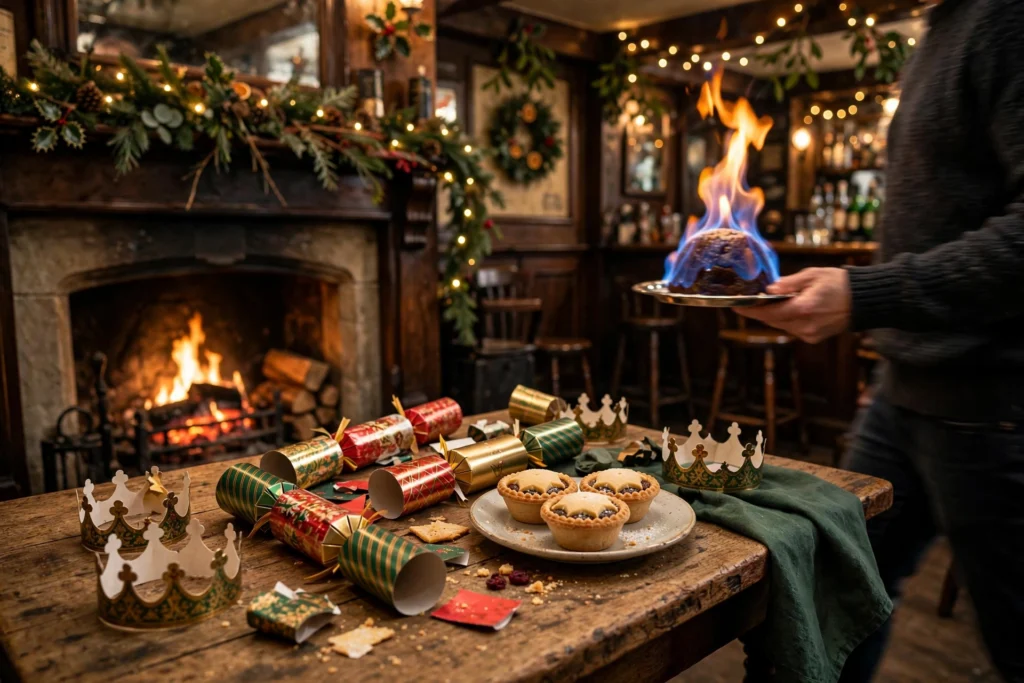
A cosy British pub at Christmas: pulled crackers and paper crowns scattered across a wooden table, mince pies ready, and the Christmas pudding carried past, still flaming.
Watch: British Christmas Traditions
Siobhan Thompson of BBC America's Anglophenia walks through ten ways Christmas differs in Britain — crackers, burning letters to Santa and more.
At a Glance: British Christmas Traditions
The traditions that make a British Christmas, and the dates behind them.
| Tradition | Date | Key detail |
|---|---|---|
| Christmas crackers | Pulled at Christmas dinner | Invented by London confectioner Tom Smith in 1847, inspired by French bon-bon wrappers; each contains a paper hat, a joke and a small gift |
| Royal Christmas Broadcast | 25 December, 3pm GMT | Begun in 1932 when King George V spoke via the BBC Empire Service from Sandringham; the first script was written by Rudyard Kipling |
| Boxing Day | 26 December | A public bank holiday named for the 'Christmas box' once given to servants and tradespeople |
| Mince pies | December | Originally meat-filled 'shrid pies'; the sweet spiced-fruit version became the standard |
| Stir-Up Sunday | Last Sunday before Advent | The traditional day for families to stir and steam their Christmas puddings, weeks ahead of Christmas |
| Christmas pudding | Flamed at dessert | A dense fruit pudding set alight with brandy; coins were traditionally hidden inside |
| Pantomime | Christmas season | Britain's theatrical tradition of fairy-tale musical plays with audience participation and cross-dressing dame roles |
Frequently Asked Questions
What is the most traditional British Christmas dinner?
Roast turkey with pigs in blankets, goose-fat roast potatoes, Brussels sprouts, stuffing, parsnips, bread sauce, cranberry sauce, and gravy — followed by flaming Christmas pudding with brandy butter. Christmas crackers are pulled before the meal, and paper crowns are worn throughout.
What is Boxing Day and why is it called that?
Boxing Day (December 26) is a UK bank holiday traditionally associated with giving boxed gifts to servants, tradesmen, and the poor. Today it means leftovers, football, horse racing, the start of the sales, and visiting family.
What time is the King’s speech on Christmas Day?
The monarch’s Christmas broadcast airs at 3:00 PM UK time on Christmas Day — a tradition since George V’s first radio broadcast in 1932. Millions watch it live; it is one of Britain’s last truly shared national rituals.
What is in a Christmas cracker?
A cardboard tube wrapped in festive paper containing a tissue paper crown, a terrible joke or motto, and a small toy or trinket. Two people pull the cracker; the one holding the larger piece “wins” the contents. They were invented by London confectioner Tom Smith in the 1840s.
Do British people say Merry Christmas or Happy Christmas?
“Happy Christmas” is the traditional British greeting, popularized in Victorian times (it is also the phrase in “We Wish You a Merry Christmas” — which paradoxically says “Merry”). Both are used today, but “Happy Christmas” remains distinctly British.
What is a pantomime?
A pantomime (“panto”) is a uniquely British musical-comedy theater tradition based on fairy tales, featuring a cross-dressing Dame, a principal boy played by a woman, audience participation (“He’s behind you!”), and slapstick. Pantos run December–January and are a childhood rite of passage.
British Christmas traditions endure because they are a complete operating system for the day — the timings, the food, the television, the walks, the jokes in the crackers. Run the program as written, from stockings at dawn to charades at midnight, and you will understand why half the world borrowed it. Pull a cracker, wear the crown, brave the sprouts, save room for Boxing Day leftovers, and have a very Happy Christmas indeed. The kettle’s on, the pudding’s lit — welcome to December 25, British-style.