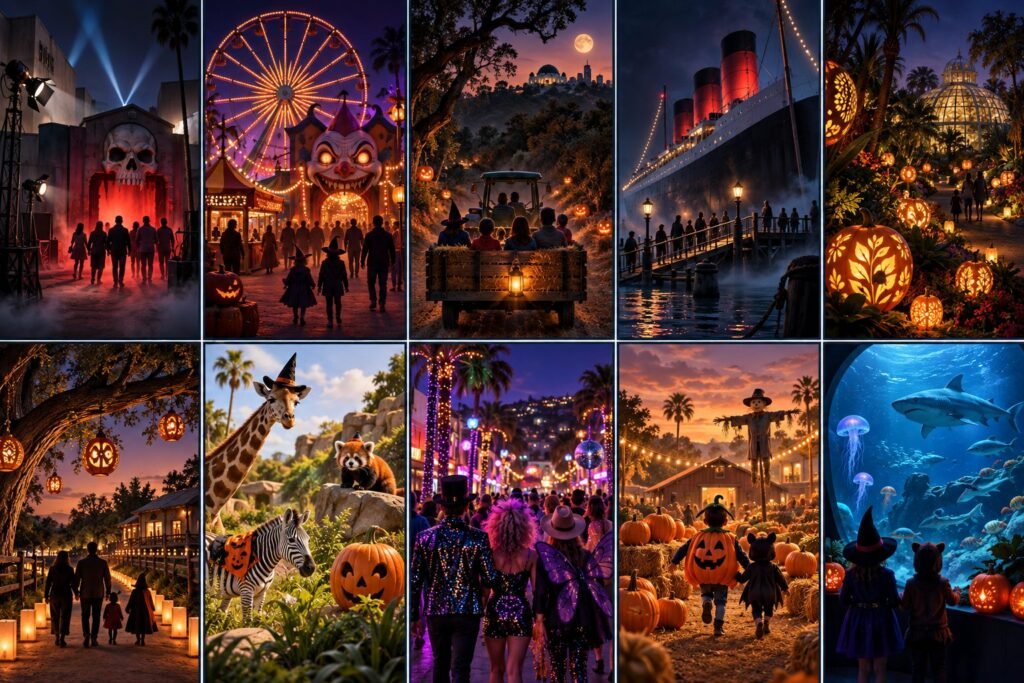
Ask any haunted-house designer what matters most and you’ll get the same answer: light. Halloween lighting ideas — projectors, blacklights and more — are the difference between decorations that sit there and a house that feels alive. The right lighting makes $20 of props look like $200, guides trick-or-treaters safely to your door, and creates the atmosphere no prop alone can deliver. This guide breaks down every lighting technology (window projectors, blacklights, string lights, spotlights, path lights, fog-and-light combos, smart bulbs), gives you a zone-by-zone design plan for the whole property, covers the electrical safety rules that actually matter, compares renting vs. buying, and adapts everything for worldwide voltage and weather. Halloween 2026 lands on Saturday, October 31st — light it like you mean it.
One principle governs everything below: layer, don’t blast. Great Halloween lighting uses three layers — ambient glow (the general mood), accent light (highlighting specific props), and effect light (projectors, strobes, blacklights for drama). A single floodlight washing everything flat kills atmosphere; layered light in two or three colors creates depth. Pick your palette first: orange + purple (classic), green + purple (witchy), icy blue + white (ghostly), or red + black (horror). Two to three colors maximum — rainbow lighting looks accidental. Pair your plan with a great yard layout, and your home will rival the best haunted houses in the USA for atmosphere per dollar.
Window Projectors: The Biggest Impact Per Dollar
A projector kit (projector + projection screen material or just your window/garage door + looped video) can cover an entire house front with animated ghosts, rising zombies or a haunted library scene. It’s the single highest-impact purchase in Halloween lighting.
- How they work: purpose-built Halloween projectors ship with preloaded scenes; or use any bright mini-projector with downloaded Halloween video loops played from a USB stick or laptop.
- Where to aim: garage doors and large front windows work best. For windows, hang a white shower-curtain liner or purpose-made projection screen inside the glass — the image shows through crisply from the street while your interior stays private.
- Brightness: for outdoor use after dark, 2,000+ lumens reads well; in areas with streetlights, go brighter. Test after dark, not in the store.
- Cost: dedicated Halloween projector kits run $40–100; a general mini-projector ($80–150) doubles as a movie projector year-round — the better buy if you’ll use it twice.
- Weather: projectors are NOT weatherproof. House them under an eave, in a weatherproof enclosure, or project from inside through glass. One rain shower kills an unprotected projector.
Blacklights (UV): The Secret Weapon
Blacklights make white, neon and fluorescent materials glow with an otherworldly intensity. A $15 UV bulb transforms a room of ordinary white decorations into a glowing phantom zone.
- Best uses: indoor party rooms, porch ceilings (white spider webs glow brilliantly), ghost decorations, white pumpkins, neon window paint.
- Bulb types: screw-in UV LED bulbs ($10–20) fit standard fixtures; UV flood lights ($25–40) cover yards; small UV flashlights ($8) are great for testing what will fluoresce.
- Safety: standard consumer UV-A blacklights are safe for party use — they’re the same technology as nightclub lighting. Don’t stare directly into high-power UV flood lights at close range, and keep them away from very young children’s eye level. They’re not tanning lamps; normal decorative use is fine.
- Pro combo: paint details with inexpensive UV-reactive (neon) paint — invisible in daylight, blazing under blacklight. Tombstone epitaphs, spider webs and ghost faces all get a hidden second life.
String Lights: The Workhorse
Orange, purple or warm-white string lights are the ambient layer of every great display. Rules: buy outdoor-rated for anything outside (indoor strings corrode and short in damp weather), keep to your palette, and run them along rooflines, porch rails, fences and bushes — continuous lines of light define the property’s shape at night. LED strings use trivial power (a 25-foot LED string draws a few watts), so you can run many on one circuit — but still use outdoor timers so the show starts at dusk automatically. Solar string lights work for fences and bushes far from outlets; they won’t be as bright as plug-in, so use them as fill, not feature.
Spotlights and Uplighting: Drama on Demand
A $15–25 outdoor spotlight aimed up at a tree, tombstone or the house facade creates the theatrical shadows Halloween is built on. Colored LED spotlights with remotes ($20–35 for multipacks) let you switch the whole yard from orange to green to purple without climbing a ladder. Place them low and aim up — uplighting is inherently dramatic because it reverses the sun’s natural direction. Hide the fixtures behind props or mulch; visible fixtures break the illusion. Two or three well-placed spotlights beat a dozen scattered ones.
Path and Marker Lights: Safety That Looks Good
Trick-or-treaters need to see where they’re walking. Line the walkway with stake lights, luminarias (paper bags + sand + LED tea lights) or pumpkin lanterns every 4–6 feet. This is safety lighting disguised as decor — it prevents trips and falls while making your path the most inviting on the street. Solar path lights are the zero-effort option; for Halloween night itself, luminarias are the most atmospheric. Keep the path brighter than the surrounding yard: visitors’ eyes follow the brightest route.
Fog Plus Light: The Cinematic Combo
Fog alone is just mist; fog with colored light is a movie set. Aim a green or blue spotlight low across ground fog and the whole yard glows. Ground foggers ($35–60) with low-lying fog fluid hug the ground instead of rising; add a simple chiller (a box of ice the fog passes through — many DIY plans exist, or buy a chiller attachment) for the true graveyard-creep effect. Safety: keep fog away from faces, don’t fog across public sidewalks or roads where it can startle drivers, use only fluid rated for your machine, and keep the hot nozzle away from kids, pets and flammable decor.
Candles, Lanterns and Flame Effects
Real flame has a flicker quality LEDs still can’t perfectly match — but it demands respect. Rules: LED tea lights and flameless tapers inside jack-o’-lanterns and near any paper/fabric decor (non-negotiable with costumes and kids around); real candles only in stable, enclosed lanterns on non-flammable surfaces, never left unattended, never on the trick-or-treat path. Flicker-effect LED bulbs in porch fixtures give 90% of the ambiance with 0% of the risk. For the Halloween party interior, cluster flameless candles at varied heights — the layered glow photographs beautifully.
Smart Bulbs and Timers: Automation
Smart color bulbs in porch and yard fixtures let you schedule the whole show: orange at dusk, shifting to purple at 8 pm, strobe-effect on party night. Outdoor smart plugs ($12–20) put any dumb light string on a schedule or phone control. The real win is consistency — your display lights itself every night of October while you’re still at work. Set a hard off-time (10–11 pm) to save power and keep neighbors happy.
The Zone-by-Zone Design Plan
Apply the three layers to each zone:
- Curb/street: effect (projector on garage or house wall) + ambient (roofline string lights). This is the beacon — brightest and most visible.
- Yard: accent (spotlights on tombstones, trees, anchor props) + path (walkway markers). Medium brightness; the journey.
- Porch: ambient (warm porch light, lanterns) + accent (pumpkin glow, wreath spotlight). Warmest and most welcoming — the reward at the end of the path.
- Interior party rooms: blacklight in one room, warm candle-glow in the social rooms, projector or TV-loop in the background room.
Walk the property after dark once it’s set. Your eyes will immediately find the weak spots — a dark dead corner, a prop nobody can see, a color that clashes. Adjust once and you’re done.
Electrical Safety: Read This Chapter Twice
Outdoor Halloween lighting is safe when you follow the rules. Every rule below exists because someone learned it the hard way:
- Outdoor-rated everything outside. Lights, cords, timers, plugs — if it says “indoor use only,” it stays inside. Outdoor gear has sealed connections that resist moisture.
- GFCI protection. All outdoor outlets should be GFCI-protected (the ones with test/reset buttons). If yours aren’t, use a portable GFCI adapter ($15) — it cuts power in milliseconds if current leaks, preventing electrocution.
- Extension cord math: know your load. Add up wattages; stay under 80% of the circuit’s capacity (1,440W on a 15-amp circuit). LEDs make this easy — but inflatables, foggers and projectors add real draw. One heavy-duty outdoor cord per major item; never daisy-chain multiple high-draw items on one thin cord.
- Cords off the path. Route cords along edges, bury under mulch, or cover with cord ramps. A cord across a walkway is a lawsuit in the dark.
- Keep connections dry. Elevate plug connections off wet ground (a brick works), use connection boxes or wrap with electrical tape in a pinch. Never let connections sit in puddles.
- Unplug in storms. Lightning + outdoor electronics = expensive regret. Unplug projectors and major items when severe weather is forecast.
- No DIY electrical work. This guide covers plugging things in, not wiring things up. Anything involving your breaker panel, hardwired fixtures or splicing wires is electrician territory — no exceptions, no YouTube heroics.
- Ladder safety: most lighting injuries are falls, not shocks. Stable ladder, three points of contact, never overreach — move the ladder instead.
Rent vs. Buy
Buy: string lights, path lights, spotlights, timers, smart plugs, LED candles — reusable for years, cheap to own. Rent: professional-grade projectors, theatrical fog machines, large truss lighting — for one big party night, event-rental shops charge a fraction of purchase price. Consider buying used: projectors and foggers depreciate fast; last year’s models sell for half price and work identically for Halloween purposes.
Budget Builds
$40 glow-up: two colored LED spotlights + a string of orange lights + solar path lights. Transforms any existing decor. $120 statement: add a window projector kit + UV flood light + outdoor timer. $250+ production: add a second projector, ground fogger with low-lying fluid, smart bulbs for the porch, and uplighting for trees. At every tier, the palette discipline matters more than the spend.
Worldwide Notes: Voltage, Weather, Timing
- Voltage: North America runs 120V, most of the rest of the world 220–240V. Buy lights rated for your country’s voltage — a 120V string plugged into 230V fails dramatically. Check the label, not the listing photos.
- UK/Ireland: rain is the enemy — IP44 rating minimum for anything exposed; project from indoors through glass where possible; battery/solar for far-flung spots.
- Canada: cold kills cheap batteries and makes plastic brittle — use lithium batteries in solar lights, bring projectors in during frost.
- Australia: daylight saving means later sunsets — your light show starts later and runs shorter; focus on porch and path lighting over big projections.
- Germany: strict quiet hours (Nachtruhe, typically 10 pm–6 am) — schedule animated/sound elements to end by 10 pm sharp.
- Everywhere: check local rules on light pollution and projection onto neighboring properties; aim your show at your own house.
Kid-Safe Lighting
For houses with young trick-or-treaters or party guests: keep all lighting low-voltage LED where kids can reach, secure cords completely out of walkways, avoid strobe effects (they can trigger photosensitive epilepsy — use slow fades instead), keep fog machines behind barriers, and never place real candles at child height. A well-lit path is the kindest thing you can do for little ghosts and goblins — and their parents will remember your house fondly. Family-focused inspiration: Halloween events for kids show how the best family displays balance spooky with safe.
Indoor Lighting Design, Room by Room
- Living room: replace one table lamp bulb with an orange smart bulb for October; add fairy lights to the mantel garland; one blacklight in the corner makes white decor fluoresce. Keep one warm-white lamp on so the room stays livable.
- Hallway: glowing witch hats or paper-bag luminarias along the floor, plus a motion-sensor light that flickers on — startling in the best way.
- Kitchen: under-cabinet LED strips in orange (peel-and-stick, battery) transform the room for $10; potion bottles backlit with tea lights on the counter.
- Bathroom: one color-changing LED tea light on the tank + the mirror message. Guests encounter it alone — maximum effect, minimum spend.
- Bedroom (kids): pumpkin fairy-light string + glow stars. Spooky but sleep-safe — avoid strobes and blacklights in sleeping spaces.
- Party room: this is where the blacklight lives, plus the projector if you have one, plus fog for the entrance moment. One dramatic room beats a whole house of mild effects.
Projector Content: Where to Get the Shows
The hardware is only half the equation — content makes the show. Options:
- Included loops: dedicated Halloween projectors ship with scenes (ghosts, zombies, haunted portraits). Fine for year one.
- Digital decoration libraries: several companies sell downloadable Halloween video loops ($10–30 per collection) — far higher quality than built-in clips, reusable forever.
- DIY: film your own: a white sheet, a friend in a sheet-ghost costume, a phone camera, and free editing software. Shaky homemade footage is authentically creepy.
- YouTube ambient loops: countless free Halloween ambience videos (crackling fireplaces, haunted windows) — stream via a laptop to any projector.
- Sync to music: for party night, run the projector with a Halloween playlist — visuals plus audio doubles the immersion.
Troubleshooting Your Light Show
- Colors look muddy: you’re mixing too many — cut back to two or three and separate them by zone rather than overlapping.
- One area glares: a bare bulb in the line of sight. Shield it behind a prop or switch to an indirect aim (bounce light off a wall).
- Timers out of sync: mechanical timers drift; replace with digital or smart plugs for precision, especially for the dusk start.
- Blacklight washes out the room: UV needs darkness to work — kill competing white light in that room or the effect dies.
- Extension cord spaghetti: label every cord with tape flags, run them along edges, and photograph the routing before takedown — next year’s setup takes minutes.
- Neighbors complain about brightness: aim lights down and inward, add shields (even cardboard) to cut spill, and set a hard off-time. Most complaints vanish with an 10 pm cutoff.
Being a Good Neighbor: Light, Noise and Curfews
The most impressive display in the world isn’t worth a neighborhood feud. House rules that keep the peace:
- Hard off-time: 10 pm for effects (projectors, fog, animated props), 11 pm for static lighting. Timers make this automatic and blameless.
- Aim inward: spotlights and projectors should hit YOUR house, not the neighbor’s bedroom window. Walk the neighbors’ sightlines once.
- Sound curfew: ambient audio off by 9 pm, always. What sounds “subtle” from your porch carries down the street at night.
- The heads-up: tell immediate neighbors your plan (“big display Halloween night, everything off by 10”). Forewarned is forearmed — and they might contribute extension cords.
- Light trespass laws: some municipalities regulate it; even where they don’t, courtesy regulates it. Shield fixtures to cut spill.
What’s New for 2026: Lighting Tech Worth Knowing
- App-controlled everything: sub-$20 smart plugs and bulbs now handle scheduling, color and effects that needed pro gear five years ago.
- Brighter mini-projectors: 1080p pocket projectors under $100 are now bright enough for window projections that used to need $300 units.
- Solar that actually works: modern solar path and string lights with bigger panels and lithium batteries now last past midnight — early solar died by 9 pm.
- Low-voltage landscape systems: 12V LED landscape lighting kits (once a pro install) now come as plug-and-play sets — safe, dimmable, and permanent for year-round use with orange bulbs swapped in for October.
- What hasn’t changed: the fundamentals — layering, palette discipline, and aiming — matter more than any gadget. Tech upgrades the tools; design still wins.
The 15-Minute Lighting Audit
Do this one walkthrough and fix 90% of lighting problems:
- After full dark, stand at the street. What’s the brightest thing? It should be your beacon (projector/beacon light), not a random porch bulb.
- Walk the path slowly. Every step should be visible. Any dark patch gets a path light or luminaria.
- Look at each prop. Can you tell what it is from 15 feet? If not, it needs its own light or it needs to move closer to one.
- Count your colors. More than three? Remove the outlier — usually a stray white or blue string that “came with” something.
- Check the neighbors’ view. Walk to the property line on each side. Any light blasting their windows gets re-aimed or shielded.
- Kill one thing. The best edit in lighting is subtraction — turn off the least-effective element and watch the rest get stronger.
In Pictures: Halloween Lighting Ideas
Lighting is what turns decorations into atmosphere — projectors for the big wow, blacklights for the party room, and warm lanterns for the porch.
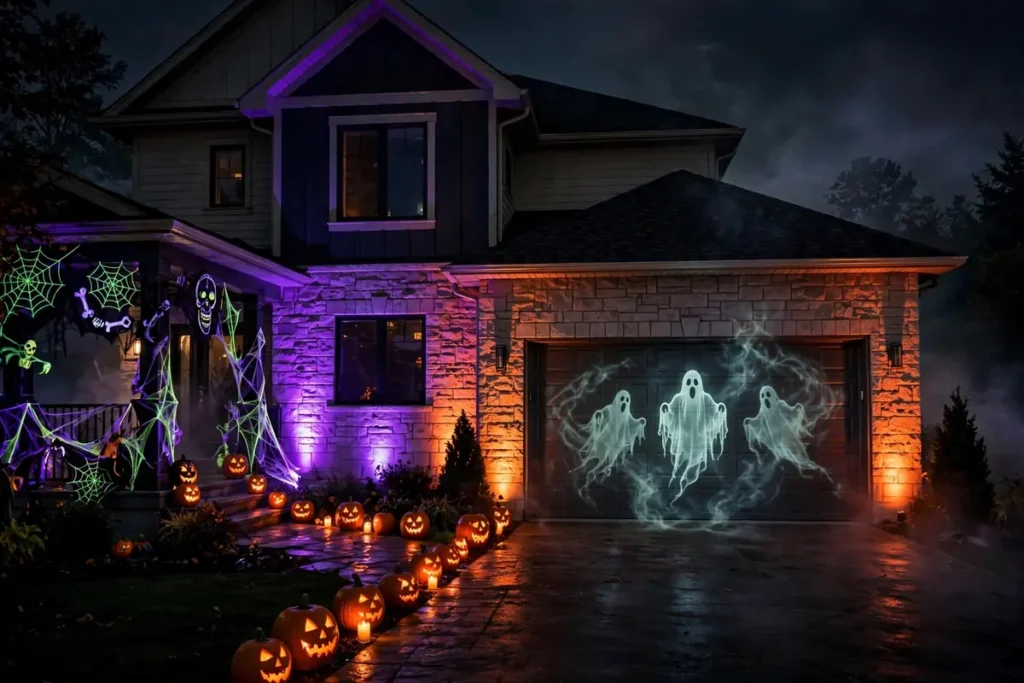
Night falls and the house transforms: ghost projections on the garage, purple-orange uplighting, and jack-o’-lanterns guiding the walkway.
Watch: Halloween Lighting Ideas
A complete guide to Halloween lighting setups — projectors, blacklights, spotlights, and string lights — with links to the exact gear used.
At a Glance: Halloween Lighting Ideas
Lighting types compared, from this guide.
| Lighting type | Best use | Typical cost | Safety note |
|---|---|---|---|
| Halloween projectors | Garage doors, large windows, house walls | $40–100 for kits | Not weatherproof — shelter under an eave |
| Blacklights (UV-A) | Indoor party rooms, porch ceilings | $10–20 per bulb | Standard consumer UV-A is safe for party use |
| Spotlights and uplights | Yard anchors, tombstones, trees | $15–40 each | Use outdoor-rated fixtures and cords |
| String and fairy lights | Roofline, porch railings, pathways | $10–30 per strand | Outdoor-rated only outside |
| Flame-effect bulbs | Jack-o’-lanterns, lanterns | $8–15 each | Safer than real candles in pumpkins |
Frequently Asked Questions
What is the best Halloween lighting: projectors, blacklights, or string lights?
They do different jobs: projectors give the biggest visual impact per dollar (whole-house animation), blacklights create the eerie glow effect for parties and porches, and string lights provide the ambient foundation everything else builds on. The ideal display layers all three — ambient strings, accent spotlights, and one effect element like a projector.
Are blacklights safe for a Halloween party?
Yes — standard consumer UV-A blacklight bulbs are the same technology used in nightclubs and are safe for party use. Avoid staring directly into high-power UV flood lights at close range and keep them above young children’s eye level. Normal decorative use is completely fine.
How do I power outdoor Halloween lights safely?
Use only outdoor-rated lights, cords and timers; plug into GFCI-protected outlets (or use a portable GFCI adapter); keep total wattage under 80% of the circuit’s capacity; route cords away from walkways; and keep all plug connections elevated and dry. When in doubt about load or wiring, call an electrician — it’s cheaper than a fire.
Can I use a regular projector for Halloween window projections?
Yes — any bright projector (2,000+ lumens for outdoor-adjacent use) works with Halloween video loops played from USB or a laptop. Project from inside through the window onto a white shower-curtain liner hung as a screen for the crispest image. Protect the projector from weather — none are rainproof without an enclosure.
How much electricity do Halloween lights use?
Very little with LEDs: a 25-foot LED string draws just a few watts, so dozens of strings cost pennies per night. The big draws are inflatables (50–100W each while inflated), fog machines (400–1,000W when heating) and projectors (50–200W). Add up wattages and stay under 80% of your circuit capacity.
When should I set up Halloween lighting in 2026?
Install and test everything by mid-October — including a full after-dark test run to aim projectors and spotlights. Put lights on timers for dusk-to-10pm operation through the month. With Halloween 2026 on Saturday, October 31st, do your final check on Friday the 30th so Saturday night is pure showtime.