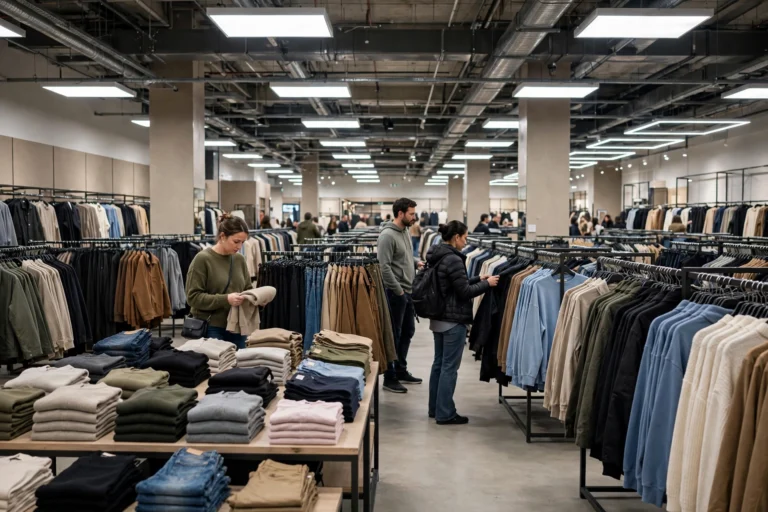
American shoppers lose hundreds of dollars a year to outlet shopping mistakes — not through obvious rip-offs, but through quiet, plausible errors that feel like smart shopping in the moment. The “70% off” sign, the made-for-outlet handbag, the final-sale clearance rack: outlet malls are engineered environments, and every design choice nudges you to spend more while feeling like you’re saving. Here are the 12 most expensive mistakes shoppers make at outlet malls, and exactly how to avoid each one.
None of these mistakes mean outlet shopping is a bad idea — it’s genuinely one of the best ways to save on brand-name goods. They just mean the savings go to shoppers who stay sharp, not shoppers who coast on the assumption that “outlet” automatically equals “deal.”
Mistake #1: Trusting the “Compare At” Price
The most expensive mistake in outlet shopping is also the most common: believing the reference price. That “$200 value, now $79” tag feels like a $121 victory — but if the item is a made-for-outlet line that never sold for $200 anywhere, the “savings” are fictional. The reference price is marketing until proven otherwise.
The fix: For any purchase over about $50, spend 30 seconds checking the brand’s website or a major retailer for the current price of the same or a genuinely comparable item. Your phone is the most powerful outlet tool you own.
Mistake #2: Shopping Without a List
Wandering is the business model. Outlet centers are designed for discovery — winding layouts, enticing window displays, strategically placed “deal” signage — because unplanned purchases carry the highest margins. Shoppers without lists consistently overspend on things they didn’t need at prices that aren’t special.
The fix: Write a prioritized list before you go, with walk-away price thresholds for each item. “Running shoes — buy under $90” turns every shoe display into a binary decision instead of a temptation. Our holiday shopping budget planner template works perfectly for outlet trips.
Mistake #3: Skipping the VIP Club and Coupon Book
Most shoppers walk straight past the visitor center and never sign up for the free shopper program — leaving 10 to 25 percent in additional savings on the table at every participating store. On a $400 haul, that’s $40 to $100 for five minutes of signup the night before plus a two-minute visitor-center stop.
The fix: Join the center’s program (VIP Shopper Club, TangerClub) before your visit, and hit the visitor/customer service desk first for the coupon book. Free money is still money.
Mistake #4: Buying Made-for-Outlet at Near-Retail Prices
Made-for-outlet merchandise isn’t bad — it’s brand-authentic product at fair prices. The mistake is paying almost-retail prices for it because the signage implies a deep discount. A made-for-outlet jacket at 15% below the price of a superior retail version on sale is a bad deal wearing a good disguise.
The fix: Learn to identify outlet-specific lines (label markings, style-number searches, asking associates), and judge each item against genuine retail alternatives — not the tag’s reference price.
Mistake #5: Ignoring Return Policies
Outlet return policies are frequently stricter than regular retail: shorter windows (sometimes 14–30 days versus 60–90), restocking nuances, and final-sale clearance. Shoppers who assume “I can always return it” discover otherwise when the receipt says otherwise.
The fix: Ask about the return policy before paying, especially for gifts, uncertain fits, or big-ticket items. For anything you’re unsure about, the fitting room is mandatory — see mistake #8.
Mistake #6: Shopping at Peak Crowd Times
Saturday afternoons at major outlet centers mean picked-over shelves, 20-minute fitting room lines, stressed staff who can’t check stockrooms, and parking lots that add 30 minutes to your trip. You’re shopping the leftovers at the worst experience level.
The fix: Weekday mornings are the golden window — restocked shelves, empty fitting rooms, attentive staff. If weekends are your only option, arrive within 30 minutes of opening and leave by early afternoon.
Mistake #7: Falling for “Buy More, Save More” Traps
“Buy one, get one 50% off” and “spend $150, save $30” are designed to inflate your basket, not your savings. The math only works if you genuinely needed the additional items at those prices. Most shoppers invent needs to “unlock” the discount — spending $80 extra to “save” $30.
The fix: Apply the list test: would you buy this item at this price if the promotion didn’t exist? If no, the promotion is costing you money, not saving it.
Mistake #8: Not Trying Things On
Outlet sizing is inconsistent across made-for-outlet and retail-transfer lines, and stricter return policies raise the stakes of a bad fit. Yet fitting-room avoidance is rampant — “I’ll return it if it doesn’t fit” meets “final sale” with depressing regularity.
The fix: Try on everything, every time. Morning visits mean no lines. Wear easy on/off layers to make it painless. This five-minute habit prevents the most common source of outlet regret.
Mistake #9: Forgetting to Stack Discounts
The deepest outlet deals come from stacking: clearance price + store coupon + center coupon + loyalty rewards. Shoppers who pay the ticketed clearance price without asking “can I use this coupon too?” routinely leave 15–30% on the table. On a $200 purchase, that’s $30–$60 per transaction.
The fix: At every register, ask: “Can I stack this coupon with the sale price?” and “Are there any unadvertised promotions today?” Also ask about loyalty price adjustments and military/student discounts. The worst answer is no — and it’s frequently yes.
Mistake #10: Driving Too Far for Too Little
An hour’s drive each way for a single $25 item “on sale” is a net loss once fuel, tolls, and two hours of your time are counted. Outlet trips have fixed costs; they only make sense when the planned savings clear those costs by a wide margin.
The fix: Batch outlet shopping into planned trips with real lists. A good rule: don’t drive to an outlet center unless your list’s expected savings exceed $75–$100. Otherwise, check the brand’s online outlet section first — many offer the same prices without the pilgrimage. Our budget road trip planner helps you calculate true trip costs.
Mistake #11: Neglecting the Receipt Check
Stacked promotions create register complexity, and errors are common: coupons that didn’t apply, “extra 20% off” calculated on the wrong base, buy-one-get-one misapplied. Shoppers who stuff the receipt in the bag without looking discover the error at home — when fixing it requires another trip.
The fix: Review every receipt before leaving each store. It takes 30 seconds. Catching a $15 error at the register is trivial; catching it three days later is a project.
Mistake #12: Confusing “Outlet Price” With “Good Price”
The meta-mistake underlying all the others: assuming that because you’re at an outlet mall, every price is a deal. Some outlet prices are genuinely excellent. Others merely look excellent next to inflated reference prices. A few are worse than what you’d pay online during a regular site-wide sale.
The fix: Make outlet shopping evidence-based. The phone check, the list, the price thresholds — these turn “feels like a deal” into “is a deal.” The shoppers saving 50%+ aren’t luckier; they’re just verifying.
Mistakes at a Glance: The Quick-Reference Table
| # | Mistake | What It Costs You | The One-Line Fix |
|---|---|---|---|
| 1 | Trusting “compare at” prices | Paying near-retail for outlet lines | Phone-check against real retail prices |
| 2 | No shopping list | Impulse overspending | Prioritized list with price thresholds |
| 3 | Skipping VIP/coupons | 10–25% left on the table | Sign up night before; visitor center first |
| 4 | Overpaying for made-for-outlet | Thin discounts disguised as deep ones | Judge vs. real retail alternatives |
| 5 | Ignoring return policies | Stuck with wrong items | Ask before paying; use fitting rooms |
| 6 | Peak-time shopping | Picked-over stock, wasted time | Weekday mornings; arrive at opening |
| 7 | “Buy more, save more” traps | Invented needs, bigger baskets | Would you buy it without the promo? |
| 8 | Skipping the fitting room | Bad fits, hard returns | Try on everything, every time |
| 9 | Not stacking discounts | 15–30% unclaimed per transaction | Ask to stack at every register |
| 10 | Driving too far for too little | Fuel + time erase savings | Batch trips; $75+ expected savings rule |
| 11 | Skipping receipt checks | Uncaught register errors | Review before leaving each store |
| 12 | Assuming outlet = deal | Everything above, combined | Verify every “deal” with evidence |
The Psychology: Why Smart People Make These Mistakes
Outlet malls are masterclasses in behavioral pricing. A few mechanisms worth knowing:
- Anchoring: The “compare at” price sets a mental anchor; everything after feels like a gain — even when the anchor is fictional.
- Scarcity cues: “Only 2 left!” and picked-over racks create urgency that short-circuits comparison shopping.
- The treasure-hunt high: Finding a “deal” triggers the same reward circuitry as winning — which is why the hunt feels good even when the math doesn’t work.
- Sunk cost: After driving an hour, shoppers feel compelled to buy something — the trip must be “worth it.” (It isn’t, unless the deals are real.)
Knowing these mechanisms doesn’t make you immune — but it does give you a fighting chance. The list, the phone check, and the walk-away thresholds are your rational counterweights.
Building Your Anti-Mistake Routine
Turn the fixes into a repeatable pre-trip routine:
- Night before: Join VIP clubs, write your list with price thresholds, screenshot retail prices for priority items.
- Morning of: Dress for fitting rooms (easy layers), pack water/snacks/phone charger, arrive at opening.
- At the center: Visitor center first, priority stores in order, clearance walls first, ask about every promotion.
- At each register: Stack everything, verify the receipt before leaving.
- After: Quick mental audit — did everything beat your thresholds? Return anything that didn’t within the policy window.
Pair this discipline with our best deals under $50 guide for small-win ideas and sustainable and ethical shopping guide for thinking about consumption beyond price.
Three Shoppers, Three Outcomes: A Cautionary Tale
The Wanderer (mistakes #2, #6, #7, #12)
Arrives Saturday at 1 PM with no list. Buys a “70% off” jacket (made-for-outlet, thin discount vs. retail), two BOGO tops she didn’t need, and a handbag in the wrong color because the line was too long to exchange sizes. Total: $340. Genuine savings vs. smart alternatives: maybe $40. She feels like she saved $500.
The Verifier (no mistakes)
Arrives Thursday at 10 AM with a three-item list and screenshot prices. Visitor center coupon book in hand. Finds the running shoes at $82 (vs. $140 retail — verified), jeans at $58 (vs. $98), skips the handbag when the price doesn’t beat her threshold. Total: $140 + tax. Genuine savings: roughly $150. She’s in and out by noon.
The Stacker (mistakes #3 and #9 inverted into superpowers)
Same as the Verifier, plus: clearance-rack find (a $120 sweater marked to $55), 20% store coupon ($44), $10 VIP reward applied, 2% card cashback. Final: ~$33 for a $120 sweater — a genuine 72% off. This is the ceiling of what’s possible when every layer stacks.
The difference between these three shoppers isn’t income or luck — it’s preparation and verification. Every mistake on this list is a choice the Verifier and the Stacker simply don’t make.
The 5-Minute Pre-Trip Audit
Before every outlet trip, run this checklist. Five minutes, twelve mistakes prevented:
- List written with price thresholds? (beats #2, #7, #12)
- Retail prices screenshot for priority items? (beats #1, #4)
- VIP clubs joined, coupon book plan confirmed? (beats #3, #9)
- Return policies checked for gift/uncertain items? (beats #5)
- Timing set for weekday morning or opening? (beats #6)
- Fitting-room-friendly outfit planned? (beats #8)
- Trip budget set; expected savings clear the drive cost? (beats #10)
- Phone charged for price checks and receipt photos? (beats #1, #11)
Eight yeses = a Verifier trip. Fewer than five = reschedule and prepare properly. The deals will still be there next week; the money you save by being ready won’t spend itself.
Outlet Myths, Debunked
A few persistent myths that fuel bad outlet decisions:
- “Everything at outlets is damaged or defective.” False. The vast majority is first-quality merchandise — transfers, overstock, and made-for-outlet lines. True irregulars are marked as such and are a small fraction of inventory.
- “Outlets are always cheaper than anywhere else.” False. Online sales, warehouse clubs, and off-price stores beat outlet prices regularly. The outlet advantage is brand-specific depth, not universal lowest price.
- “Luxury outlets sell fakes.” False for brand-operated outlets — the goods are authentic. The real question isn’t authenticity, it’s whether you’re buying past-season transfers or made-for-outlet lines.
- “You can haggle at outlets.” Mostly false. Prices are fixed; the rare exceptions are floor models and imperfect items. Coupons and stacking are the negotiation.
- “The bigger the ‘was’ price, the better the deal.” The most expensive myth on this list. The “was” price is often the least trustworthy number in the store.
- “Outlet shopping is only for clothes.” False — luggage, sunglasses, cosmetics, housewares, and even furniture outlets offer strong value in their categories.
The One Mistake That Combines All Twelve
If the twelve mistakes had a parent, it would be this: shopping on autopilot. Every mistake on this list — trusting the tag, skipping the list, ignoring coupons, forgetting the receipt — is what happens when you let the environment do your thinking. Outlet centers are designed by experts to convert autopilot shoppers into high-margin buyers. The entire facility, from the winding layout to the “compare at” typography, assumes you won’t verify, won’t compare, and won’t walk away.
The fix isn’t complicated, but it is deliberate: decide your rules before you arrive, verify every claim with your phone, and treat every “deal” as guilty until proven innocent. Autopilot is the product being sold. Attention is the discount.
Frequently Asked Questions
What is the biggest outlet shopping mistake?
Trusting the “compare at” reference price without verifying. It underpins most other outlet shopping mistakes — inflated anchors make mediocre prices feel like steals. A 30-second phone check against current retail prices defeats it completely.
Are outlet mall deals fake?
Not fake, but variable. Genuine past-season transfers at 40–65% off are real deals. Made-for-outlet items at modest discounts off inflated reference prices are less impressive than they look. The format is legitimate; individual “deals” need verification.
How do I avoid overspending at outlets?
Shop from a prioritized list with walk-away price thresholds, set a hard trip budget, and apply the “would I buy this without the promotion?” test to every unplanned item. These three habits prevent the vast majority of outlet overspending.
Is it better to shop outlets online or in person?
In person wins for inspection, fitting, and immediate stacking of in-store promotions. Online wins for price comparison and avoiding travel costs. Use online outlet sections to research prices before in-person trips — and buy online when the price matches.
Why are outlet return policies stricter?
Outlet inventory (especially clearance and transfers) is harder to restock and resell, so brands limit return windows and mark deep-clearance items final sale. Always confirm the policy before purchasing.
Do coupons work on clearance at outlets?
Sometimes — it varies by brand and promotion. Always ask at the register; coupon-on-clearance stacking is the single deepest discount mechanic in outlet shopping when it’s allowed.